Dansk
Dansk
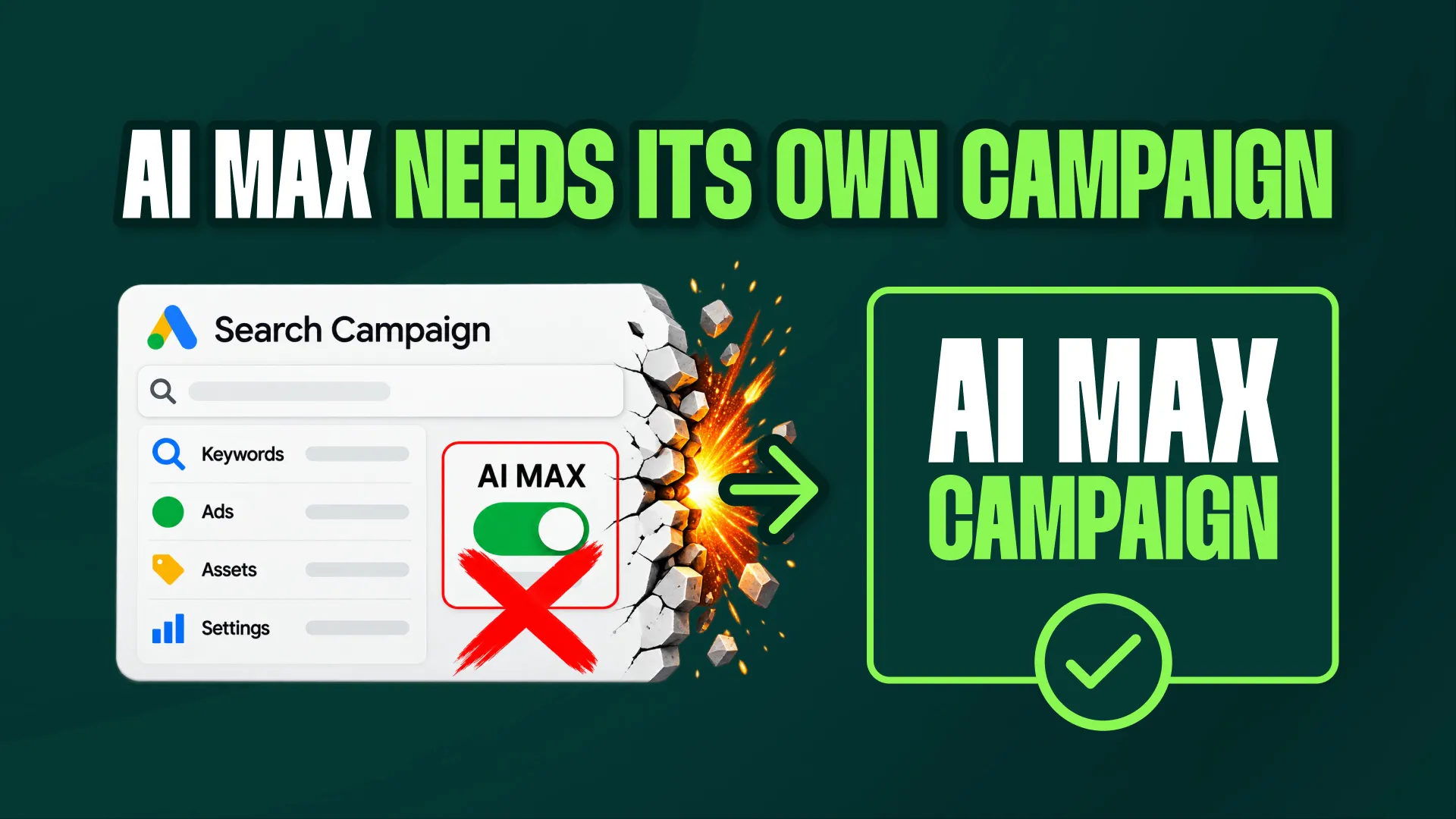
I spent a week in Mountain View brainstorming with a lot of smart people who are hands-on in Google Ads every single day. One question kept coming back up, no matter who I was talking to: should AI Max be its own campaign type? And what exactly is the advantage of enabling it inside existing campaigns?
This article is my attempt to reflect on those conversations and to convince you to think about AI Max differently, even if Google never changes its stance on AI Max being a feature you toggle on inside Search and Shopping campaigns.
First: something I’ve changed my mind on lately: AI Max will become the BEST way to get your ads into AI Mode.
My change stems from the fact that you need AI Max to give Google permission to reformat your ads into whatever format works best inside AI Mode. So how Google packages AI Max (feature or campaign type) decides how all of us buy ads in AI Mode for the next decade.
Disclaimer: Everything in this article are my own views, and does not reflect views from people inside Google or special insider knowledge on my behalf.
The Background: Google Learned From the PMax Rollout
I feel there has been a lot of soul searching at Google since Performance Max launched. The rollout was flawed, in my opinion, for three specific reasons:
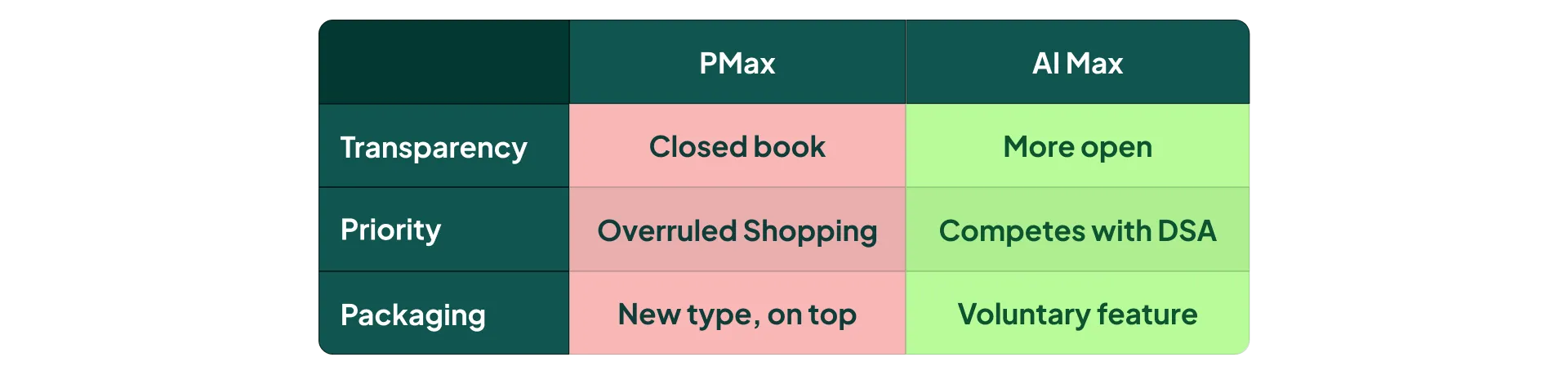
- PMax was a closed book. No visibility, no meaningful reporting.
- PMax was an ultra priority. Remember when having a single PMax campaign meant your Standard Shopping campaigns didn’t run at all?
- PMax was a brand new campaign type on top of everything else that already existed.
My overall assessment is that Google is doing things differently this time. AI Max is more open. It competes on equal footing with DSA (for now). And it’s a voluntary feature enablement on campaigns you already run, a bit like Smart Bidding is.
Looking from the outside in, the one big strategic decision at Google over the last few years has been to simplify. PMax was launched as a way to simplify campaign types: one campaign, multi-channel, “simple”. Adding AI Max as a separate campaign type runs directly against that direction and creates more complexity, not less.
The confusion between AI Max and Performance Max would be enormous. I can already see the memes.
For a company the size of Google, that’s also a hard direction to suddenly reverse. What else does it open up? More campaign types? More complexity? So I can see the logic in saying AI Max is just a feature on existing campaigns.
Let’s start there, with the honest case for the feature approach, before I explain why I still think it’s the wrong long-term call.
The Case for AI Max as a Feature
1) Adoption Speed
Enabling a checkbox is simple, and simple means fast adoption. In a world where AI is moving at an absurd pace, Google needs as many advertisers as possible on AI Max as quickly as possible.
Making it a checkbox, combined with the forced adoption that comes from DSA being shut down, is clever from an adoption standpoint.
Remember the point from the intro: AI Max is your ticket into AI Mode.
2) Immediate Access to Your Assets
For the AI to avoid inventing assets out of thin air, it needs access to your actual assets. This is the second, and much bigger, advantage.
By enabling AI Max on existing campaigns, Google gets immediate access to every asset you already have across Search and Shopping. That shouldn’t be understated.
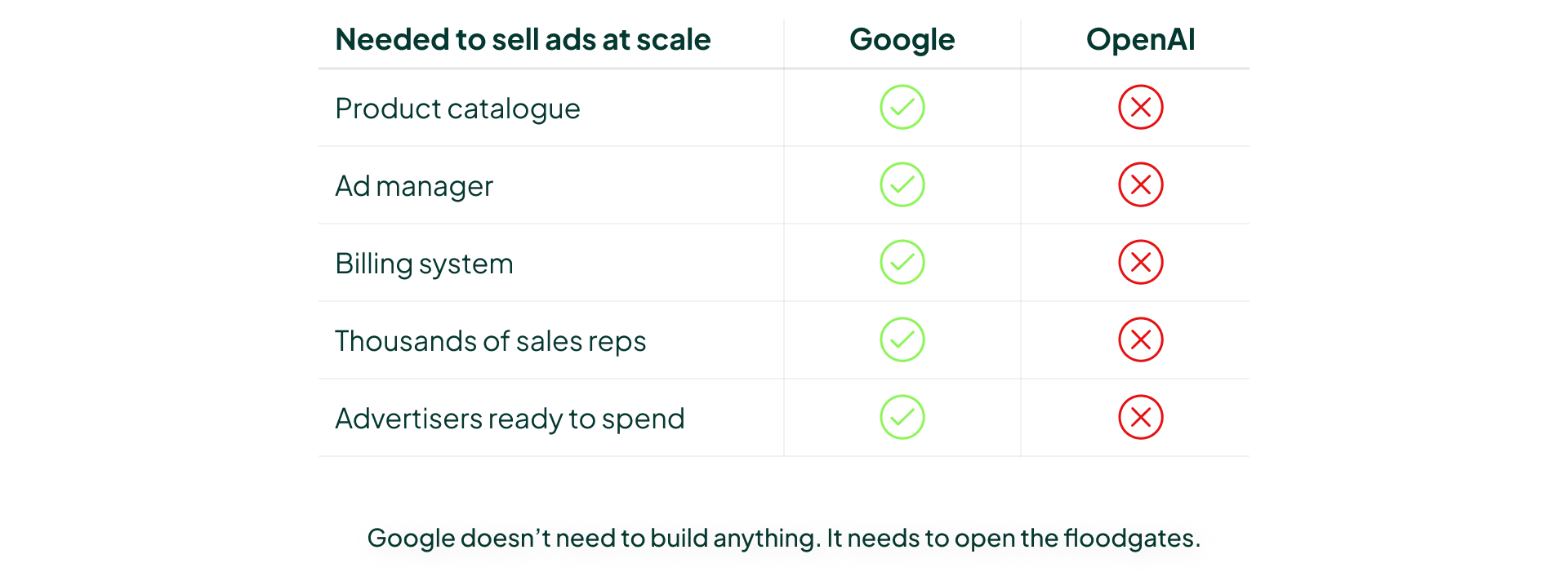
If Google had to wait for all of us to build new campaigns, upload assets, set budgets and get approvals through procurement, the AI race could be over before the ads even launched. Google’s structural advantage over OpenAI is that it already owns the ad ecosystem.
It doesn’t need to build a product catalogue, an ad manager, a billing system, or thousands of sales reps from scratch. It just needs to open the floodgates and it has all the ads it could ever need, plus advertisers ready to pay for them.
Simple for Google to roll out, simple for advertisers to adopt, and fast enough to matter in the AI race.
Now let’s talk about why I still think it’s a mistake.
Why AI Max Should Be Its Own Campaign Type
I have three core arguments, and they map to the three questions nobody has answered yet:
- What is a keyword?
- Where does this sit in the funnel?
- How do we measure performance?
1) What Is a Keyword in a Conversation?
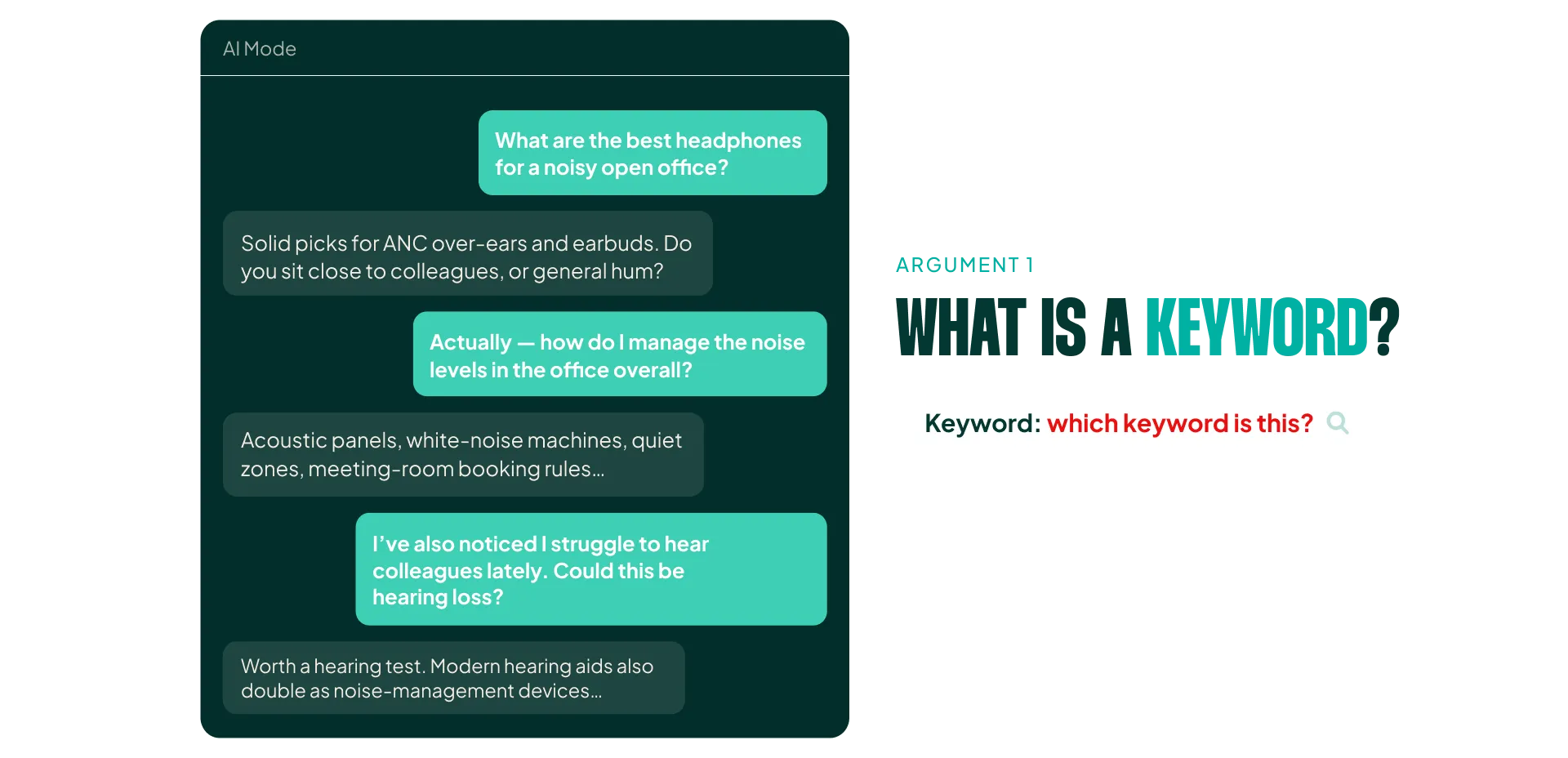
The question that came up again and again in Mountain View was deceptively simple: what is a keyword inside a chat?
It isn’t the first query. It can’t be every query either, because that’s an enormous volume of new ad matches, constantly. And some combination of queries is confusing to the point of being unusable.
Take a real scenario. A conversation starts about headphones and drifts into managing noise levels in an office. Is that still a headphone keyword, or has it become a hearing aid keyword? Are your headphone ads still relevant?
One of Google’s biggest problems is that Google Ads is old.
They have people like me who remember when exact match actually meant exact match, and we complain about it endlessly. (Yes, I’m that old.)
Now think about the uproar that followed exact and phrase match loosening up, and multiply it by ten for a world where a keyword isn’t really a keyword at all.
A new campaign type gives Google a clean break from keywords in their current shape, and in my opinion that break is necessary for AI Mode to work.
A feature inside an existing campaign can’t make that break, because it inherits twenty years of expectations about what a keyword is supposed to do. A new campaign type resets those expectations on day one.
2) Where Does This Sit in the Funnel (and Whose Budget Pays for It)?
Then there’s the question of what Search is actually turning into.
Search used to be primarily bottom funnel in the big-picture sense. Someone had to be compelled to search, and they had to already know your product category existed before they could type it in. AI Mode flips that on its head.
You can now start a query completely oblivious to the possible solutions and, through the best multiple choice quiz ever built, end up researching specific products. That’s top-funnel behaviour happening inside a Search product.
So where does the budget come from?
For small businesses, it’s simple. There’s just budget, with no top-funnel or bottom-funnel line to argue over.
For mid-sized ecommerce, it’s also simple: follow the ROAS. Is ROAS good? Is the revenue incremental? Then pour as much money into it as you can.
For enterprise, it’s a real problem. Does this money come out of the TV budget? Radio? Or is it Search?
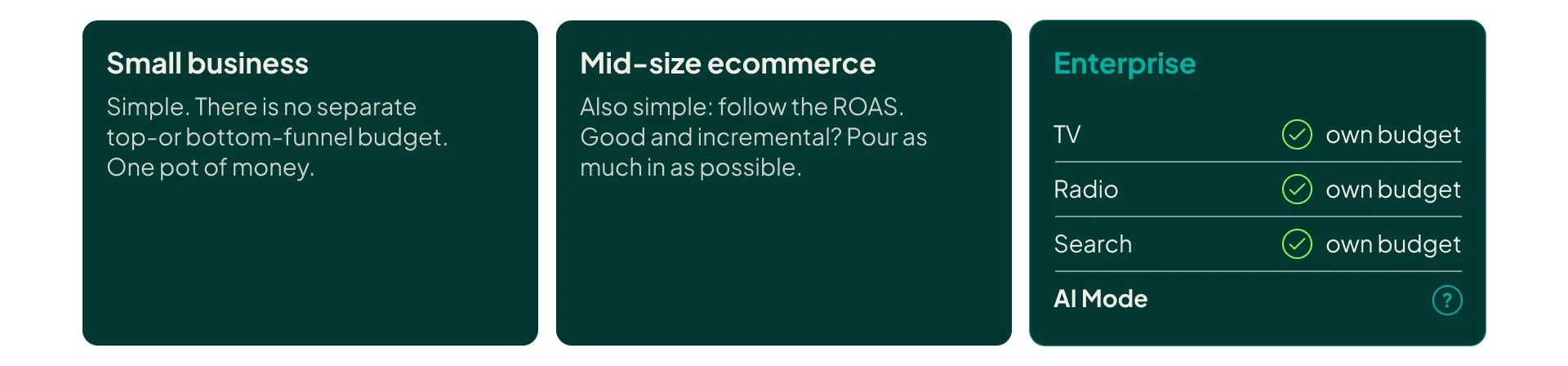
As long as AI Max is a feature you switch on inside a Search or Shopping campaign, the money has to come out of the Search line item.
That can be a serious strategic error, because you’re funding top-funnel demand creation from a budget that was justified, forecast and defended on bottom-funnel logic.
A new campaign type gives AI Mode its own line item, so that budget conversation happens up front instead of quietly eating Search.
3) How Do We Measure Performance?
This is the most complex piece, and the one I find most interesting.
Flip the earlier example around. A query starts with how to manage noise levels in an office so you can focus. The conversation ends up landing on noise cancelling headphones. How should we think about performance here?
Does it still make sense to pay for the final click? What if the AI and the consumer decided together, over several exchanges, that the AirPods Pro 3 are the number one solution? Do we still only pay for that final click? If not, what exactly are we paying for? And if the pricing model changes, how do we measure performance, because it clearly can’t just be click-to-conversion anymore.
Whenever I raise this, someone pushes back with: but why do you care? If your ROAS is good, why do you need to read why it’s good?
It took me a while to articulate the answer. Every time you understand why something works, you can improve it. If your only insight is the final click in an AI Mode conversation, and that final step represents 5% of the actual decision, how do you influence the other 95%?
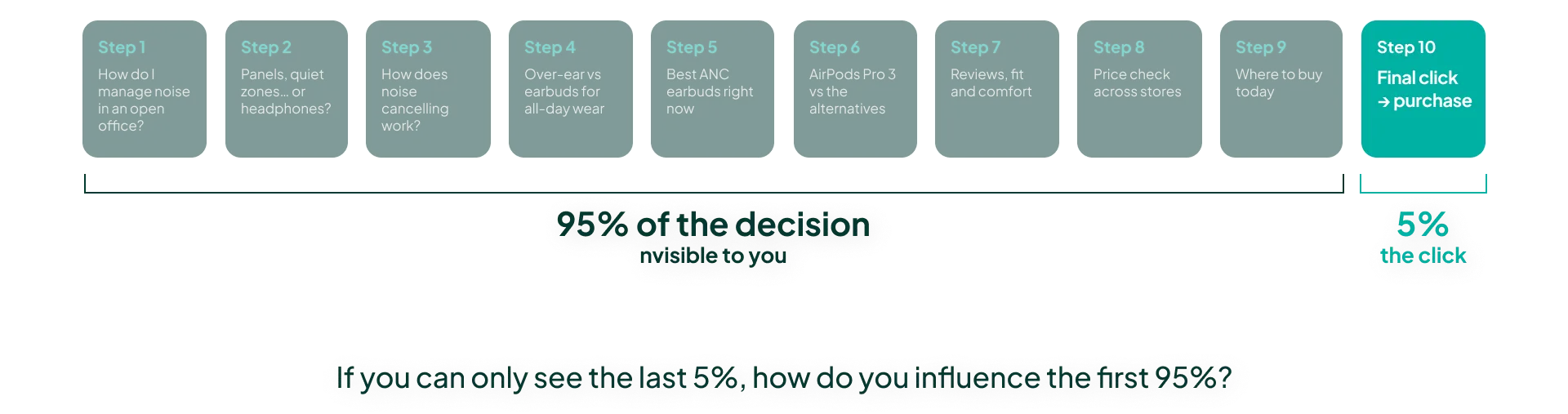
Said differently: what is the value of AI turning an informational query into a transactional one?
All of these questions are still open. In my opinion, Google’s first job should be to prove that AI Mode moves people from the research stage to the buying stage faster. The way to prove it is to report it. This chat started informational and turned transactional. Give us a view-through, an assisted click, an assisted conversion, something.
Once they give that away for free, every advertiser will ask how they can pay to get in front of it. Exactly like we all did with organic Search. Give people a taste, get them hooked, then charge for it (while delivering good returns, of course).
When AI Max is enabled inside Search and Shopping, we will evaluate it on clicks and conversions, because those are the columns available to us. That might be exactly the wrong lens. This kind of measurement needs its own reporting and its own pricing logic, and that is far easier to build into a new campaign type than to retrofit into the click columns of Search and Shopping.
Conclusion
My position stands: AI Max should be its own campaign type.
Yes, Google gets a real short-term win from the feature approach. They get every advertiser’s permission to reformat existing assets into whatever ad formats AI Mode requires, and to use keywordless matching to serve those ads. That’s good business in the next twelve months.
But long term, I think it hurts more than it helps. AI Mode is a fundamentally different way to think about advertising. It needs its own definition of a keyword, its own budget line, and its own performance reporting. You don’t get any of those three by adding a checkbox to a campaign type built for a search box.
[TL;DR]
- AI Max is your best route into AI Mode, because it’s the mechanism that lets Google reformat your assets for AI Mode ad formats. How Google packages it decides how we all buy AI Mode ads.
- Google has good reasons for making it a feature: instant adoption via a checkbox, and immediate access to every asset in your existing Search and Shopping campaigns. In an AI race, speed wins.
- But a feature inherits twenty years of expectations about what a keyword is. AI Mode needs a clean break from keywords, and only a new campaign type delivers that.
- AI Mode behaves like top funnel inside a bottom-funnel product. As a feature, the money comes out of the Search line item, which is a strategic mistake for enterprise advertisers.
- Measurement is the real dealbreaker. Paying for the final click when that click is 5% of the decision makes optimisation impossible. AI Mode needs its own reporting and pricing logic, which is far easier to build into a new campaign type than retrofit into Search’s click columns.