 Ah, Google reps. The very words can make a seasoned PPC manager’s blood boil or a new advertiser feel like they’ve finally made it. The experience is all over the map, but if you’re reading this, you probably want to know how to stop them from wasting your time.
Here’s the trap: if you flat-out reject every Google rep, clients can see you as close-minded. But if you entertain every pitch they throw at you for every single client, you’ll quickly burn 5-20% of your week. In agency life, that 5-20% is our entire margin. So how do we balance this?
I’ve spent 15 years in the Google Ads ecosystem. I’ve been to the intimate events, the trips to Mountain View, and was part of a handpicked 15-agency group back when Premier Partner actually meant something—all while not being particularly accommodating to Google. The key is a simple system that keeps the relationship productive and your week protected. The core idea is this: don’t nitpick every stupid thing they suggest, but make them accountable with you. This flips the call from salesy to strategic in 60 seconds and changes the entire conversation.
If they know you’re going to hold them accountable in one, two, or three months for what they’ve recommended, they become a lot more careful. Here’s the framework I use to do just that.
Go Beyond the Article
Why the Video is Better:
- See real examples from actual client accounts
- Get deeper insights that can’t fit in written format
- Learn advanced strategies for complex situations
First, Understand Who You’re Dealing With
Before you can manage the conversation, you need to know who is on the other end of the line. Not all Google reps are created equal. In fact, the entire support system is a massive, tiered structure, and knowing where your rep fits is crucial.
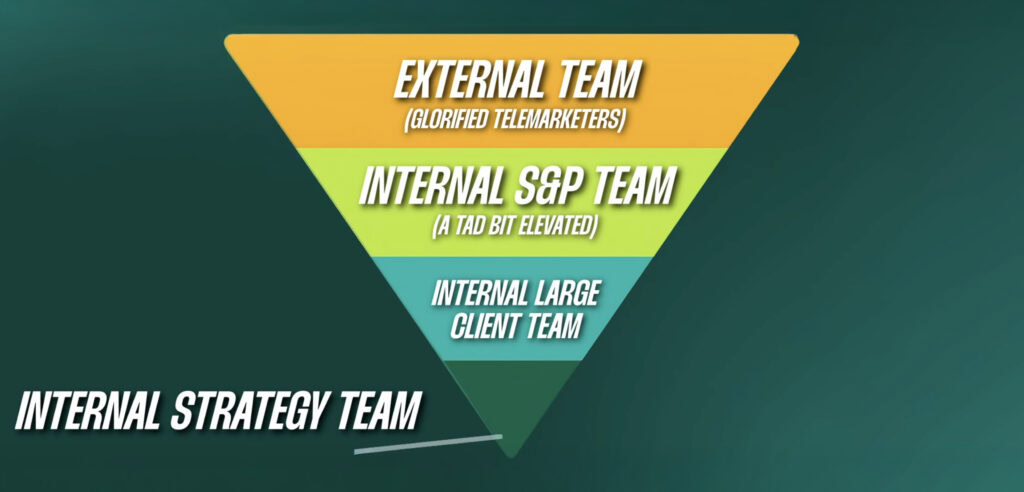
Yes, I’m simplifying here, but this is the general hierarchy from my experience:
- The External Team: These are outsourced, glorified telemarketers. They get a call list generated by a recommendation engine and they just dial. They’re annoying, and you should discard them immediately. If someone calls and you see they aren’t from Google directly, just say no. They have nothing to bring to the table.
- The Internal SMB Team: These are a step up. They’re actual Google employees, usually in big hubs, and they have more direct touchpoints inside the company. There are thousands of them globally, and some of them are actually quite good.
- The Internal Large Client Team: Now we’re getting somewhere. You have to have a significant amount of ad spend to get access to these teams. They’re typically staffed with the best people who have grown through the ranks at Google, not just hired off the street. They have a lot more freedom and experience in their recommendations.
- The Internal Strategy Team: This isn’t a client-facing team. These are the product managers, engineers, and marketers who own different parts of the Google Ads product (PMax, broad match, Smart Bidding, etc.). They form the strategies and recommendations that get passed down to the client-facing teams.
You also have to remember that almost all client-facing teams have KPIs they need to hit related to ad spend and product adoption.
Your Job is to Bring Nuance, Not Opposition
Your job is not to shoot down everything Google says or find holes in their logic just for the sake of it. (Unless they’re from the external team, in which case, send them away).
Your role is to bring your unique, hard-won insights about your client’s business to the conversation. Sometimes you’ll agree with Google, and sometimes you’ll heavily disagree. The goal is to get on their good side and make the conversation productive.
When you disagree, show them why. If you say, “I’m not going to run broad match,” don’t just leave it there. Show them the data. Ask them, “Based on this performance data and our current focus on profit margins, where am I wrong?”
This requires you to be open-minded. We all think we’re much smarter than we are. I’ve had conversations with incredibly tenured PPC people who were completely closed off to ideas that could have helped them. I still talk to people today who refuse to run Smart Bidding. Don’t be that person. Just because Google said it doesn’t automatically make it wrong.
Here’s the playbook:
- Bring ammunition to say no. Use your client’s data and business goals.
- Test what you don’t have ammunition to say no to. This is the fastest way to get data.
- Use that data to shoot down the recommendation next time.
By bringing nuance and holding Google accountable, you transform the relationship. You get more out of your rep and you stop wasting time on pointless arguments.
Always Factor In Your Client’s Perspective
How you handle a Google rep depends heavily on your client. I group clients into three categories based on their experience with Google:

- The Brand New Client: They’re flattered that Google has even reached out. To them, Google is an authority.
- The Experienced Client: They’ve been in the game for a while. They’ve seen some good things from Google and some bad things. They’re more balanced.
- The Jaded Client: They’ve been burned again and again by bad recommendations and have wasted time and money. They trust you, not Google.
For the jaded client, you have a free pass to handle the rep however you see fit. But for the new client, your approach is critical. Their opinion is almost always, “They’re Google. How can they not know more about their own platform than you do?”
If you simply discard the Google rep, it makes you look like you think you’re God. It immediately raises questions: “What is he worried they’ll find in there? Why is he so close-minded?” You will look bad. For these clients, you have to at least take the meeting and guide the conversation using the framework I’m outlining here.
A Practical Breakdown: Analyzing a Real Google Deck
Before we dive into a real deck I received for a client, let me state what I don’t like about Google’s pitches: they’re salesy, and their case studies are often useless.
When you start asking product managers questions like, “What was the data foundation for this case study?” the answers are never good. “Oh, those numbers are from a single case study, one advertiser.” The second I hear that, I stop listening. I don’t know the baseline. If they say enabling broad match produced 50% more conversions, what were they doing before? Only exact match? What about DSA coverage? The numbers are meaningless without context.
The worst is when they compare apples to oranges. I once saw a case study comparing standard shopping to PMax with full assets. That’s not a fair comparison. That’s comparing a shopping campaign to a campaign running across Shopping, Search, Display, and YouTube. Of course it’s going to generate more conversions. If it only brought in 20% more, I’d be shocked at how poorly it performed.
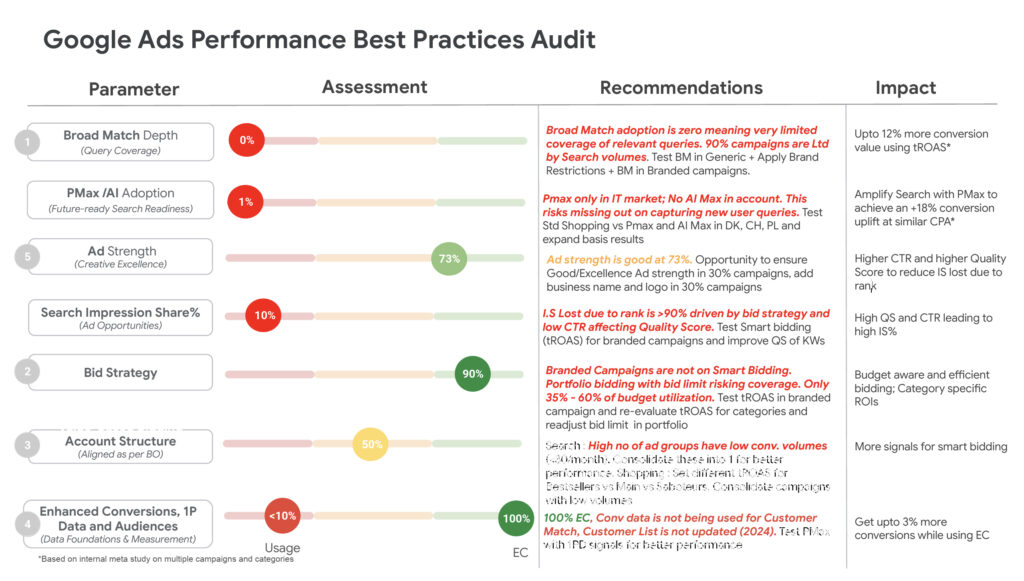
With that skepticism in mind, here’s how I approached a recent deck from Google, on a call with the client.
Recommendation 1: PMax Adoption
The deck pointed out we had low PMax adoption. For this particular advertiser, I don’t believe in PMax. We lose impression share metrics, we can’t use max bid limits (which we use heavily), and we can’t prioritize certain products. However, instead of just saying no, my plan is to say yes to a limited test on one or two smaller accounts. Why? Because I want to stop the “what if” conversation. Running a small test will give us the data to end the debate for good.
Recommendation 2: Broad Match
Google’s deck claimed our “limited coverage of relevant queries” could be solved with broad match for a 12% lift in conversion value. This is just not true. We have great coverage with phrase match and Dynamic Search Ads. But my main objection was rooted in the client’s current business goal: increasing profit. Right now, the waste that would inevitably come from broad match would be a problem. This is where I bring nuance to the conversation. I explained, “We are focusing on profit, so opening up a potential waste-mission like broad match isn’t wise at this point.”
Recommendation 3: “AI Max” / AEM Adoption
Their deck recommended enabling what they called “AI Max” to be ready for AI Overviews. This is simply not true; you don’t need Automatically Created Assets to appear there. But instead of a “gotcha” moment on the call, I handled it diplomatically. I said, “We feel we’ve covered this through our other campaign types like DSA and standard shopping.” I then waited. The Google rep agreed. Conversation over, we move on.
Recommendation 4: Bidding & Ad Groups
They recommended we stop using bid limits, test tROAS on branding campaigns, and aggregate ad groups with under 30 conversions. These were just plain stupid. Testing tROAS on brand is ridiculous. Aggregating ad groups would mean lumping “running shoes” in with “shin guards”—they don’t go together. These are the recommendations you can firmly and quickly reject as they don’t align with fundamental strategy.
Recommendation 5: The One Thing They Got Right
The deck pointed out that our customer list hadn’t been updated in 2024. This one hurt my pride a little bit because it’s something I should have caught. I owned up to it immediately. I said we should have checked better, and the client fixed the data sync in 10 minutes. Don’t fight Google when they’re right. Give them their flowers, even if it puts you in a slightly bad light. It builds trust.
[TL;DR]
- Understand Your Rep: Know who you’re dealing with. If it’s an outsourced telemarketer, dismiss them. If it’s an experienced internal team, engage strategically.
- Understand Your Client: Your client’s experience with Google dictates your approach. If they’re new and impressed, you have to play along to maintain their trust in you.
- Play Your Part: Your role is to bring client-specific nuance and data to the conversation. Don’t just be negative; come with proof. If you don’t have proof, be open to testing.
- Hold Them Accountable: Track the performance of their recommendations. When they see you’re measuring the outcome, the quality of their advice improves dramatically.
- Never Jump on a Random Call: My final advice to every person on my team. If you don’t have a clear agenda and you haven’t prepared, a random call with a Google rep is a complete waste of time.