Most PPC specialists open up Google Ads, stare at 15 empty headline slots, and proceed to write the same generic fluff every single time. You’re not writing to improve performance; you’re writing to get a higher Ad Strength score. You’re secretly trying to serve an algorithm just to get an A+ on your homework.
But what you’ve actually done has a negative impact on your account. The problem isn’t that you’re a bad copywriter. The problem is you don’t have a framework. Without a framework, you default to the same generic headlines because you can’t figure out where to start. The worst place for a copywriter is staring at a blank page. Now imagine staring at dozens, even hundreds, of ad groups that each need 15 headlines and 4 descriptions.
Today, I’m going to show you the Responsive Search Ad (RSA) writing framework I use for all my e-commerce clients. It’s built on 14 clear formulas for writing headlines that actually work. By the end, you’ll be able to write better ads in 30 minutes instead of not updating an ad for an entire year.
Go Beyond the Article
Why the Video is Better:
- See real examples from actual client accounts
- Get deeper insights that can’t fit in written format
- Learn advanced strategies for complex situations
The Problem: Chasing “Ad Strength” with Generic Headlines
Here’s what happens without a framework. You open your ad group for “men’s winter jackets” and need to fill 15 headline slots to make the Google Ads gods happy. So you write:
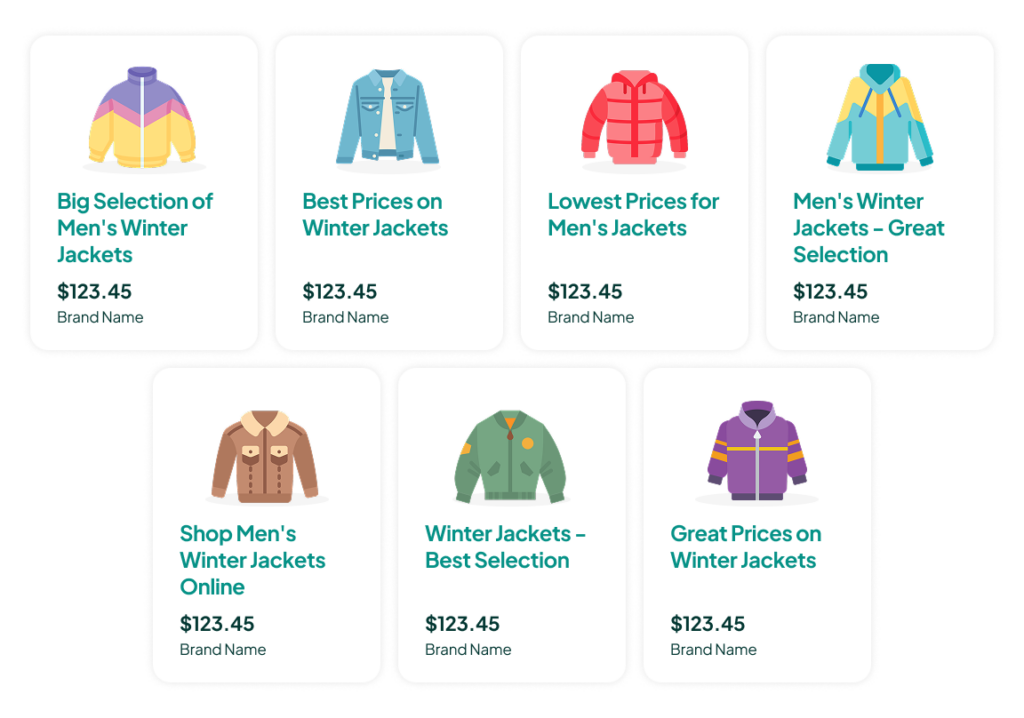
See a pattern here? You’ve written seven headlines that all say the same thing: We have jackets, we have a lot of them, and they’re cheap. Now multiply this across 50 ad groups. The result is that you can’t learn what works because you don’t know what you’re testing. Your ads blend in with everyone else’s, performance is mediocre, and you waste time because you aren’t iterating on winners or developing new concepts.
Ad Strength is a Vanity Metric, Not a Performance Indicator
Whenever I present these findings in account audits, I always get the same pushback: “But Andrew, don’t I need to create 15 headlines to get a high Ad Strength?”
My answer is twofold.
First, no. Ad Strength by itself isn’t important. It only looks at how many headlines you’ve created, not the quality of those headlines. It’s like getting an A+ on an exam just for answering all the questions, regardless of whether your answers were correct. It’s a measure of completion, not competence.
Second, Responsive Search Ads are designed to test different headlines for different search terms, audiences, and devices. When you write the same thing 15 times in slight variations, the system can’t work as intended. You’re giving the algorithm a handful of rocks and asking it to build a house.
The Solution: A Framework for Writing RSAs That Actually Work
I had this same problem when RSAs first came out, so I built a framework. It’s a system of 14 headline formulas specifically for e-commerce, split into two groups: 5 core formulas that work for 90% of your campaigns and 9 advanced formulas for when you need more differentiation.
The benefits are simple:
- You write ads in 30 minutes instead of never. Let’s be honest, you probably aren’t writing them at all. This framework removes the blank page problem.
- You can test ads systematically. It’s much easier to write a new “social proof” headline than to stare at 15 variations of “great selection” and wonder which one to replace.
- You can scale what works. You can copy the winning formulas across campaigns, saving a massive amount of time.
The 5 Core Headline Formulas (The Non-Negotiables)
Every single RSA should start with these five formulas. They are your foundation.
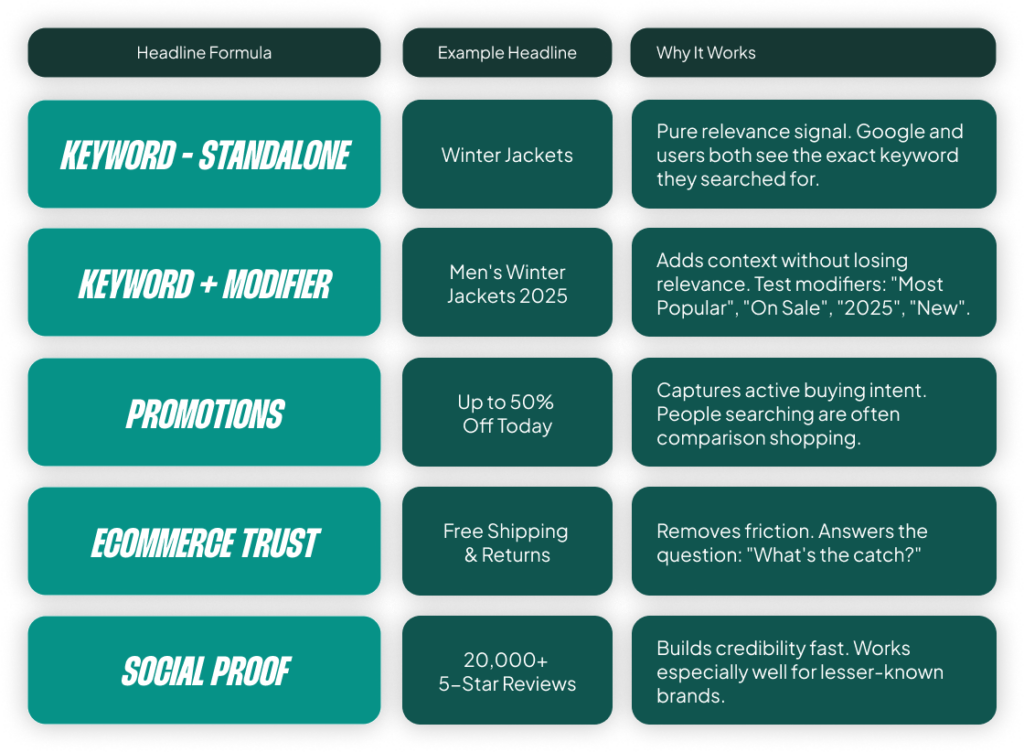
- Keyword Standalone: Just the core keyword, like “Men’s Winter Jackets”. I’ve seen this simple headline have the highest CTR and conversion rate countless times.
- Keyword + Modifier: Add context to the keyword. Examples: “Most Popular Winter Jackets,” “Men’s Winter Jackets 2025,” or “New Winter Jackets for Men.”
- Promotion: This is the one everyone knows. “Up to 40% Off This Week” or “Black Friday Deals.”
- E-commerce Trust: Remove friction for the buyer. “Free Shipping & Returns” is a classic for a reason.
- Social Proof: Build credibility. “15,000+ Happy Customers” or “20,000 Five-Star Reviews” works, especially if you’re not a household name.
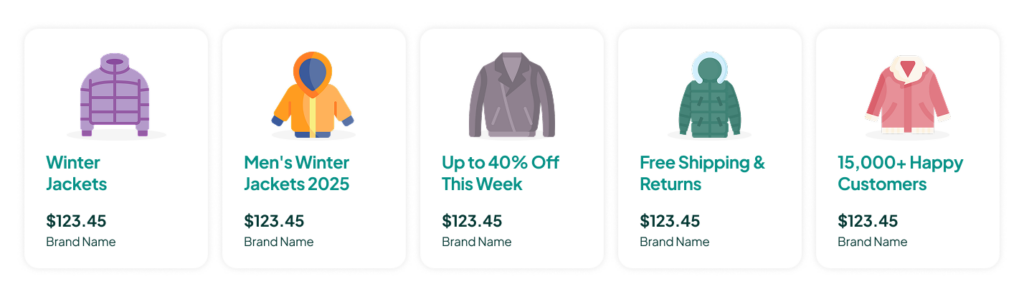
Suddenly, your ad has five distinct, non-repetitive headlines: “Winter Jackets,” “Men’s Winter Jackets 2025,” “Up to 40% Off This Week,” “Free Shipping & Returns,” and “15,000+ Happy Customers.”
The 9 Advanced Formulas (For When You Need to Differentiate)
Use these when you need to stand out in a competitive auction, or when you have a unique selling point worth highlighting. You don’t need them all at once. Pick one or two to test against your core formulas.
The nine formulas are: Seasonality, Benefits, Features, Brand/Authority, Target Audience, Problem/Solution, Comparison/Value, Urgency/Scarcity, and Gift/Occasion.
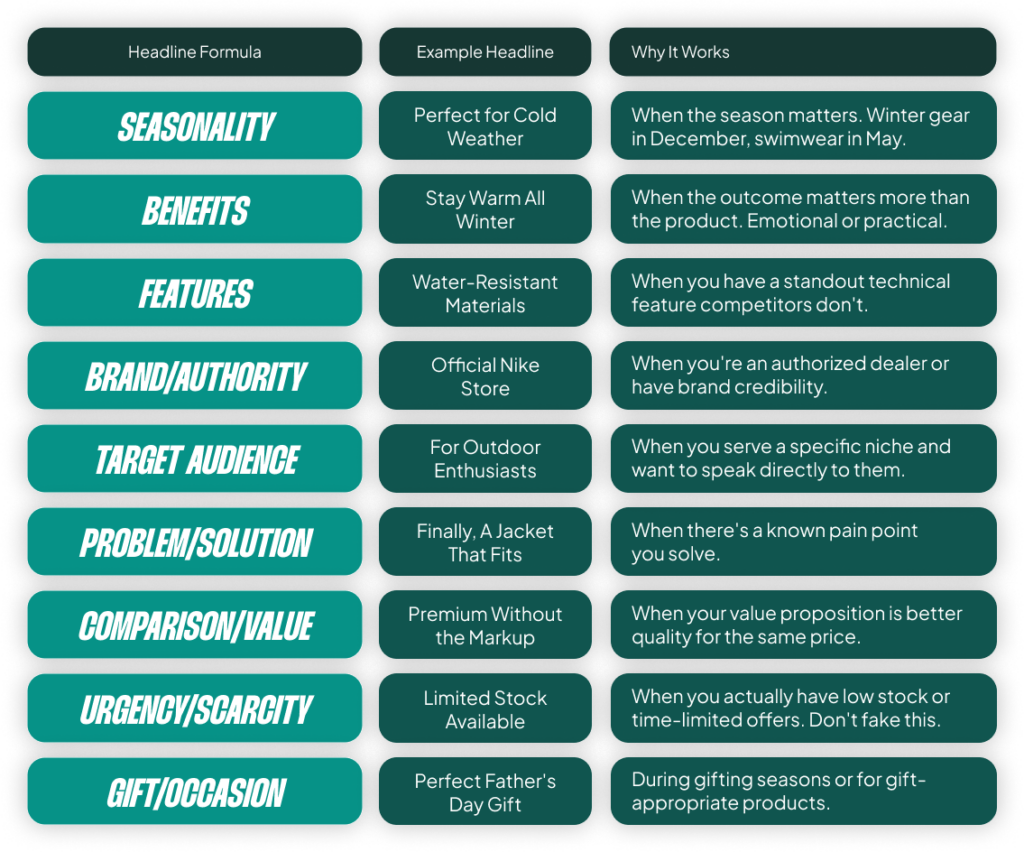
Here are a few of my favorites:
- Features: This is a goldmine if you have a high SKU count because nobody else does it. Instead of “great selection,” write “Primaloft Gold Insulation” or “Waterproof Gore-Tex Shell.” Technical features crush generic headlines.
- Target Audience: Call out your ideal customer directly. “For Outdoor Enthusiasts” or “Your Kids Will Love This.” Speaking to a specific niche builds an instant connection.
- Gift / Occasion: This is an easy win. “Perfect Father’s Day Gift” works even if you’re not running a specific promotion for it.
How to Use The Framework: The Rules of Engagement
Having formulas isn’t enough. You have to use them correctly.
Rule 1: Start with the Right Number of Headlines
RSAs are algorithmic. They need data. More headlines require more data to optimize. My rule of thumb is simple:

Yes, Google says to use 15. No, you shouldn’t. The math doesn’t work. If you have 15 headlines and 30 conversions per month, Google doesn’t have enough data to determine which combinations lead to sales. It will default to optimizing for the highest Click-Through Rate (CTR), and a high CTR does not always equal a high conversion rate. This is how you end up with high-CTR ads and low ROAS.

Rule 2: Reuse Proven Headlines Across Campaigns
This is where you save 80% of your time. Your E-commerce Trust (“Free Shipping”), Social Proof, and Promotion headlines work for almost every ad group. Write them once and copy them everywhere. Only customize the keyword-specific and feature/benefit headlines.

Rule 3: Write 2-3 Custom Headlines Per Ad Group (Advanced)
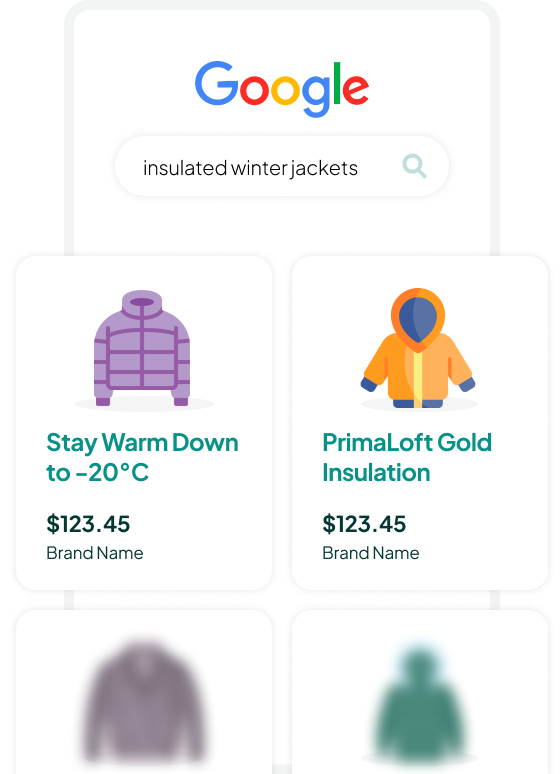
If your search performance has stagnated, this is the next level. Go deep on product-specific features and benefits. For insulated jackets, a headline like “Stay Warm Down to -20°” will outperform a generic ad 2-to-1 because your competitors aren’t doing it.
Rule 4: Use Only Proven Winners During Peak Season
Do not test 15 new headlines during Black Friday. Take your 4-6 winning headlines from the rest of the year and run only those. At least two of them should be promotional. Limit your testing during high-stakes periods.
Rule 5: For Goodness’ Sake, Don’t Pin Your Headlines
I know you want to control everything, but don’t pin. You’re going to mess it up. Google’s algorithm is better at choosing winning combinations than you think, so let it work. I see so many accounts pin the keyword to position 1 and a promotion to position 2, not realizing that position 3 is hardly ever shown. They’ve essentially created a two-headline ad by accident.
Your 3-Step Plan to Implement This Tomorrow
Here’s how to put this into practice.
Step 1: Audit Your Current Headlines
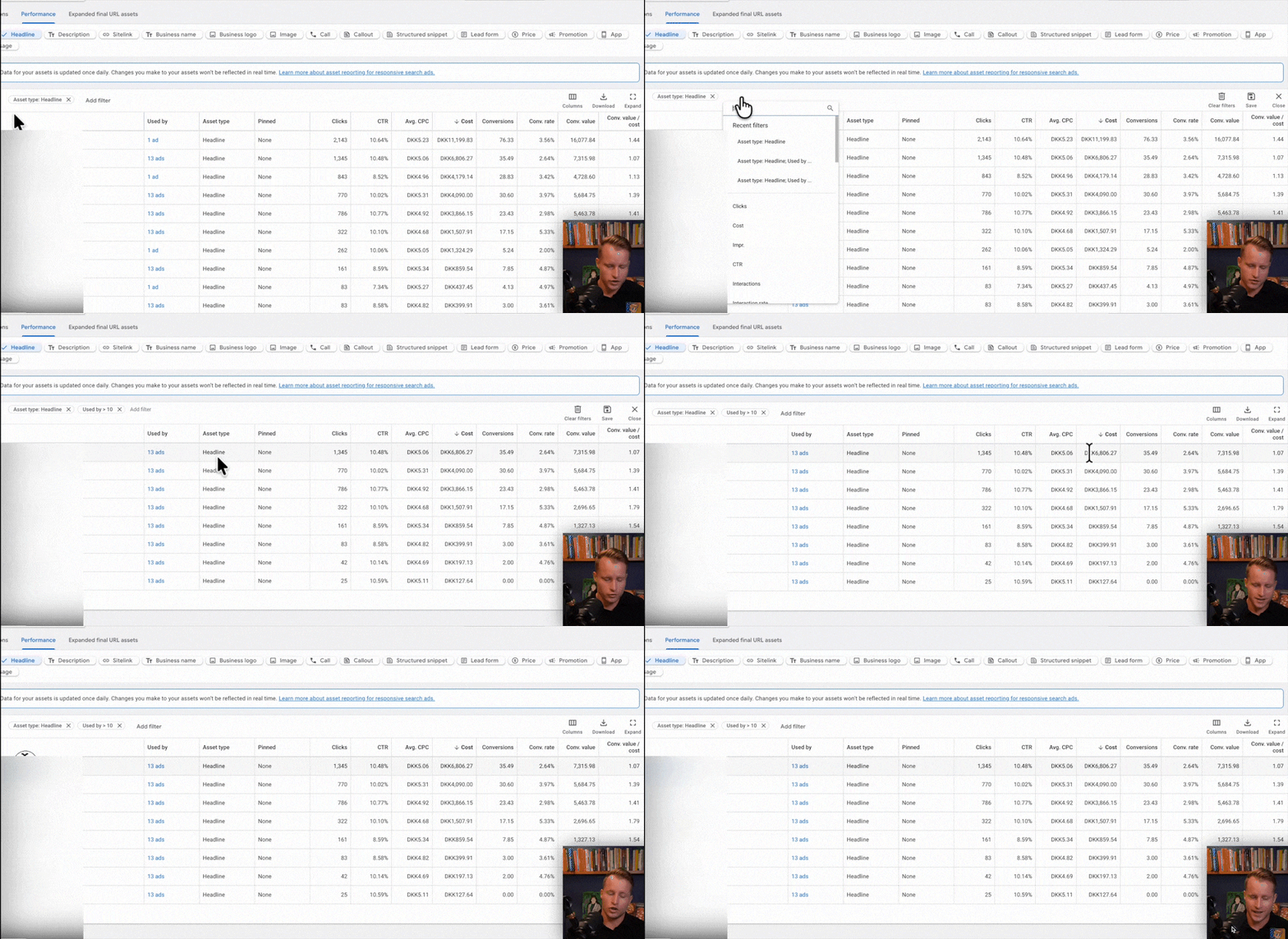
In Google Ads, go to a non-brand campaign and view your headlines at the campaign level. Filter for headlines used in more than 10 ad groups to isolate your generic, reused headlines. Look at the CTR, conversion rate, and ROAS. You’ll often find that the headline with the highest CTR doesn’t have the best ROAS. Identify the clear losers (low impressions, low performance) and pause them.
Step 2: Rebuild with the Core Formulas
Look at your remaining headlines. Are any of the Core 5 formulas missing? If you don’t have a social proof or trust headline, add one. Then, take one or two of your best-performing existing headlines and try to write a better version. Now you have a mix of proven winners and new, structured tests.
Step 3: Test and Iterate (Every 90 Days)
Once a quarter is more than enough for most accounts. Go back into your headline data, see which formula categories are performing best, and write more variations in those categories. Delete headlines in the losing categories and repeat the process.
Stop Serving the Algorithm and Start Making It Work for You
Remember those 15 headlines that all said “big selection” and “best prices”? With this framework, each headline now serves a distinct purpose. You have headlines for relevance, for price-conscious shoppers, for building credibility, and for differentiation. No more repetition.
Now, the algorithm can actually use your ad components to make an impact instead of sorting through 15 shades of the same boring color. This works.
[TL;DR]
- Chasing a high “Ad Strength” score with 15 similar headlines is a vanity metric that prevents the Google algorithm from learning and hurts performance.
- Use a framework of headline formulas (start with the Core 5: Keyword, Keyword + Modifier, Promotion, Trust, Social Proof) to ensure each headline serves a distinct purpose.
- The number of headlines you use should depend on conversion volume. If you have fewer than 50 conversions/month in a campaign, stick to 4-6 headlines to provide enough data per variation.
- Save time by reusing universal headlines (like “Free Shipping”) across campaigns and only customizing product-specific ones.
- Do not pin headlines when you’re starting a test. Let the algorithm find the best-performing combinations on its own.