What if I told you that by lowering your ROAS target, you could actually make more money during a sale? It sounds counterintuitive, but it’s true.
Applying a seasonal bid adjustment is a solid tactic, and it’s something I do all the time. But if that’s the only thing you do, you risk going into your sale with one hand tied behind your back. You’re leaving suppressed volume on the table without even knowing it.
Today, I’m going to cover how and when to combine a seasonal bid adjustment with a change to your Target ROAS to maximize revenue. We’ll also cover the specific scenarios where you should only use one or the other.
Go Beyond the Article
Why the Video is Better:
- See real examples from actual client accounts
- Get deeper insights that can’t fit in written format
- Learn advanced strategies for complex situations
The Problem With Only Using a Seasonal Bid Adjustment
The common best practice for a sale is to increase your bids in Google Ads. The correct way to do this with Smart Bidding is by applying a seasonal bid adjustment. This tells Google to bid a certain percentage higher for a short duration, usually a few days up to a week.
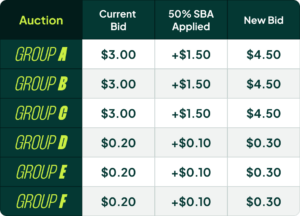
So what does it actually do? It increases the bid for every auction by the exact percentage you set. Let’s use a simplified example. Imagine you have three groups of auctions (A, B, and C) that are performing well, and you’re currently bidding $3 on them. If you apply a 50% seasonal bid adjustment, your bid now becomes $4.50. This is exactly what we want for our high-performing segments.
But here’s the issue. You also have another set of auctions (let’s call them D, E, and F) where you aren’t really participating. Your bid on these might be something tiny, like $0.20. The reason the bid is so low is that these auctions have historically performed poorly. Based on the data, they simply don’t deserve a higher bid.
The problem is that a 50% increase on a $0.20 bid is just $0.30. It makes no practical difference. You’re still not competitive. You’re effectively just pushing harder on auctions that were already working, while completely ignoring a pool of potential customers.
Why Lowering Your ROAS Target is the Key
During a big sale, consumer behavior changes dramatically. A product that had a 0.2% conversion rate can suddenly jump to 2%, 3%, or even 10%. Maybe your Nike shoes were always 20% more expensive than a competitor’s, but during the sale, you have price parity. That previously “bad” auction can become a goldmine. Smart Bidding doesn’t know this is about to happen, which is why we use a seasonal bid adjustment in the first place.
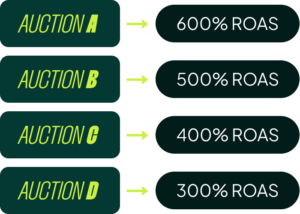
This is where lowering your ROAS target comes in. While a seasonal adjustment just increases existing bids, lowering your tROAS gives Smart Bidding permission to go after those suppressed auctions. It tells the algorithm, “I’m willing to accept a lower return to capture more volume,” which allows it to start bidding meaningfully on those D, E, and F auctions.
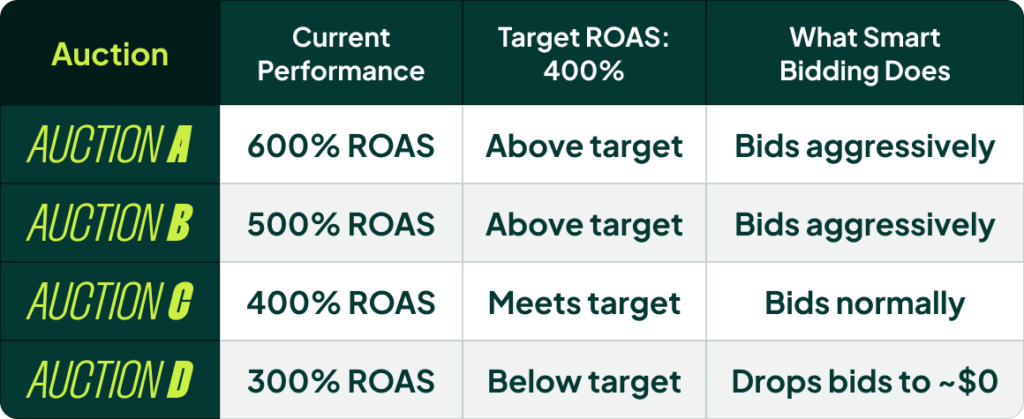
There’s another critical reason for this strategy: the pre-sale slump. For major sales events (Black Friday is the classic example), consumers know a deal is coming. They hold onto their money in the days and weeks leading up to the sale. Your ROAS naturally declines.
What does Smart Bidding do when it sees declining performance? It restricts your bids to protect your target. This is the absolute worst thing that can happen right before a huge sales spike. By proactively lowering your tROAS, you counteract this dip and tell Google to keep its foot on the gas.
The 3 Scenarios: Which Strategy Should You Use?
This isn’t a one-size-fits-all approach. You need to choose your strategy based on your account’s performance leading into the sale. There are three core scenarios.

Scenario 1: Use Only a Seasonal Bid Adjustment
You’ll want to stick with just a seasonal bid adjustment in two specific cases:
- You’re already exceeding your ROAS target. If performance is strong and volume is good in the week before the sale, Google hasn’t started pulling back. You don’t need to unlock new volume, you just need to bid more aggressively on what’s already working.
- Your sale is very short. If your promotion lasts for less than two full days, changing your ROAS target adds unnecessary complexity and the algorithm likely won’t have time to react anyway.
Scenario 2: Use Only a tROAS Decrease
This is the right move when you are barely hitting, or even missing, your ROAS target before the sale starts. If your target is 400% and you’re only hitting 300% (even after accounting for conversion lag), you’re already stretched thin.
In this case, your primary goal is to unlock new volume, not to push harder on existing auctions that are already underperforming. A percentage increase on auctions you’re barely bidding on won’t help. Skip the seasonal bid adjustment and focus on lowering your tROAS to give Smart Bidding room to find new opportunities.
Scenario 3: Use Both (The Most Common Scenario)
This is the strategy I recommend most often. It’s ideal when you’re hitting your target ROAS going into a sale, but not exceeding it by a huge margin. It works best for sales events that last at least five days.
This approach gives you the best of both worlds. You get to unlock those suppressed auctions while also pushing harder on the auctions that are already performing well. The key here is to be more modest with your seasonal bid adjustment to compensate for the fact that you’ve already lowered your ROAS target.
By lowering the target, you increase your baseline bidding potential across the board. Then, you apply a conservative seasonal adjustment on top to give your proven winners an extra edge. This combination will massively increase your total volume compared to using just one tactic alone.

Don’t Leave Money on the Table
Remember where we started. A seasonal bid adjustment increases bids equally by percentage, but it does nothing to help you unlock auctions that Smart Bidding has already decided are not worth pursuing. Lowering your ROAS target gives the algorithm permission to explore and find the hidden pockets of profit that emerge during a sale.
Don’t make the mistake of only applying a seasonal bid adjustment and leaving that suppressed volume on the table for your competitors.
[TL;DR]
- Simply applying a seasonal bid adjustment only increases bids on auctions that are already active. It does little for auctions with very low bids that Smart Bidding has suppressed.
- Lowering your tROAS target gives Smart Bidding permission to “explore” and bid on these historically underperforming auctions, which can become highly profitable during a sale.
- Consumer behavior before big sales (like Black Friday) often causes a ROAS dip, making Smart Bidding pull back right when it should be aggressive. Lowering tROAS counteracts this.
- There are three scenarios: use only a seasonal adjustment if you’re over-performing; use only a tROAS decrease if you’re under-performing; and use a combination of both (the most common case) if you’re hitting your targets.