Margin-based campaigns are still being recommended by people in the Google Ads space, and it constantly surprises me. It’s a broken strategy. The entire foundation for that campaign structure is full of holes, yet agencies and freelancers continue to build accounts on top of it.
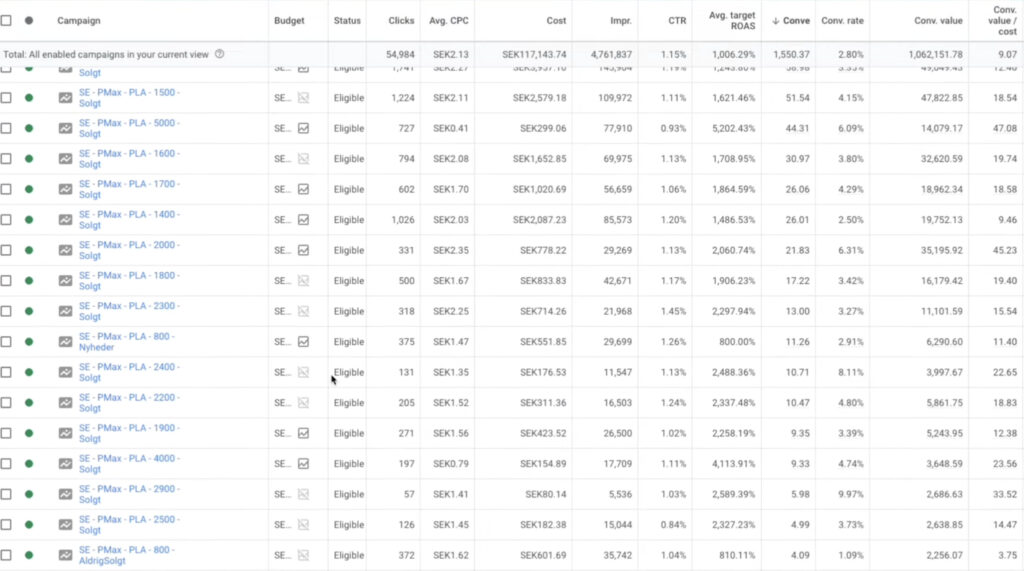
I’m here to tell you why they don’t work and what you should be doing instead. Because if you’re trying to scale your e-commerce business, this is one of those “logical” strategies that quietly sabotages your performance.
Go Beyond the Article
Why the Video is Better:
- See real examples from actual client accounts
- Get deeper insights that can’t fit in written format
- Learn advanced strategies for complex situations
The Flawed Logic of Margin-Based Campaigns
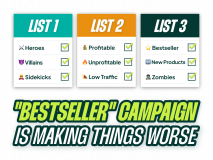
On paper, the strategy makes a lot of sense. You set up different Shopping or Performance Max campaigns for different groups of products based on their margin. It typically looks something like this:

The numbers don’t really matter. The idea is to bid aggressively for your high-margin products to maximize volume, while protecting your low-margin products from becoming unprofitable. You don’t want to overspend on products with thin margins, and you want to get as much as you can out of your cash cows. It seems perfectly logical.
But the entire strategy rests on one massive, incorrect assumption.

The Problem: What People Click Isn’t What They Buy
The core assumption of a margin-based structure is that consumers buy the specific product they click on. This is fundamentally untrue.
I’ve done this analysis in many, many accounts over the years. Every single time, I find that at least 35-50% of consumers buy a completely different brand or category than the product they originally clicked on. They might click on a Nike shoe ad but end up buying an Adidas shirt and a pair of socks. Your campaign, however, is bidding as if they only bought the Nike shoe.
You’re trying to set a precise bid based on the margin of Product A, but half the time the customer ends up buying Product B, C, and D, completely invalidating the premise of your campaign structure.
The Second Problem: Google’s Reporting Misleads You
This brings us to the next problem. Many advertisers assume that because Google shows clicks and conversions tied back to an individual product ID, it’s showing what people actually bought. This is also wrong.
Google Ads reports conversions against the product that was clicked on, not the product that was actually purchased. So even though the user bought something completely different, the conversion value gets attributed back to the product in your high-margin campaign. The system is operating on bad data.
Yes, you can expand your conversion tracking with cart data, but that doesn’t change my point of view here. The foundational structure is still trying to control bidding based on an initial click, not the final transaction reality.
Why Splitting Your Data Is a Bad Idea
The issues don’t stop there. By breaking your products into multiple campaigns, you’re actively hurting Smart Bidding’s ability to perform.
If you have thousands of conversions a month, this might not be a huge deal. But for most accounts—anything below a thousand conversions per month—Smart Bidding starts to underperform when you starve it of data.
Let’s use an example. Say you have 1,000 conversions in total per month:
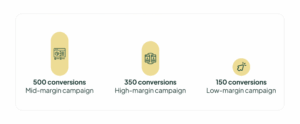
Suddenly, your low-margin campaign, which has a very high ROAS target, is trying to optimize with only 150 conversions a month (that’s just five per day). Smart Bidding has an awful lot of trouble hitting an aggressive target with so little data to work with. The result is often that this campaign underperforms, and those 150 conversions might drop to 120 or 110. Your overall performance suffers because you’ve sliced your data too thin.
The Right Way: Shift from Margin Segments to Profit Tracking
So, if segmenting by margin is a flawed model, what works better? The answer is to stop bidding based on a proxy (margin segments) and start bidding on the real thing: profit.

Image credit to ProfitMetrics.io
The proper way to fix this is to implement a gross profit tracking method. You might hear it called Profit on Ad Spend (POAS), contribution margin, or just profit tracking. It’s all roughly the same concept. Instead of sending revenue data to Google Ads, you send the actual gross profit from each sale.
This bypasses the entire need for margin-based campaigns. Each transaction tells Google the exact gross profit it generated. Google now knows that Product A has a low margin and Product B has a high margin because the profit value is sent directly with the conversion. It can then use that precise data to set bids accordingly.

How Profit-Based Bidding Actually Works
Right now, you’re likely just sending revenue to Google. To calculate gross profit, we send a value that looks more like this:
Gross Profit = Revenue - Discounts - COGS - Shipping - Payment Fees - Packaging/Handling
This is a monumentally better way to run a nuanced bidding strategy. It allows Smart Bidding to bid higher for high-margin products, keywords, devices, and audience segments because it knows exactly what they’re worth. It also gives you perfect insight into when you start losing money on a sale. We use this at Savvy to know exactly how low we can push ROAS on upper-funnel keywords before a campaign becomes unprofitable.
To put it simply:
- The Wrong Way (Margin-Based Campaigns): Tracks what people click on, but not what they actually buy. The effect you want is lost.
- The Right Way (Profit-Based Bidding): Tracks what actually happens in a transaction, including multi-item carts with mixed margins.
Today, we recommend ProfitMetrics.io for profit tracking in Google Ads.
The Caveats of Profit-Based Bidding (It’s Not a Silver Bullet)
Now, I’m a pragmatist. This approach isn’t perfect, and it comes with its own set of challenges you need to be aware of.
- The Sale Problem: When you run a 20% off sale, the profit value you send to Google suddenly drops. Smart Bidding is used to seeing $100 in value, and now it’s seeing $80. This can hurt performance right when you want to be pushing for more volume. There are ways around this (conversion rates usually go up), but it’s a real issue for businesses that run frequent promotions.
- The Low-Margin Problem: If your business has razor-thin margins, you might have very little room to maneuver. Going from a 120% POAS target to 110% might cut your profit in half, but for Google Ads, it’s a tiny change that can be hard for the algorithm to work with effectively.
- The Human Problem: I’ve seen this happen now that clients can see the exact profit from every sale. They become obsessed with daily profitability. Any day they don’t hit their target, they go crazy, decrease bids, and kill their volume. You still need to look at the bigger picture with metrics like blended ROAS and new customer acquisition.
And of course, if you have the same margin on 90% of your products, none of this is necessary. Don’t overcomplicate things if you don’t need to.
Google’s Upcoming Solution (And Why I’m Skeptical)
Google has a profit-based bidding feature in beta that should roll out sometime in 2025. But it opens up a few issues for me.
First, you can’t troubleshoot it. If it’s not working, you have no visibility into why, unlike with a third-party tool like Profit Metrics or a custom solution.
Second, if I put on my tinfoil hat for a moment, you’re handing Google your exact COGS and margin data. I’m wary of what that could do to your auction costs if Google knows exactly how hard it can squeeze you for profit.
Finally, it doesn’t account for things like shipping and handling costs, which can be significant for some businesses.
Your Action Plan: Moving Beyond Flawed Structures
By splitting your campaigns by margin, you’re making your life harder and likely hurting your performance. You can’t create more sophisticated campaign structures (like segmenting by brand or product performance) because you’ve already used your one “split” on a flawed margin-based methodology.
It’s time to move to a smarter system.
- Look at profit tracking. If you have varied margins across your products, I highly recommend looking at a software solution like Profit Metrics or building your own custom-coded profit tracking.
- Implement it in your account. Start sending profit data instead of revenue data to Google Ads. I have another video that explains how to do this.
- Test your targets carefully. Don’t just stare at the in-platform POAS number. Make sure you use a secondary data point like blended ROAS or new customer acquisition data to guide your strategy.
[TL;DR]
- Margin-based campaigns are built on the false assumption that users buy the product they click on. Data shows 35-50% of users buy something different.
- This structure starves Google’s Smart Bidding of data by splitting conversions across too many campaigns, which hurts overall performance.
- Profit-based bidding is the superior method. It sends the actual gross profit of each transaction to Google, giving the algorithm precise data to work with.
- This approach allows you to consolidate your campaigns, providing more data for Smart Bidding and opening the door for more effective campaign structures.
- While profit tracking has its own challenges (like handling sales), it is a fundamentally more accurate and powerful way to manage e-commerce ad accounts.