Dansk
Dansk
If you’re staring at 50 different attributes in your Google Shopping feed and you feel completely overwhelmed, you’re looking at the problem all wrong. For the last 10 years, I’ve lived inside these feeds. It’s one of my favorite parts of managing Google Ads, but I also don’t have unlimited time.
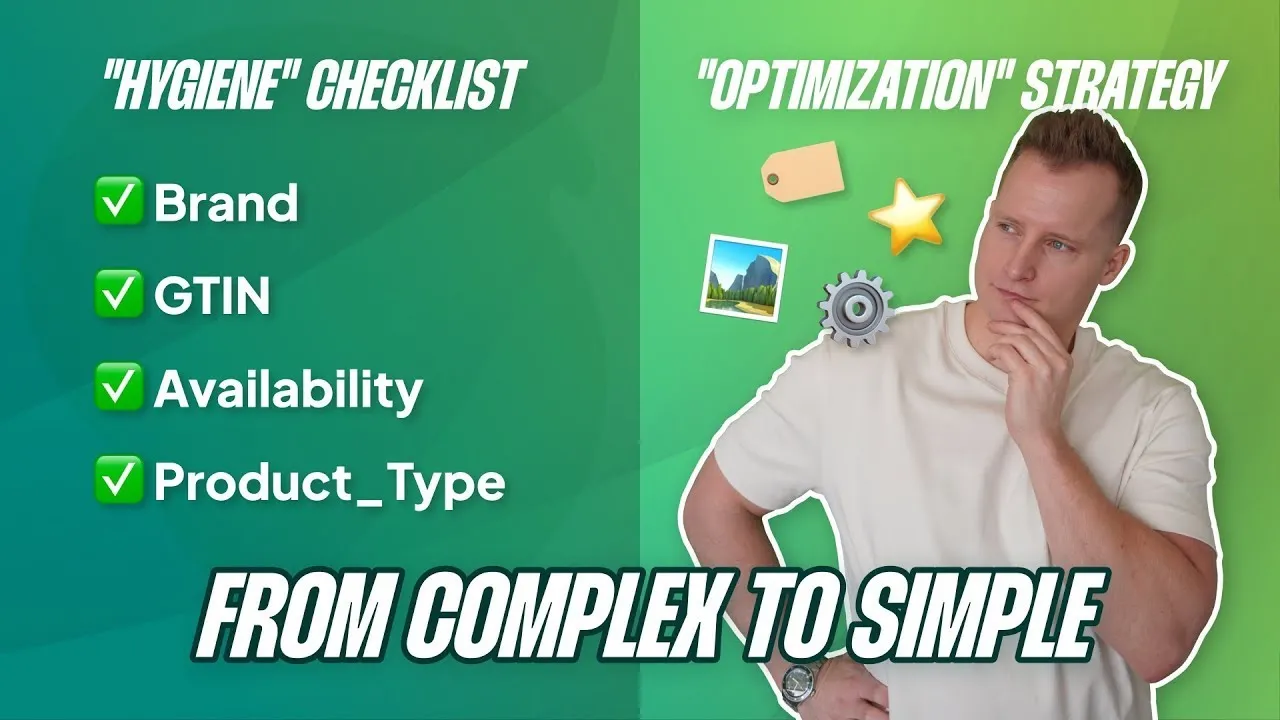
The key isn’t to try to optimize everything. The key is to split the work into two distinct jobs: Feed Hygiene and what I call True Feed Optimization. One is a foundational, pass/fail task you do once. The other is where the real leverage is.
Most agencies and advertisers blur these two together, creating a chaotic mess. We don’t do that. In this article, I’ll show you how to take the chaos out of feed optimization and make the process so simple you’ll wonder why you ever did it any other way.
Stage 1: Feed Hygiene - Your Pass/Fail Foundation
Let’s start with the foundation. Feed hygiene isn’t about being clever or creative; it’s about being 100% accurate. This first stage involves making sure all the relevant, factual attributes for your products are present and correct. Think of attributes like GTIN, availability, brand, color, condition, and material.
Your only job here is to ensure the data is accurate. This is black and white. Is the brand attribute filled out correctly? Yes or no. Is the condition present? Yes or no. This work doesn’t directly make you a lot of profit or dramatically boost your visibility. What it does is stop you from getting disqualified before the game even starts.
A clean, complete feed builds trust with Google’s systems. As we move into an AI-first world, Google will rely on this structured data to understand context. When a user searches for “an office-friendly, black CrossFit shoe under $100,” Google will use these attributes to find your product. If they’re missing, you’re invisible.
How to Systematically Tackle Hygiene (Without Losing Your Mind)
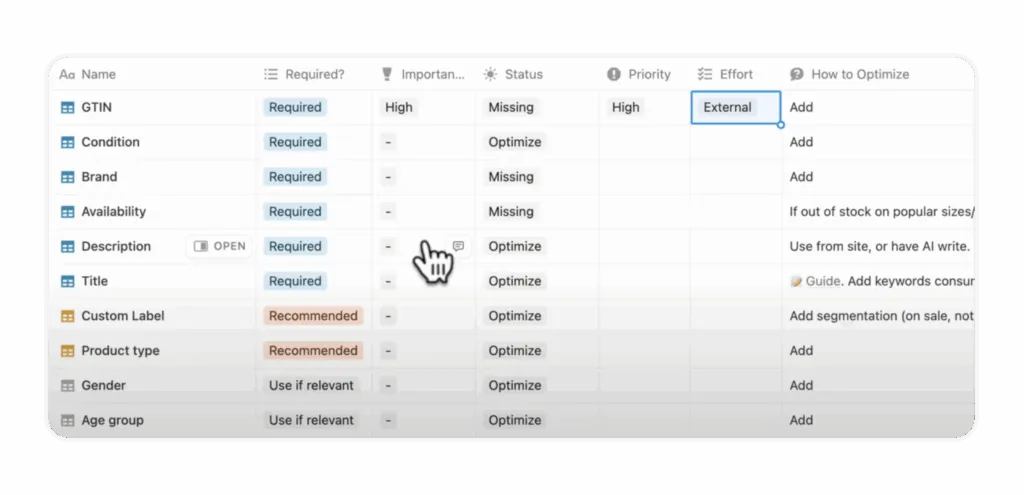
The issue is that it’s easy to get lost. The way I do this is with a simple checklist. You can use a Google Sheet, a Notion template, whatever works for you. Just list all the potential attributes and go through your feed, one by one, marking the status:
- Exists and is correct: Great, move on.
- Needs to be added/fixed: This goes on your to-do list.
- Not applicable: Mark it and ignore it. (For example, the ‘adult’ attribute isn’t relevant unless you’re selling sex toys).
You’d be surprised how often a standard Shopify feed is missing something basic like ‘condition’. Your feed management tool (like Channable or DataFeedWatch) won’t add this automatically. You have to tell it to. This simple audit immediately gives you a clear, actionable list of what to fix.
The Dealbreaker: Why GTINs Are Non-Negotiable
If there’s one hygiene attribute people try to skip, it’s the GTIN. That’s a huge mistake. The GTIN is what links your specific product to the exact same product sold by your competitors.
This has massive implications:
- Shared Product Ratings: If your competitor has 500 reviews on a Nike shoe and you sell the same one (with the same GTIN), you get to show those same 500 reviews. It’s a product rating, not a store rating. It’s an incredible advantage.
- Shared Learning: Google learns which search queries are relevant for a specific GTIN. If a competitor’s product shows up for a certain search, Google understands your product is also relevant for that search, independent of your title. It bundles the learning.
Getting your hygiene right, especially GTINs, is the non-negotiable first step. Once it’s done, you almost never have to touch it again.
Stage 2: True Feed Optimization - Where the Leverage Is
With a clean foundation, we can now move on to the interesting part. True optimization means strategically improving a select few attributes for one of two purposes: improving visibility or improving your analysis and campaign structure.
Optimizing for Visibility & Traffic
These are the attributes you tweak to get more relevant impressions and clicks.
1. Product Title
The title is still Google’s primary way to understand what search queries your product should rank for. The goal is to front-load the most important information because titles often get cut off. If you’re a reseller of Nike running shoes, putting “Nike” at the front makes sense. If you’re a DTC brand nobody has heard of, your brand name is low priority and should go at the end (or not at all).
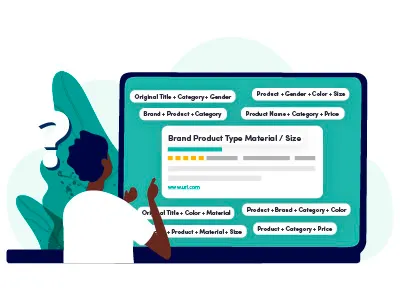
I see two common mistakes here: not optimizing titles at all, or overdoing it. Overdoing it looks like this: Brand + Title + Gender + Model + Color + Size + Material. This is nonsense. Nobody searches for a t-shirt by size (“medium t-shirt”). Nobody searches for apparel by model number. Think about what users actually search for in your category. If you have to make a mistake, it’s better to overdo it than to do nothing, but a little bit of logic goes a long way.
2. Product Ratings
These are the review stars that show up directly on your Shopping ads. To be eligible, you need to collect and submit a separate product reviews feed with at least 50 total reviews. Once you’re in the program, you gain access to the entire pool of reviews for any product with a GTIN you sell.
But here’s my pragmatic advice: if you sell your own private label products and only have a handful of reviews for each (e.g., 3 reviews on one, 8 on another), I’d wait. Seeing a low number of reviews can sometimes be worse than seeing none at all. It can make a potential customer think, “Nah, not many people seem to like this product.”
3. Images
I consider image optimization a “nice to have” in most cases. The exception is when your primary hero image is just plain bad. For accounts with thousands of SKUs, it’s rarely worth the effort unless there’s a systemic problem. But if you have fewer products, testing a lifestyle/model shot versus a simple product shot can be valuable.
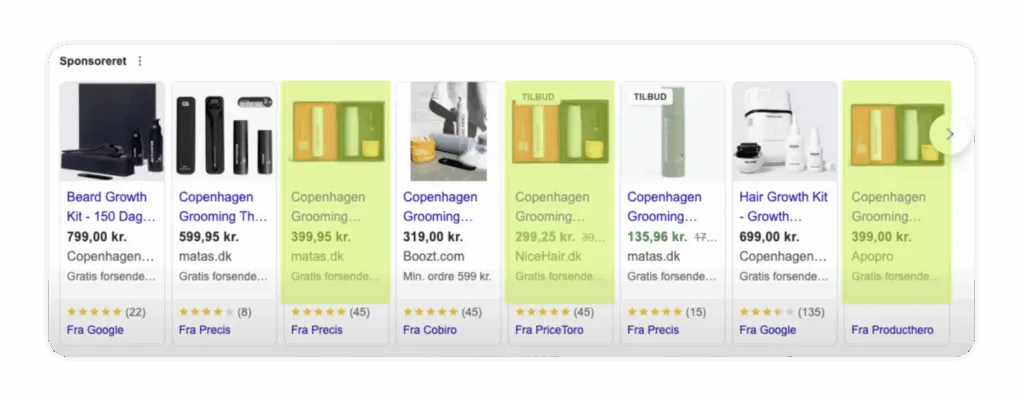
Look at this example. On the far left, the product from the brand’s own store is almost impossible to decipher on a small mobile screen because of the black background. Compare that to the retailer images on the right, where you can clearly see the products inside the box. That’s an example of a poor image that absolutely needs to be improved.
Optimizing for Analysis & Campaign Structure
This is about adding data to your feed that you use internally to make better decisions. It has nothing to do with visibility.
Custom Labels
Custom labels are your best friend here. Google doesn’t look at them for ranking purposes, so adding keywords does nothing. Their sole purpose is for you to segment products in your campaigns.
My favorite custom labels are:
- Bestseller/Saboteur: Is this a top product or one that bleeds money no matter what?
- On Sale: Grouping sale items allows for different bidding strategies.
- Price Range: How do my high-AOV products perform versus my low-AOV ones?
- Margin: Essential for profit-based bidding.
What You Can Safely Ignore (Most of the Time)
Just as important as knowing what to do is knowing what not to do.
- Description: I haven’t manually optimized a product description in years. The description pulled from your website is almost always good enough. Don’t waste your time here.
- Google Product Category: Google is generally very good at categorizing products automatically. It’s worth a quick check to ensure a sofa isn’t being categorized as a lounge chair, but this rarely needs manual intervention.
Focus your limited time and energy where it actually matters.
The Right Tools for the Job
You can manage feeds manually with Google Sheets, but for anyone with a decent number of products, a third-party tool is essential. The most common options are Channable and DataFeedWatch, and for smaller Shopify stores, a tool like Simprosys can do a good job.
But I have to be crystal clear about this: simply running your feed through a tool does nothing. A tool has no inherent value if you don’t apply rules to change and improve the attributes. The tool is just the vehicle; you still have to provide the directions.
[TL;DR]
- Stop trying to optimize everything. The key is a two-stage framework: Hygiene first, then strategic Optimization.
- Feed Hygiene is a pass/fail foundation. Your only job is to be 100% accurate on all factual attributes (GTIN, brand, color, etc.) to ensure eligibility and future-proof your account.
- GTINs are non-negotiable. They are critical for sharing product ratings and search query learnings, giving you a massive competitive advantage.
- True Optimization focuses on a few high-leverage attributes. Prioritize optimizing your Title for visibility and using Custom Labels for better campaign structure and analysis.
- Don’t waste time on low-impact tasks. In most cases, manually optimizing product descriptions or Google Product Categories is not a good use of your resources.