Knowing when and how to apply each bidding method in Google Ads is one of the most important skills you can master. It’s also one of the most neglected.
Once your account is set up properly, your understanding of Smart Bidding becomes your biggest differentiator.
Two advertisers with identical feeds and identical campaign structures can get completely different results based on nothing more than the bidding method they chose and how they manage it.
The confusion around bidding hasn’t gotten any better over the last few years. If anything, it’s gotten worse. Google keeps adding options and changing how existing ones behave, and the advice floating around the industry is often outdated or flat-out wrong.
So I’m going to rank every bidding method available, from manual bidding all the way to Target ROAS.
For each one, I’ll cover where it works, where it fails, and the myths that keep people using it in the wrong situations. A few of these rankings will probably go against what you’ve been told.
Go beyond the article
Why the video is better:
- See real examples from actual accounts
- Get deeper insights that can’t be conveyed in writing
- Learn advanced strategies for complex situations
Maximize Clicks (Fail)
This is the bidding method I dislike most, and the one I think is most misunderstood.
The premise is that you get the most clicks possible for your budget. The misunderstanding is believing that’s a good thing.
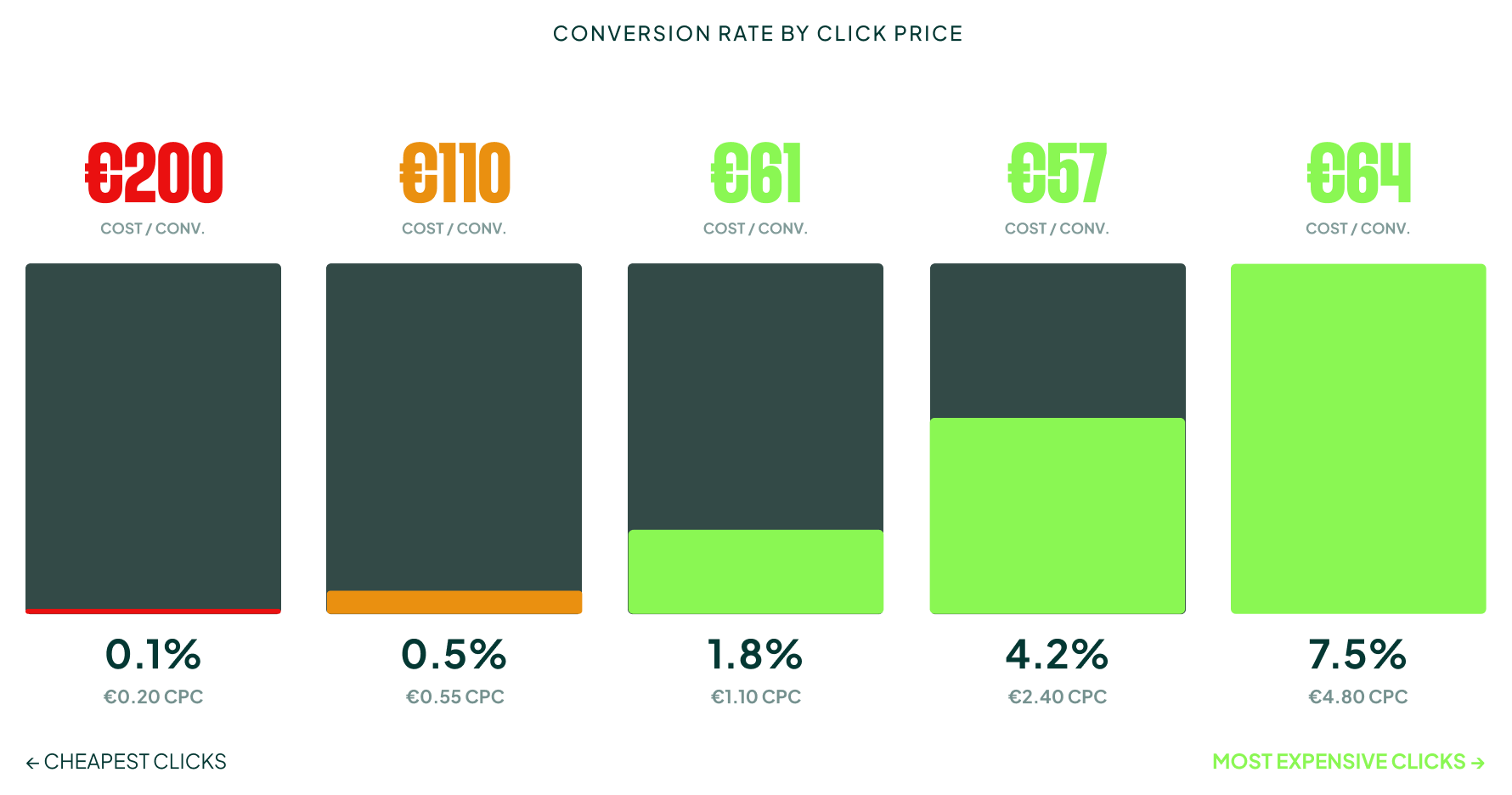
It goes directly against how the Google Ads auction works. The best clicks are the most expensive ones, because every competitor with Smart Bidding is also bidding up on the queries most likely to convert. When you ask the algorithm for the maximum number of clicks, you’re explicitly asking it to avoid the clicks that are worth the most.
Think about where cheap clicks come from today. They come from search terms nobody else wants: vague informational queries and low-intent traffic that the rest of the auction has already learned doesn’t convert. They’re cheap for a reason.
In the early days of Google Ads, there was a real arbitrage opportunity to buy clicks cheaply that were still valuable. That window closed a long time ago. Everything is so automated today that the cheapest possible clicks almost always come from search terms that bring no value.
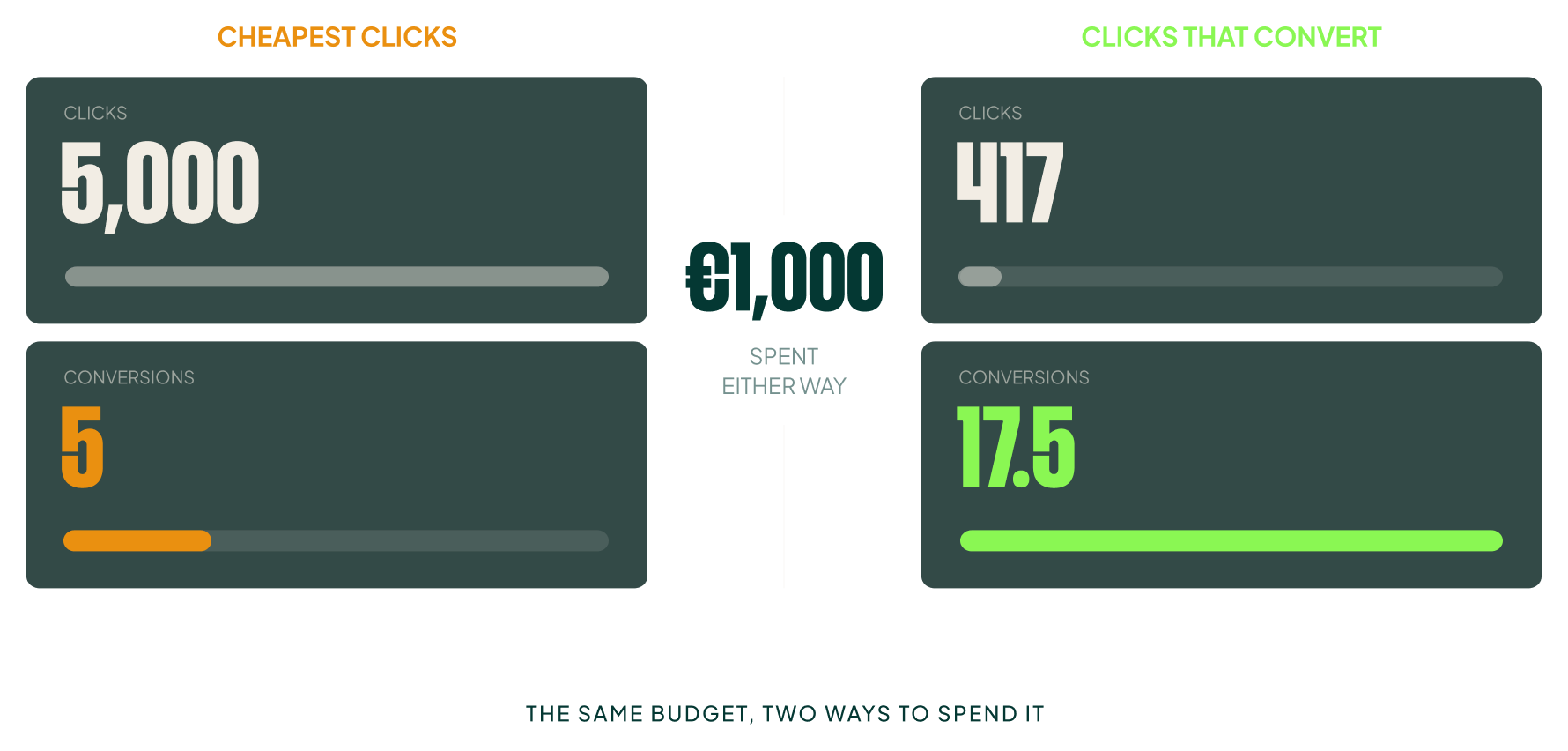
Getting 10x the clicks is irrelevant if you get fewer conversions at the end. And that’s what usually happens.
The most common pushback I hear is that Maximize Clicks is a good way to get a new account started. I couldn’t disagree more. You’re setting up the account for failure by training it to seek out the lowest possible bids from day one. The data you collect will be skewed toward exactly the traffic you don’t want.
Under no circumstances should you use Maximize Clicks.
Maximize Conversions and Maximize Conversion Value (A-Tier)
Maximize Conversion Value has grown in popularity for two reasons. Smart Bidding changed how it treats campaigns that are limited by budget, and the bidding method became available for Standard Shopping.
The major advantage is that it sustains the same level of spend no matter what. I call this auction pressure. Especially for accounts with high AOV and low conversion volume, your biggest danger with Target ROAS is the death spiral: you miss your ROAS target for a few days, spend drops, you get less data, performance gets noisier, and spend drops further.
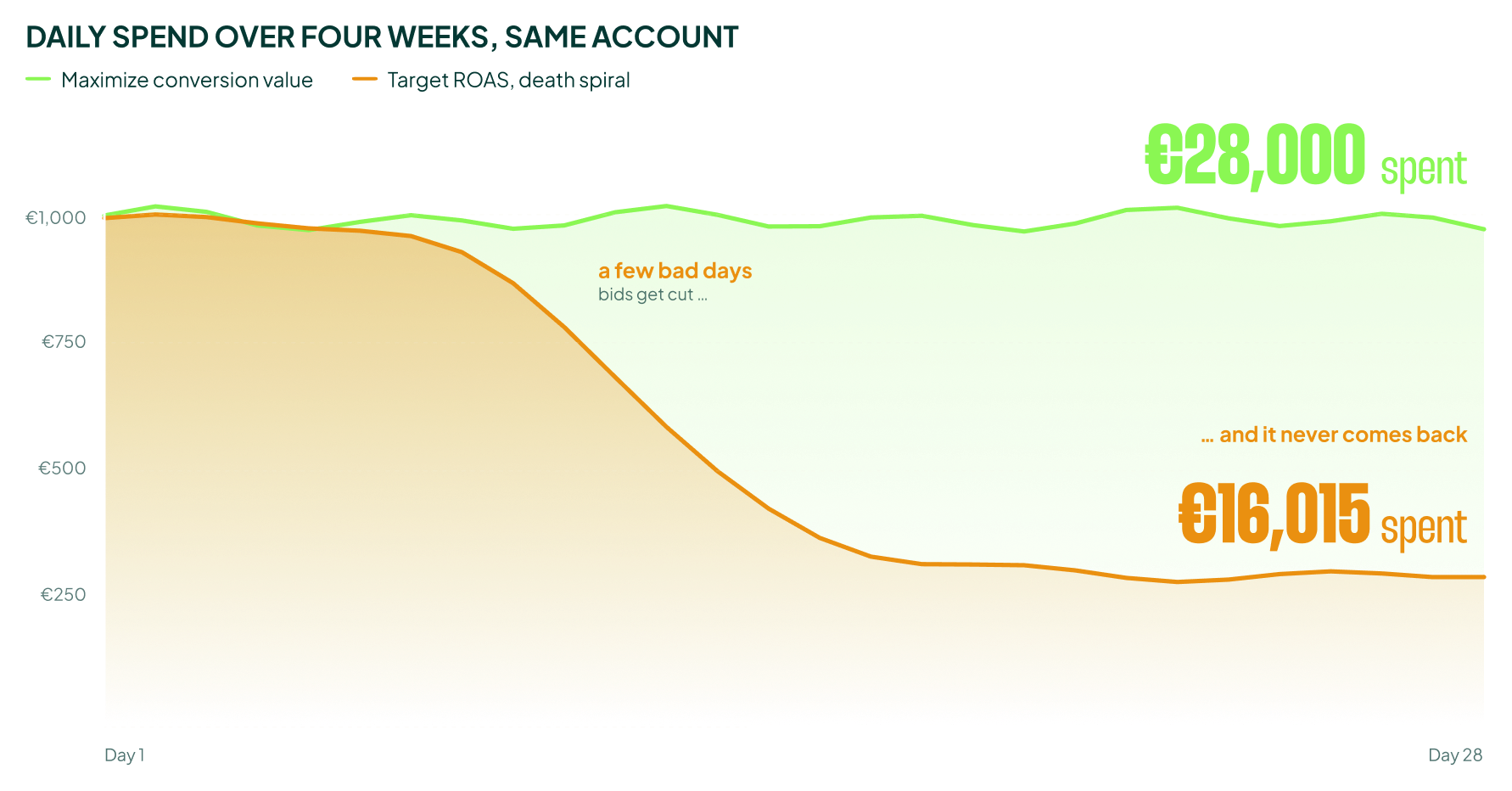
Maximize Conversion Value doesn’t fall into that trap. It keeps spending the budget you’ve given it. If you measure your results over weeks or months instead of days, that stability can make it the better choice over Target ROAS.
It also handles the overperformance problem better. When results come in above your expected ROAS, Maximize Conversion Value doesn’t respond by overspending. For accounts where the YoYo effect is a real drag on long-term results, that’s a meaningful advantage.
The challenge is that the burden shifts to you. You need a strong pulse on what the right budget is at all times. Set it too high and you overspend into unprofitable territory. Set it too low and you leave revenue on the table.
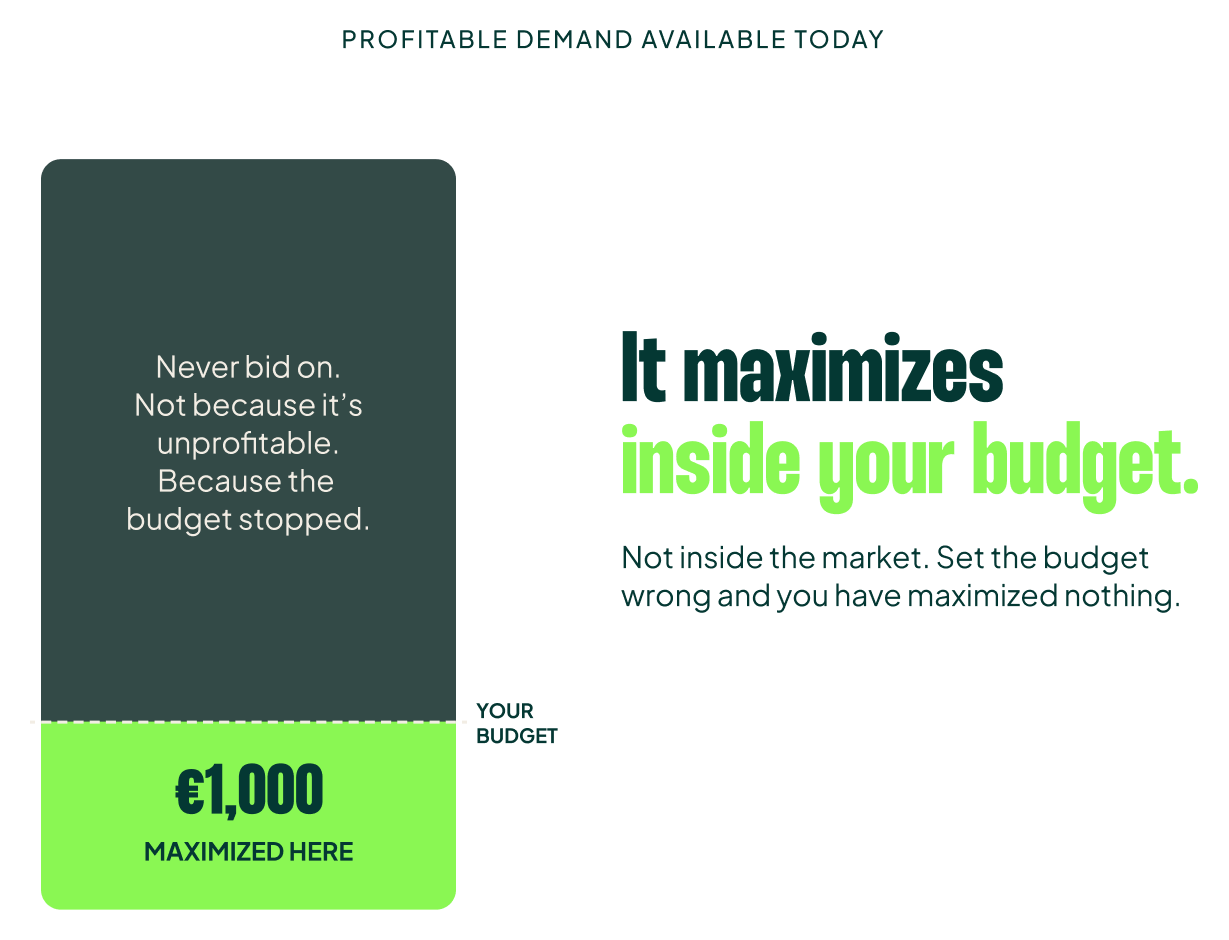
There’s also a lag effect. The bid that hit your desired budget last week can be the wrong bid this week. If you’re in a volatile market, you can find yourself constantly running the wrong bid relative to the budget you’ve set, always one step behind.
With that being said, it works well for accounts with fixed monthly budgets and for campaigns that are actually limited by budget.
The most common misunderstanding is in the name. Maximize Conversion Value doesn’t actually maximize your conversion value. It maximizes conversion value relative to the budget you’ve given it. If your budget is wrong, you’re not maximizing anything (the name is doing a lot of heavy lifting here).
Manual CPC (Fail)
Manual CPC is in the same category as Maximize Clicks for me, though it’s not quite as bad. I have two core issues with it.
The first is that you can’t bid at the search term level. Today, every keyword match type can trigger search terms you never intended. Without Smart Bidding adjusting bids up and down for each individual search term, you quickly end up paying the same CPC for high-performing and low-performing queries.
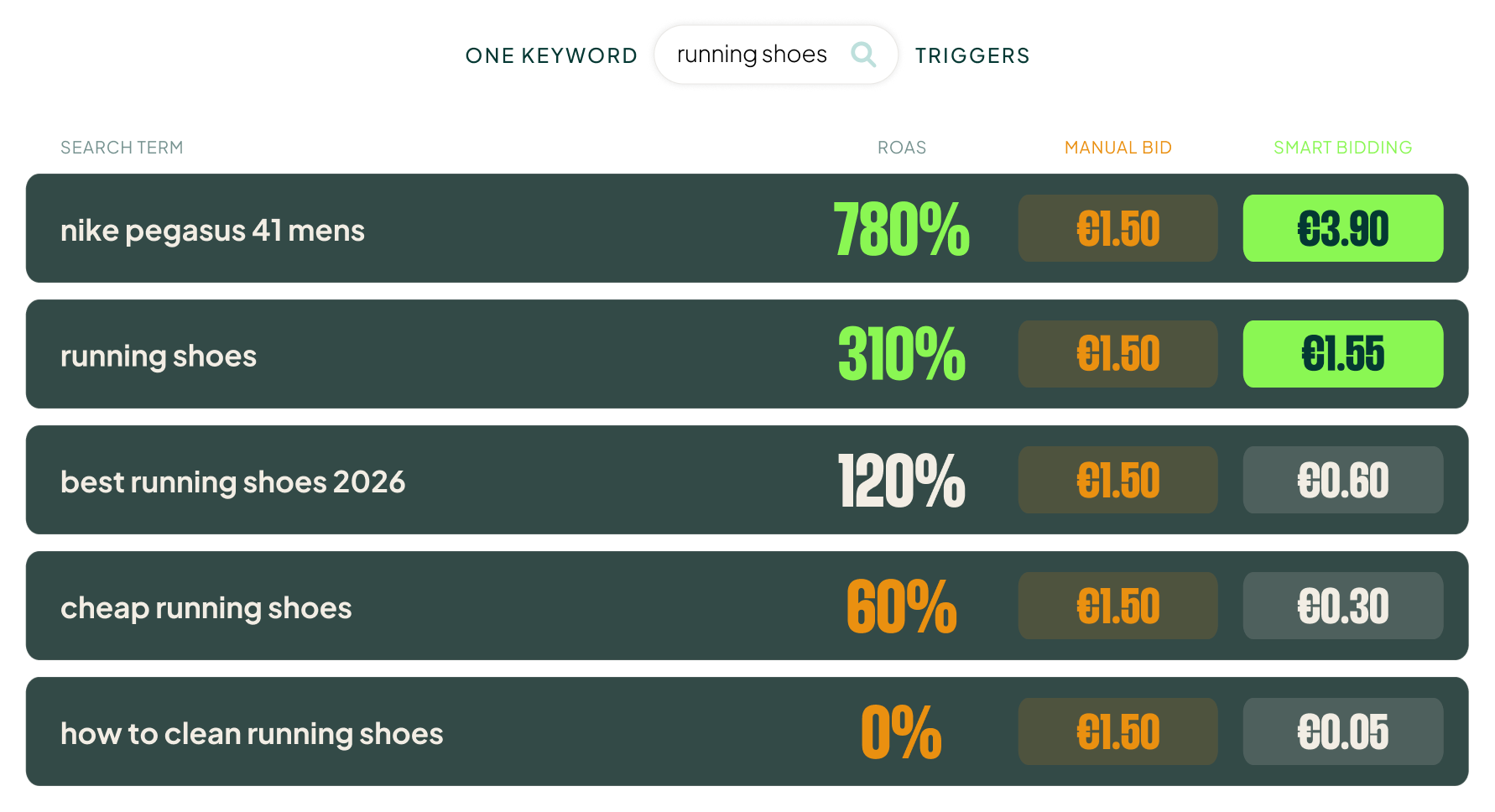
It gets worse over time. Your ROAS drops because you’re overpaying for the weak terms. The natural reaction is to lower your bids. But lowering bids across the board pushes you toward the cheapest clicks available, which, as I’ll explain in the next section, is the worst thing you can do. You end up fixing the symptom by amplifying the cause.
The second issue is that manual bidding is a lost skill. Doing it properly means device adjustments, location adjustments, rigorous search term analysis, and a dozen other sub-skills we simply don’t practice anymore because Smart Bidding handles them. You’d need someone who ran PPC 5-10 years ago to find anyone who can run manual bidding without the flaws. (Yes, I’m one of those people. No, I don’t miss it.)
So even in cases where manual bidding could theoretically be an acceptable option, I almost never recommend it, because very few people know how to run it well anymore.
On the positive side, if you have zero conversion data, it can be a reasonable place to start. It’s better than Maximize Clicks. But you should move to a conversion-focused bidding method as quickly as possible.
There is one narrow exception where we still use it at Savvy. It’s when a client runs Search only (rare), the auction is very narrow with few competitors, and we’ve identified the best-performing keywords over years of data. In that situation, we don’t care about short-term fluctuations in performance. We just need to be present as much as possible. This works very well for long customer journeys, but it’s also high risk. We had to build up the negative keyword list over years before it was as efficient as it is today. That’s not a setup you replicate in a quarter.
The final nail is campaign coverage. Manual bidding is poorly suited to Shopping and DSA campaigns, where you have no control over the bid at the search term level at all. The same will be true for AI Max campaigns. As Google moves more of its inventory in that direction, manual bidding becomes less relevant every year.
Target CPA (B-Tier)
Target CPA is the simpler task for the algorithm because you don’t have to provide conversion value as a signal. It only needs to predict whether a conversion happens. That makes it work better for low volume accounts or for situations where you simply don’t know the value of a conversion.
That’s common for local lead gen advertisers. From an e-commerce perspective, subscription businesses are the clearest use case, since the first-order value is usually stable and the real value sits in the lifetime of the customer anyway.
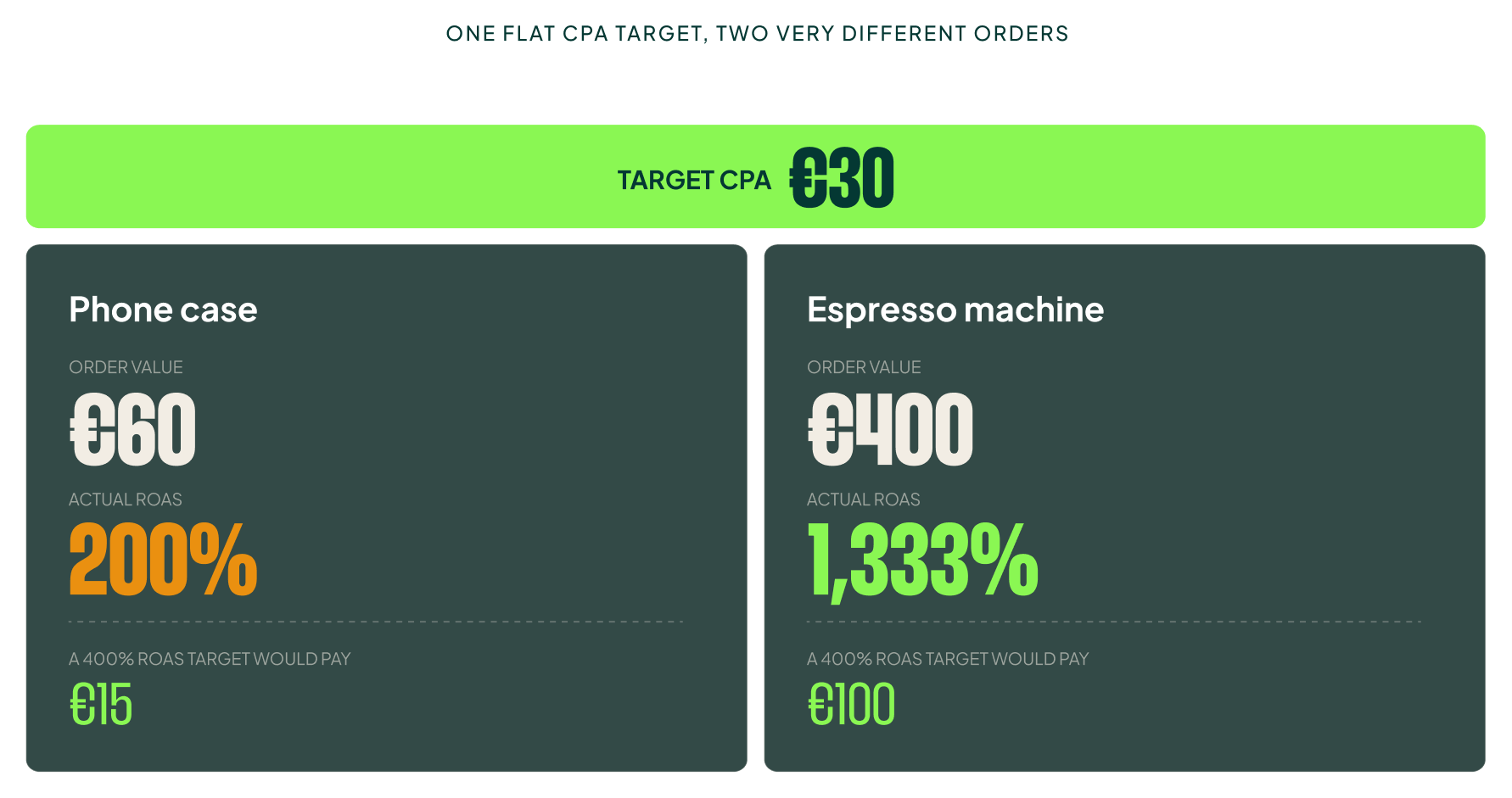
The problem with Target CPA for traditional e-commerce is exactly the thing that makes it simple: it ignores conversion value. A €20 order and a €400 order count the same. You’d constantly have to translate what a given CPA means in ROAS terms for each campaign, which is a lot of manual work to approximate something Target ROAS does natively. For a standard e-commerce store, Target ROAS is the better option.
I do still like Target CPA for:
- Simple conversion campaigns
- Any local business lead gen
- High AOV Search campaigns (to avoid the YoYo effect that large conversion values create)
- Subscription businesses
Target ROAS (S-Tier)
It won’t surprise anyone who follows my work that Target ROAS is my favorite bidding method. But it isn’t flawless, and I’ll get to its weaknesses in a moment.
It sits at the top because it automatically scales your spend up and down with demand, as long as you’re hitting your efficiency target. If five times as many people search for your product today as yesterday, Target ROAS is there with the same CPC as yesterday, ready to capture that surge. When demand or conversion rates drop, it lowers your CPCs to keep you at a profitable level. You ride the wave in both directions.
That’s why I’m comfortable saying that 90% of all e-commerce stores should run on Target ROAS.
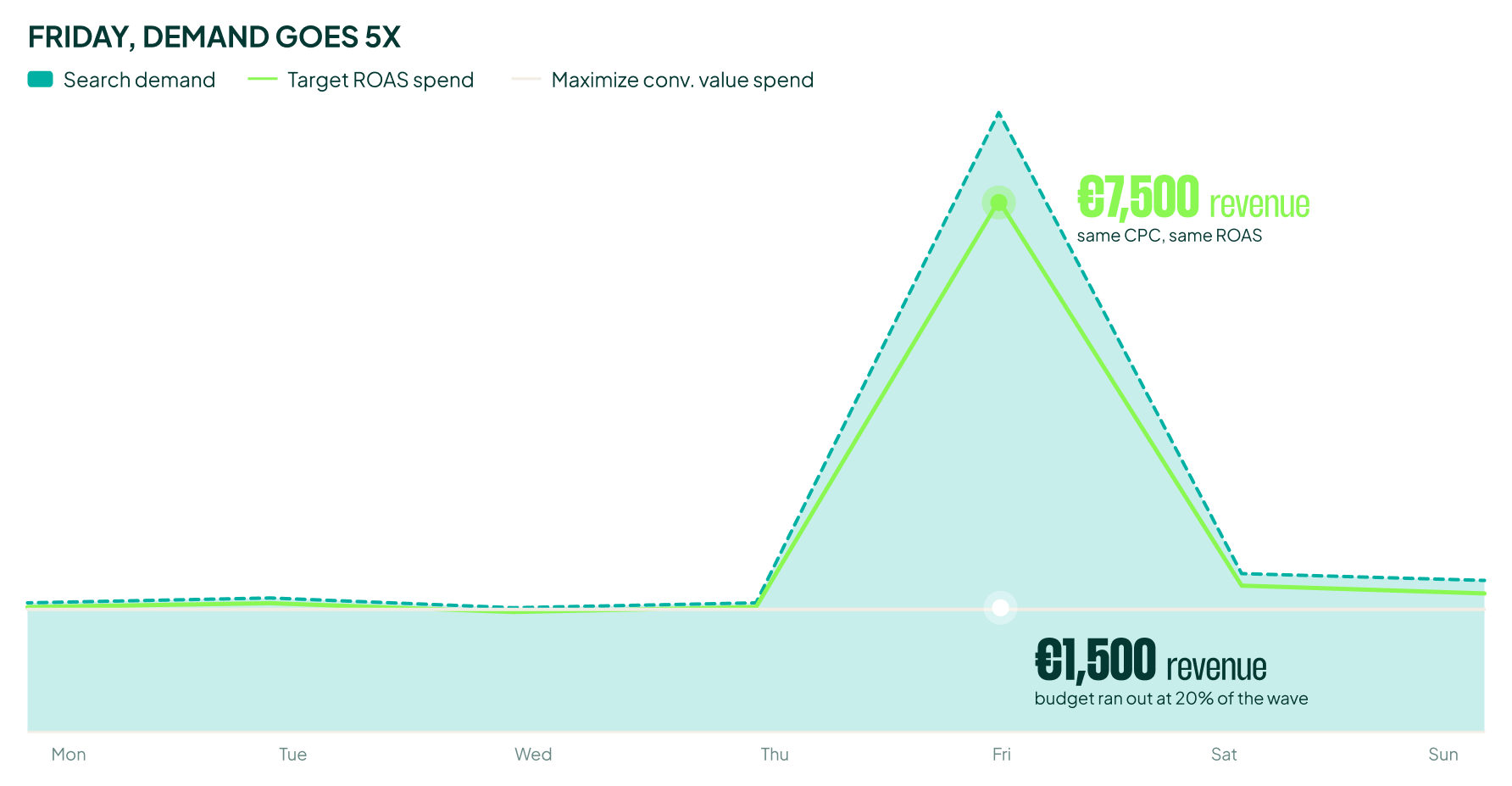
If you have any experience with Meta Ads, you know how different this is. On Meta, you constantly have to match your budget to the demand that exists. You can always spend whatever budget you set, but the results will swing wildly. Target ROAS removes that guesswork. You define the efficiency you need, and the algorithm figures out how much spend the market can support at that level.
The weaknesses are real, though.
Target ROAS requires more conversion volume than Target CPA. This is frequently misunderstood. You’re asking the algorithm to predict whether someone converts and also how much that conversion is worth. That’s a harder problem, and it needs more data to solve.
For lead gen, Target ROAS is highly sensitive to the value you assign per lead. If that value is wrong, every bid built on top of it is wrong. You need to be 100% certain it’s correct before you go down this road.
The most annoying weakness is what happens when you overperform. If your actual ROAS lands above your target, Smart Bidding reads that as a signal to spend more.
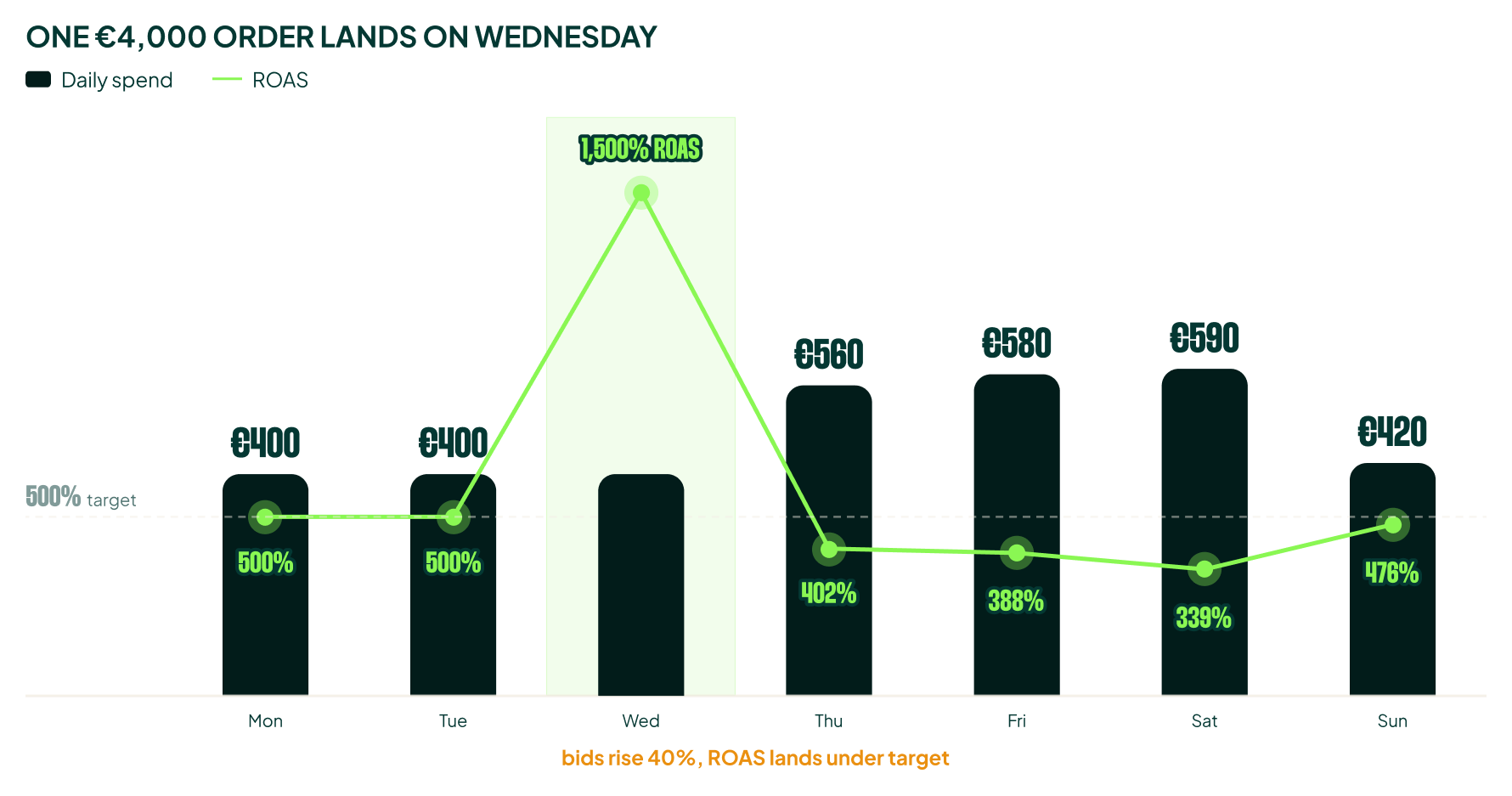
Anyone who has managed an account for a boss or a client knows this conversation. Performance was great last week, and now you’re overspending because Smart Bidding has decided to bid at levels that history tells us are unprofitable. You can live with it, but it’s a recurring headache.
High AOV accounts are especially exposed. A handful of large orders can suddenly push your ROAS well above target, which tells Smart Bidding to bid more aggressively, often right before performance normalizes again. The result is a constant up and down that I call the YoYo effect.
Even with all of that, the ability to automatically follow demand outweighs every one of these issues for the vast majority of e-commerce accounts.
Target Impression Share (C-Tier)
I fought against Target Impression Share for years. My view was simple: impression share should never be a metric you bid for. It’s a vanity metric dressed up as a strategy.
What changed my mind was building an automatic bidding system for brand campaigns at Savvy, for clients running many markets across Europe. As we were sketching it out, I realized we were essentially rebuilding Target Impression Share with max bid limits. That already exists. So we just used Target Impression Share.
That doesn’t mean I’ve made peace with how most people use it. My core issues are these:
- Most people don’t set a max bid limit. Without one, the algorithm will happily overbid on brand terms where you’d win the click for a fraction of the price.
- Most people set the target impression share too high.
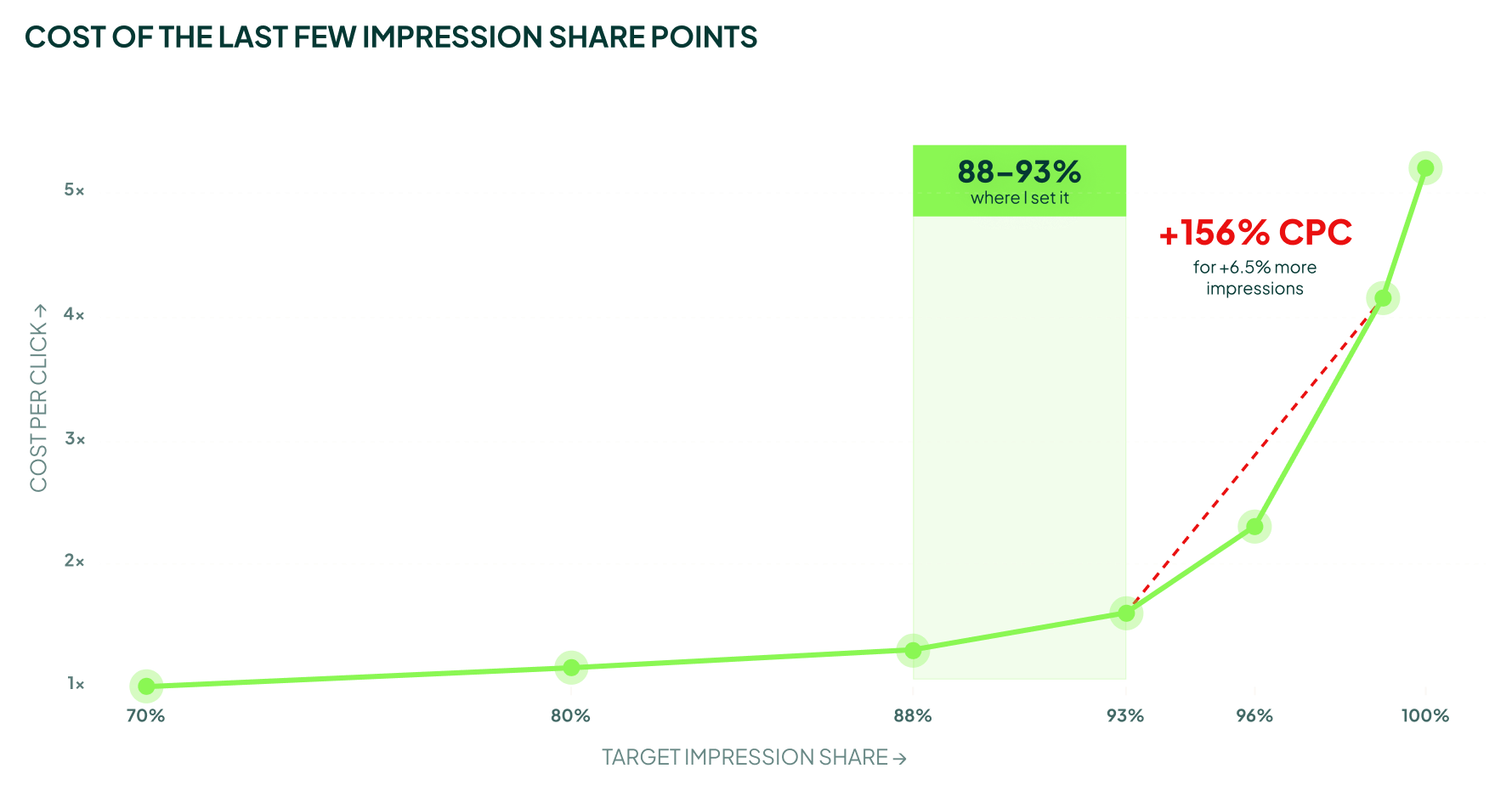
Combine no max bid limit with an overly aggressive target, and you end up paying 5-10x the necessary cost per click for the same number of clicks. That last few percent of impression share is disproportionately expensive, and on your own brand terms it rarely brings incremental value.
I like a target impression share of around 88-93%. Avoid those two loopholes, and Target Impression Share becomes a solid way to handle brand bidding without the overhead of managing it manually.
But never use it for anything else. If you work for a huge brand where impression share is a board-level KPI, so be it. Just recognize that you’re paying for visibility with no accountability for what that visibility returns.
The Decision Framework I Actually Use
So there’s the board. Target ROAS on top, Maximize Clicks at the bottom, and a lot of nuance in between.
The right bidding method still depends on your account. Being good at this job means knowing when to break the rules and which strategy fits which circumstances, rather than picking the most widely accepted strategy.
My defaults, by situation:
- Traditional e-commerce: Target ROAS. 90% of all stores should run on it.
- Limited by budget or a strict fixed monthly budget: Maximize Conversion Value, but only if I can’t get Target ROAS to pace the budget correctly.
- Lead gen without reliable conversion values: Target CPA. The same goes for local businesses and subscription businesses where first-order value is stable.
- High AOV Search campaigns: Target CPA over Target ROAS to avoid the YoYo effect that large conversion values create. Possibly even Maximize Conversions.
- Brand campaigns: Target Impression Share at 88-93%, but only with an aggressive max bid limit.
- Zero conversion data: Manual bidding is an acceptable starting point. Move to conversion-focused bidding as fast as you can.
- Under no circumstances: Maximize Clicks.
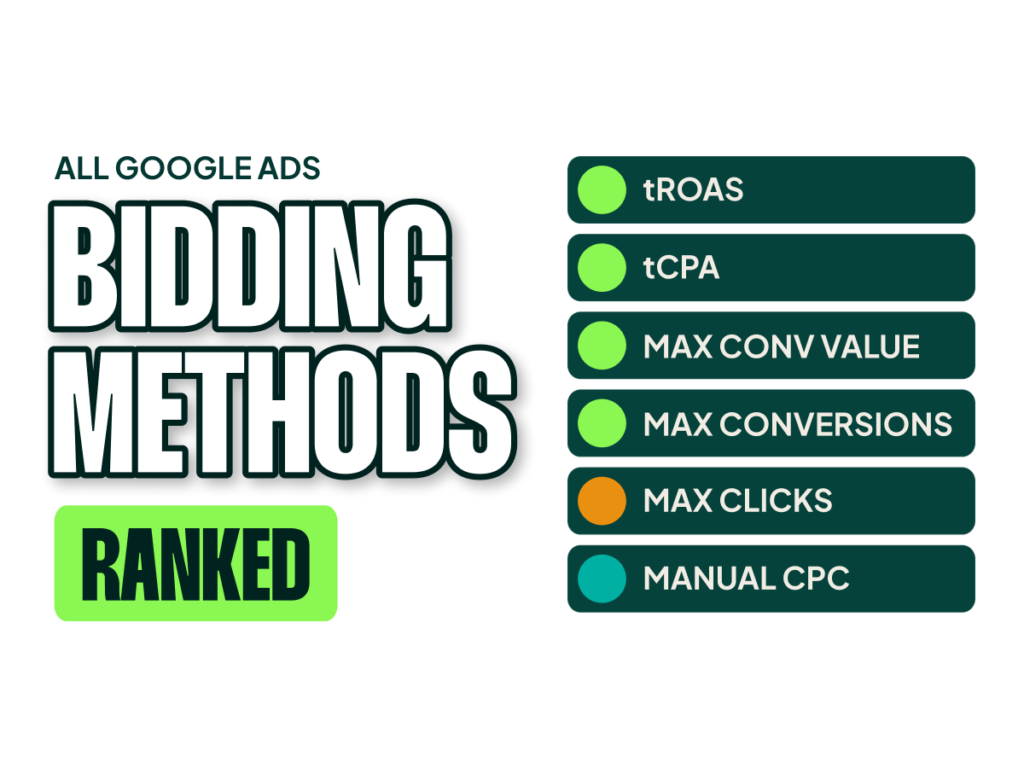
The Full Ranking at a Glance
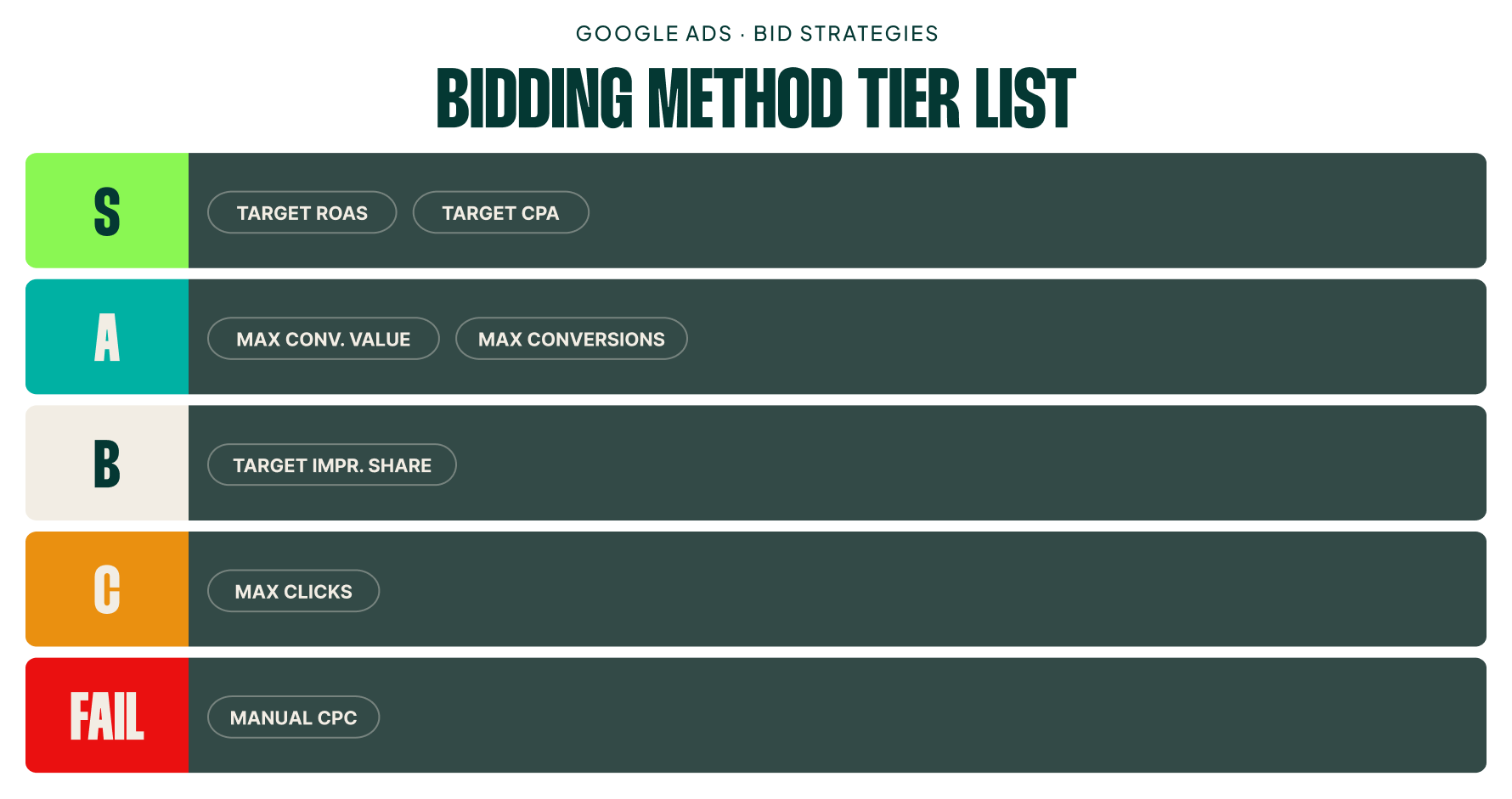
- S-tier: Target ROAS
- A-tier: Maximize Conversions and Maximize Conversion Value
- B-tier: Target CPA
- C-tier: Target Impression Share
- Fail: Manual CPC
- Fail: Maximize Clicks
Before you take that list and run with it, know that the ranking reflects how useful each method is for the average e-commerce account. Your account may not be average. So for each method, I’ll explain why it sits where it does, because that’s what tells you when to deviate.
Choosing the right bidding method is only half the job. The other half is reading what Smart Bidding is actually doing with it: why spend moved, and whether it’s reacting to real demand or to noise. Once the foundation is right, that’s where most of the remaining gains in an account come from.
[TL;DR]
- Target ROAS is S-tier and the right choice for roughly 90% of e-commerce stores, because it automatically scales spend with demand while protecting efficiency. Expect overspending when you overperform, especially with high AOV.
- Maximize Conversion Value is A-tier for fixed budgets and budget-limited campaigns. It avoids the death spiral, but it only maximizes value relative to your budget, so a wrong budget means wrong results.
- Target CPA is B-tier: ideal for lead gen, local businesses, subscriptions, and high AOV Search campaigns, but a poor fit for traditional e-commerce because it ignores conversion value.
- Target Impression Share is C-tier and only acceptable for brand campaigns, at 88-93% with an aggressive max bid limit. Without that limit, you’ll pay 5-10x the necessary CPC.
- Manual CPC and Maximize Clicks both fail. Manual bidding can’t adjust at the search term level and is a lost skill, while Maximize Clicks systematically buys the lowest-value traffic in the auction. Never use Maximize Clicks.