Dansk
Dansk
You’ve probably heard the argument that Performance Max needs your brand terms to learn about your audience and that removing them will kill performance. I’m going to show you why that’s a myth and explain the actual reason some accounts benefit from including brand terms.
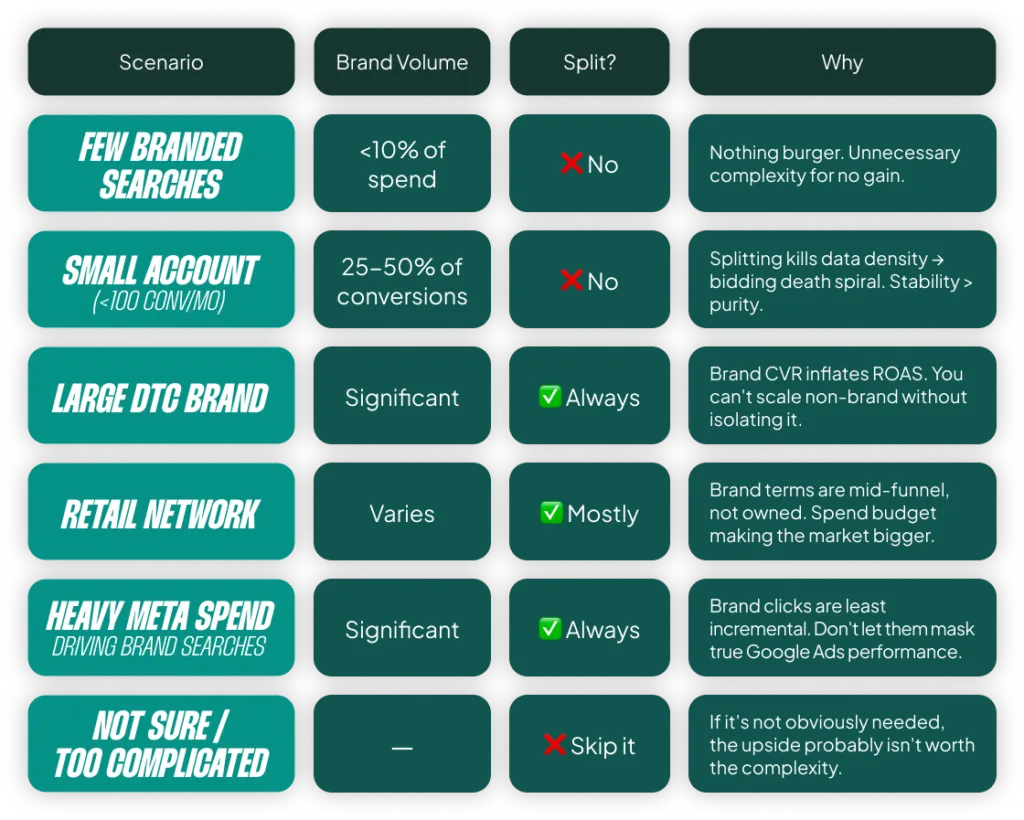
Here’s the thing: whether you should split your brand searches in Shopping or PMax campaigns isn’t a simple yes or no question. It depends entirely on your account. So, I built a simple framework we use at Savvy that tells us exactly when to split, when not to, and when it flat-out doesn’t matter. This is what I’m sharing with you today.
Later, I’ll open up five real client accounts that cover completely different scenarios so you can see how this plays out with actual data. But first, let’s make sure we agree on a couple of terms. A brand campaign targets your own brand name (the name of your store or product), not third-party brands you sell. A non-brand campaign is everything else. We’ll use the term mixed campaign when both are together.
The Myth of “Audience Learning”: Why PMax Doesn’t Need Your Brand Data
Before we get into the framework, let’s address the reason I haven’t included “PMax needs brand terms for learning” as a reason not to split. Because in my opinion, it’s a myth.
The argument goes something like this: PMax requires your brand terms to learn about your audience demographics in order to find profitable non-brand terms. In my experience, that’s just blatantly wrong. When it comes to Google Ads, intent trumps audience. The search intent dictates 80-98% of the conversion probability. Google Ads is a pull medium; no amount of audience data will make someone searching for “jewelry” buy a shoe.
Intent Trumps Audience (Almost) Every Time
Let me show you an example. This client has a lot of data, and we’ve added a bunch of different audiences to a campaign. As you can see, all the added audience segments get about 50% of the clicks.
Now, let’s look at the bidding report, specifically at the “Top signals.” This is where we see what signals Smart Bidding is actually using to steer the bidding. And here’s where it gets funny: there is zero overlap between the audiences we added to the campaign and the audiences that show up as top signals.
Does that mean audiences are completely irrelevant? No, not at all. But it does mean they don’t matter nearly as much as people think, especially when you have plenty of intent data from search terms. I still haven’t seen any real evidence that PMax requires branded data to learn about customers.
The Real Reason to Keep Brand Mixed: Bidding Stability
So, is there ever a good reason to keep brand terms in your PMax or Shopping campaigns? Yes, but it has nothing to do with audience learning. The only valid reason is bidding stability.
For small accounts (under 100 conversions per month), removing brand volume can cause a performance death spiral. If 50% of your 100 conversions come from stable, predictable branded terms, removing them increases volatility. A few bad days or weeks can cause Smart Bidding to drop bids too low, killing momentum. In these low-volume cases, keeping brand terms included creates a data baseline that helps the algorithm bid more efficiently.
This is a big difference from the argument that PMax “requires” brand data to learn. It’s about correlation, not causation. Keeping brand terms in can help performance in small accounts, but the reason why is stability, not audience discovery.
The Framework: 3 Reasons You SHOULD Split Your Brand Campaigns
With that myth out of the way, let’s get to the scenarios where splitting your brand and non-brand campaigns is almost always the right move. This typically applies if you’re a large DTC brand, drive a lot of traffic from other channels like Meta, or see a significant performance difference between brand and non-brand.
1. You Have a High Brand Conversion Rate (The Overbidding Trap)
If your brand terms convert significantly better than non-brand terms, a mixed campaign is likely wasting budget. Smart Bidding will see the high average conversion rate and overbid for branded clicks that you would have won for much less. We see this all the time.
In this account, the separated brand campaign has a conversion rate double that of the other campaigns and a POAS that is three to four times higher. I remember before we split it, CPCs on brand terms were closer to $1. Now, in its own campaign, the CPC is just 28 cents. By splitting it, we stopped Smart Bidding from throwing money away.
2. You’re Facing the Scaling Paradox
When you want to scale, the logical step is to lower your ROAS target. But in a mixed campaign, this can create a false negative about your growth potential. Smart Bidding might just use the extra budget to inflate your brand CPCs without actually generating any new non-brand volume. You end up paying more for the same customers, concluding that “scaling doesn’t work,” when the real issue is your campaign structure.
3. You Need True Customer Acquisition Clarity
Splitting your campaigns gives you clean data. It allows you to set aggressive goals for your non-brand campaigns to acquire new customers while protecting the efficiency of your brand spend. You can’t properly optimize for new customer acquisition if your data is being distorted by high-intent, existing customers searching for your name.
When NOT to Split: 3 Scenarios Where It’s a Bad Idea
Splitting isn’t always the answer. In some cases, it can create more problems than it solves.
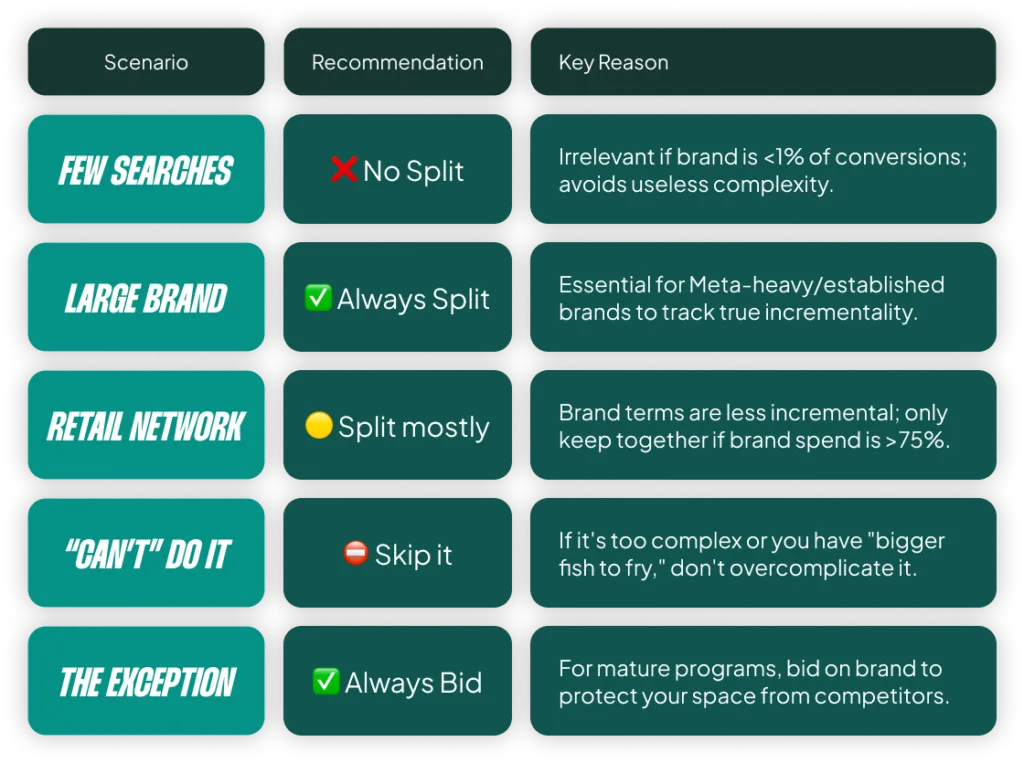
1. You Have Very Few Brand Searches (<10% of Spend)
This is the most common scenario for retailers who sell many different brands. People are searching for the product categories or third-party brands you sell, not your store name. If brand searches account for less than 10% of your spend, this whole discussion is a big nothing burger. The volume just isn’t there to make a real impact.
Look at this account. In the last 30 days, searches for our client’s brand name in Shopping accounted for $35,000 out of a $2.6 million total spend. It’s simply not relevant. The brand term converts at almost the same rate as the account average, so there’s no data distortion to worry about.
2. You Have a Large Retail Network
When you have resellers competing on your brand terms, your brand name stops being a pure bottom-funnel keyword. It becomes a mid-funnel keyword where customers are comparing options. The search term “Nike” is not a pure brand term for Nike.com anymore; it’s a competitive, mid-funnel search where they have to compete with Foot Locker, Dick’s Sporting Goods, and others.
3. You Have a Small Account with Low Conversion Density
This goes back to our bidding stability point. If brand terms make up 25-50% of your total conversions, splitting can starve your non-brand PMax or Shopping campaigns of the data they need to function. The risk of triggering a performance death spiral outweighs the benefits of data purity. Stability is better than perfect data if it leads to better overall performance.
How to Correctly Set Up a Brand/Non-Brand Split
If you do decide to split, setting it up correctly is critical. Most people get this wrong.
Search Campaigns: The Easy Part
This is simple. Create a dedicated Search campaign for your brand terms. Then, add your brand terms as negative keywords to all your non-brand Search campaigns to prevent overlap.
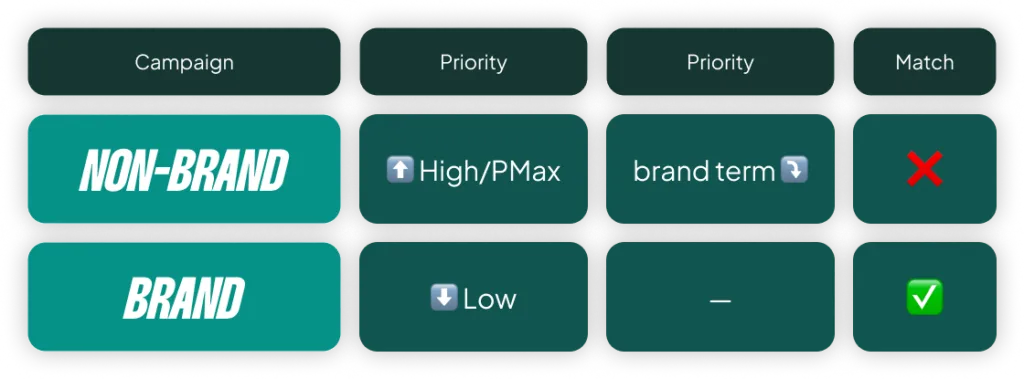
Shopping & PMax: It’s All About Campaign Priority
For Shopping, the approach is different and non-intuitive. Here’s the correct setup:
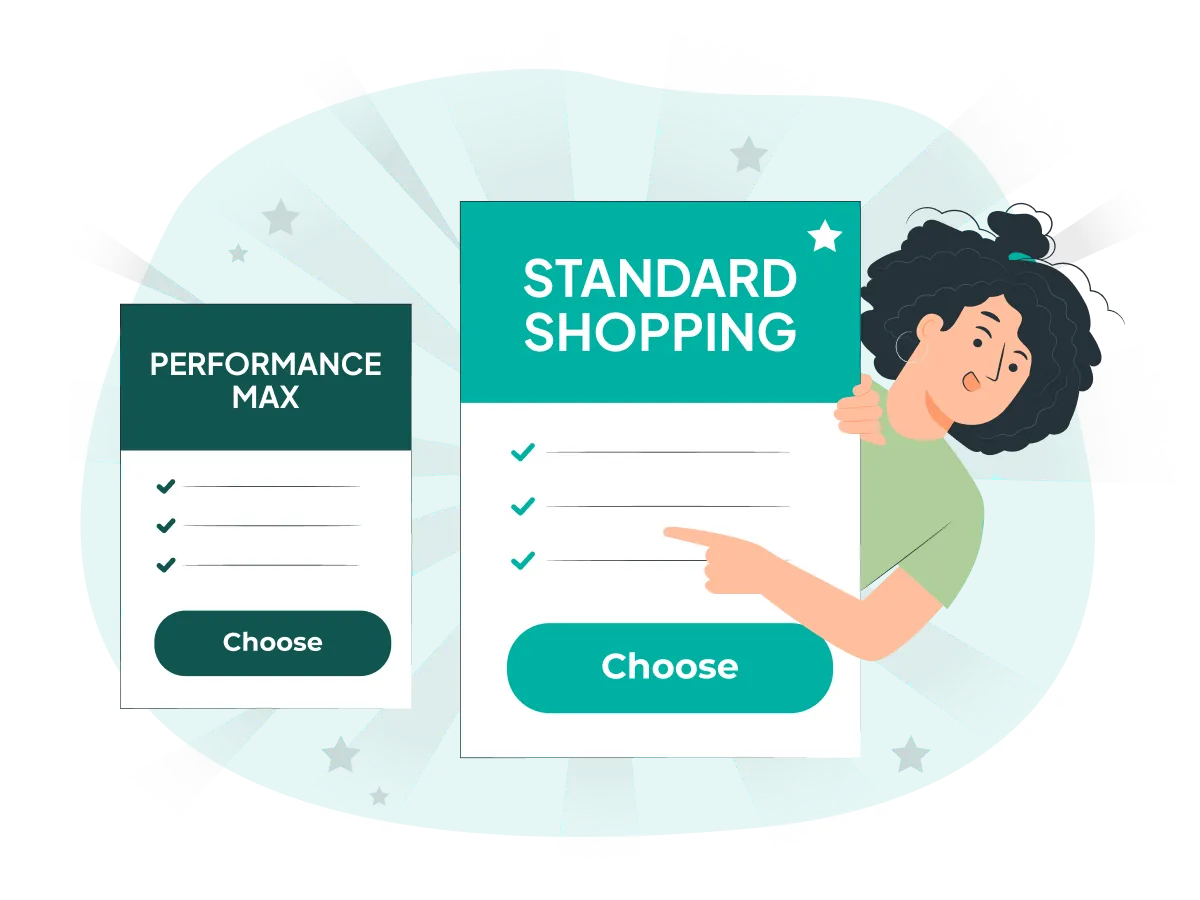
- Non-Brand Campaign: This can be PMax or a Standard Shopping campaign. If it’s Standard Shopping, set the priority to High. Add your brand terms as negative keywords.
- Brand Campaign: This MUST be a Standard Shopping campaign with a lower priority (Medium or Low).
Because the non-brand campaign has a higher priority and negative keywords, it will ignore brand searches. Those searches then “fall down” to the lower-priority brand campaign to be picked up. Most people get this backward, set the brand campaign to High priority, and wonder why it keeps pulling in non-brand traffic.
If you have a script running to clean generic terms out of your brand campaign, it’s almost always because your priority settings are wrong. We see new specialists at Savvy make this same mistake. Their mouths drop when I show them you should never need a script to keep your campaigns clean if the structure is correct.
My Final Take: When in Doubt, Keep It Simple
At the end of the day, the question isn’t “should I split brand into different campaigns?” The real question you should ask is: “Does my brand volume actually distort my data?”
If it does, split it. If it doesn’t, move on. There are bigger fish to fry.
If you’re in doubt or this feels too complicated, it’s probably not needed. The potential upside isn’t worth the added complexity. In fact, I see more advertisers go wrong by including brand in a mixed campaign and failing to realize their spend isn’t incremental than advertisers who mess up by excluding brand terms entirely. If you’re not sure, it’s often safer to just exclude your brand from PMax and Shopping altogether and focus on true non-brand growth.
[TL;DR]
- The idea that PMax “needs” brand data for audience learning is a myth. The real reason to keep brand mixed in small accounts is for bidding stability, not audience discovery.
- You SHOULD split if you are a large brand, have a high brand conversion rate that skews your data, or need clear new customer acquisition metrics.
- You should NOT split if you have very few brand searches (<10% of spend), have a large retail network competing on your brand term, or have a small account where splitting would starve the algorithm of conversion data.
- To split correctly in Shopping, use a High Priority non-brand campaign with negative keywords and a Low Priority Standard Shopping campaign for brand.
- The core question is: Does my brand volume distort my data? If not, there are bigger levers to pull in your account.