Dansk
Dansk
I don’t think AI is going to replace marketers. I think marketers who use AI carelessly are going to get replaced, and it will happen much faster than anyone expects.
I see it in audits. I see it in the teams we coach. I see it internally at Savvy, where I’ve had to call out the behaviour more than once (and yes, I’ve been guilty of some of it myself).
The pattern is always the same: the tool is excellent, the output looks polished, and somewhere along the way the human stopped being accountable for the work.
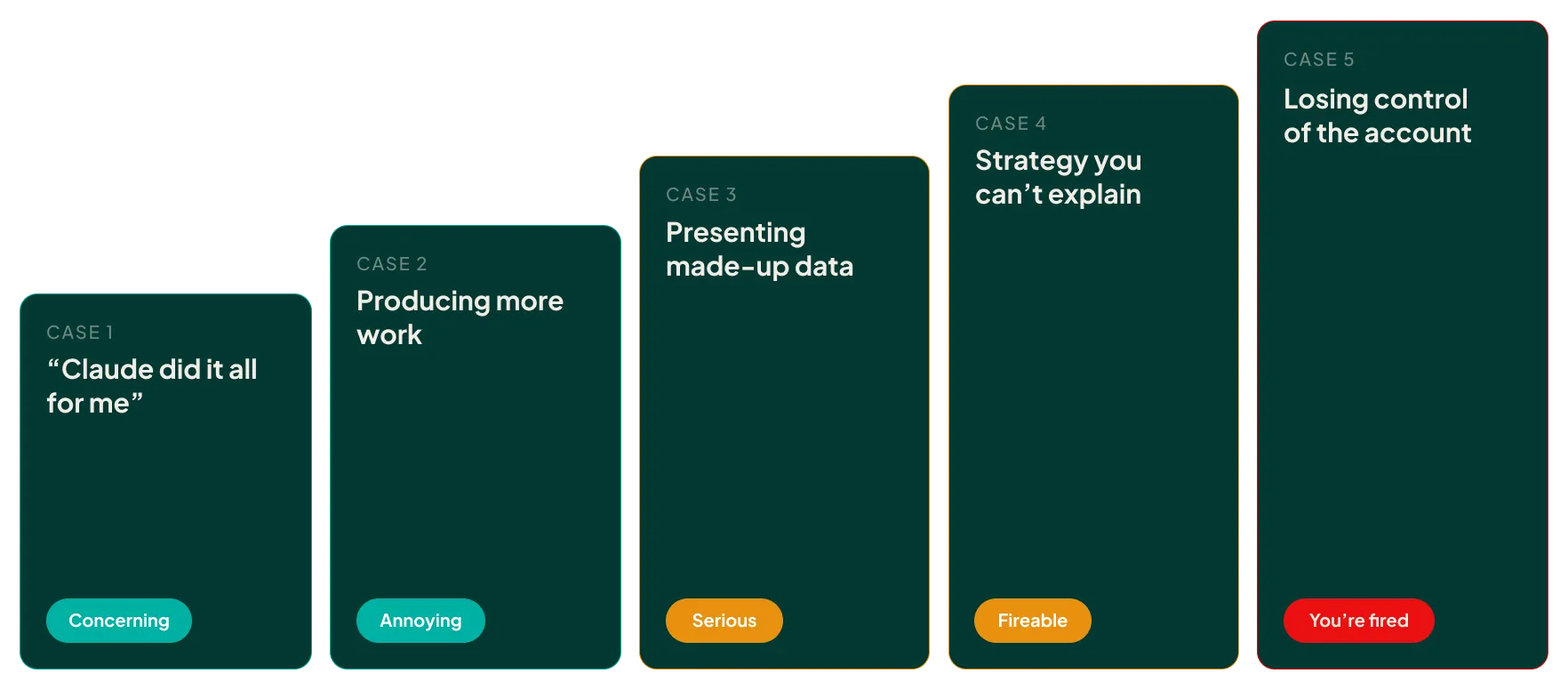
Below are the five ways I expect marketers to lose their jobs because of Claude, ordered from “mildly concerning” to “you’re fired.” At the end I’ll give you the rules that keep you on the right side of that line. Because the biggest mistake isn’t using AI badly. It’s not using it at all.
Mistake 1: You Give Claude All The Credit
This one is easy to fall into because nobody does it on purpose. You’re excited about what the tool can do, so when you present the work, you spend half the time talking about how it was made instead of what it means.
“Claude just did it all. It’s amazing. I can’t believe it.”
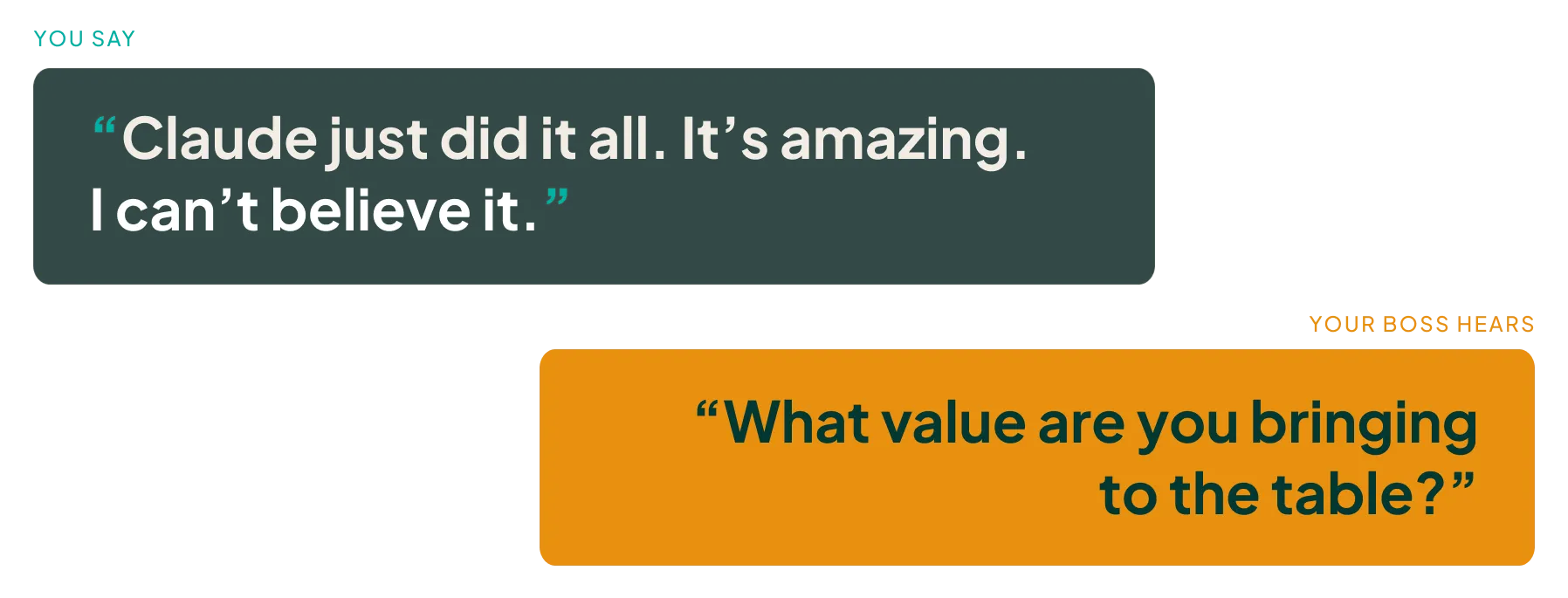
What your boss hears is: “So what exactly are you bringing to the table?”
There’s still a stigma attached to AI-generated work. Fair or not, if your boss believes the entire deliverable came from Claude, they think less of you. If they believe you delivered faster and more accurately because you used Claude, they think more of you. Same work, completely different perception. Atlassian ran a survey showing 94% of knowledge workers used AI in the last month, while being open about using it actively hurt how the work was perceived.
Years ago I argued that Google Ads managers should stop talking about Smart Bidding in the third person. Stop saying “Smart Bidding decided to do this.” Treat it as part of your team and talk about what you and Smart Bidding achieved together. The same principle applies here.
I use Claude Cowork constantly for crunching data, visualising data and finalising presentations. But there is one step I never hand over: reading the data and drawing the conclusions.
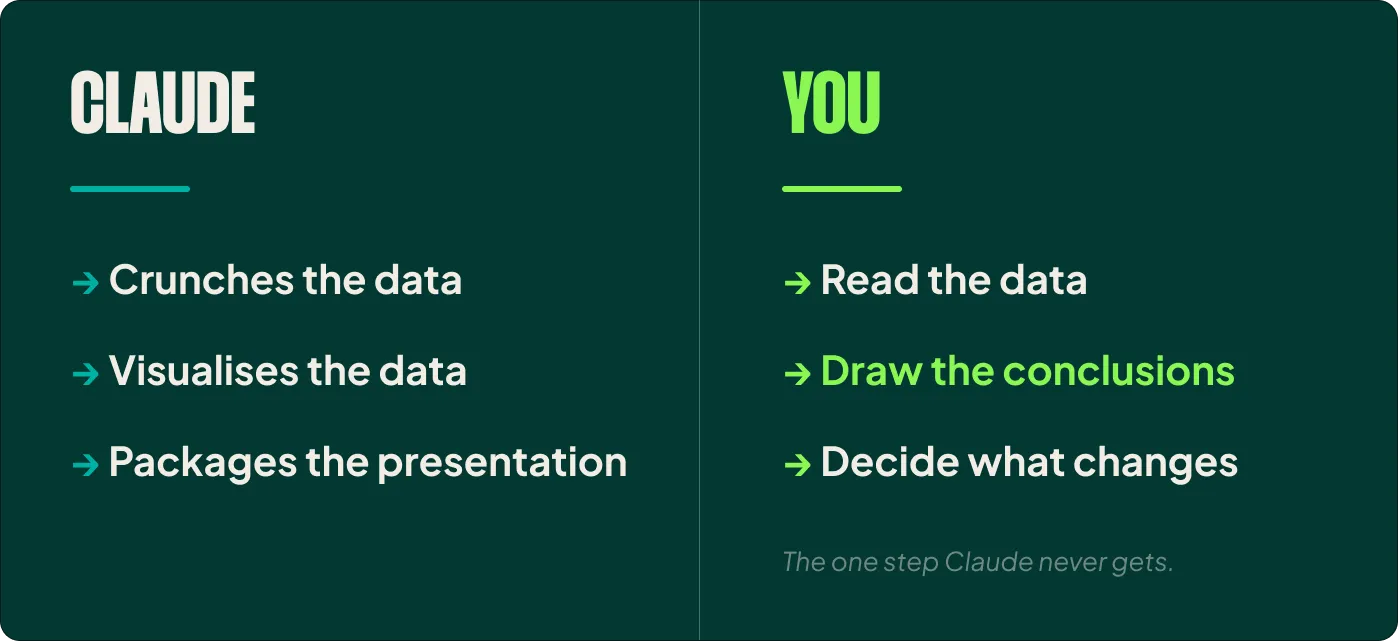
Unless the question is trivial, don’t even let it try. If Claude gives you a conclusion and you then have to decide whether it’s right or wrong, you will lean towards accepting it. It’s the inverse of blank page syndrome. Something is already on the page, and now you have to spend energy disproving it instead of thinking freely. It blocks you from seeing the other conclusions sitting in the same data. Your brain takes the cheap route.
And if you’re not experienced in the subject, you won’t spot a wrong conclusion at all. Claude is persuasive. We all know this.
Let Claude package the takeaways with the right visualisations. Tell your boss how you used it. But don’t let a tool that saved you 75% of the grunt work walk away with 100% of the credit for your judgment.
Performance review: The work may be good. You just communicated your contribution badly. Concerning, but not fireable.
Mistake 2: You Use Claude To Produce More Work
Watch this part (3:59) (opens in a new tab)Ever since somebody automated the process of pulling a search term and adding it as a keyword, we’ve known that doing more in Google Ads is not the same as doing better in Google Ads.
We deal with this every time we hire at Savvy. We bring in PPC specialists who have been juggling 20 to 100 accounts and give them 2 to 4. Their first instinct is to finally do all the things they never had time for: more ad extensions, deeper search term analysis, breaking campaigns apart, more granularity. It’s almost never the right move.
The better move is the opposite direction. Go up, not down. Spend the time on strategy, on the product assortment, on the marketing plan, on how consumers actually behave in that specific industry.
Claude makes this trap significantly worse, because you can now produce far more than any human can reasonably consume. Someone gets Claude Cowork to generate a 40-page report, exports it as a PDF, sends it around. The recipient then uses Claude to condense the PDF back down.
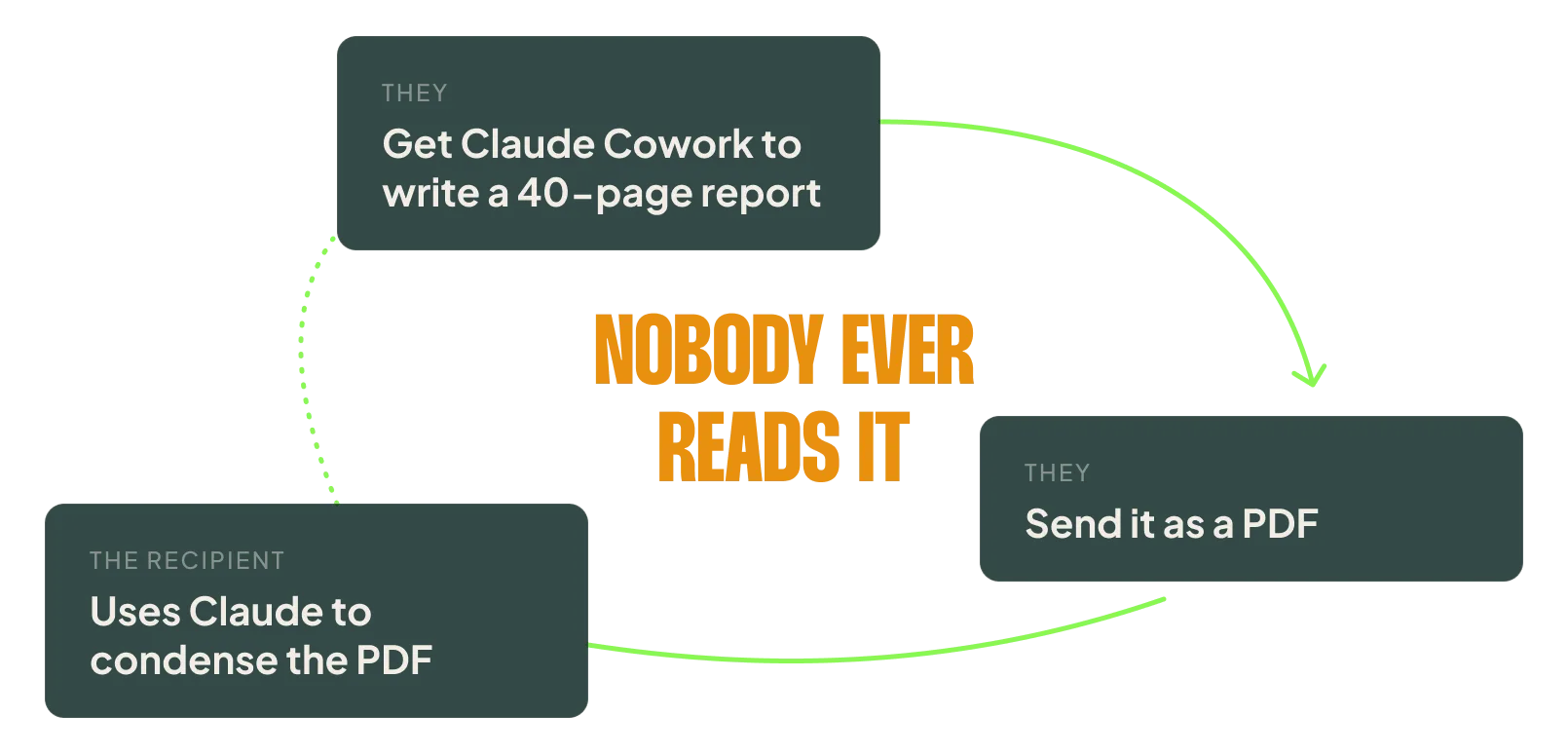
It’s just so dumb.
I’ve been very active (read: annoying) about rejecting this behaviour internally, but I see it everywhere. In our own team, with clients, in the teams we coach.
A recent example: I ran an audit report that was full of good information. Most of it was accurate. Most of it was completely irrelevant to the person I was presenting to. The fix was to pull out the individual charts that supported the specific points I was making, rather than dumping the whole report on the client.
The biggest adjustment was stripping out anything without an actionable takeaway. We had roughly the same performance across most categories. Technically that’s a finding. Realistically it’s a footnote. But the natural inclination is to keep it, because the analysis is already sitting there and it cost you nothing.
With most reports Claude Cowork produces, you should cut 80% of the insights. They sound good. They probably are good. They’re irrelevant to the point you’re making.
Everyone can tell when something is off. The dangerous part is that they usually can’t articulate why. A long, unprioritised report creates exactly that feeling, and it doubles when there are obvious AI telltales in there, like the endless “not this, but that” phrasing.
Claude should make your work easier to understand, not create more content for someone else to process. Distillation is your job. Handing over a long report used to be a signal of effort. Now it’s a signal of poor judgement.
Performance review: Not immediately fireable, but do it often enough and your boss will get progressively more annoyed with you.
Mistake 3: You Present Something That Never Happened
Watch this part (8:09) (opens in a new tab)You’ve either done this or come close. You ask Claude for something. It delivers. It looks good. You send it on. The reply comes back: “Ehm, what happened here?” You go back, check properly, and sure enough, parts of it are invented.
This happens less than it used to, but it still happens. I had a case the other day.
I was preparing Auction Insights trends showing how TEMU had dropped out of our auctions. I gave Claude the data and a solid prompt. The output looked great. I was tired and about to send it without a real review, but I checked in depth anyway, because that’s what I tell my team to do.
The data I supplied showed TEMU at 40% impression share in January and 12% in July.
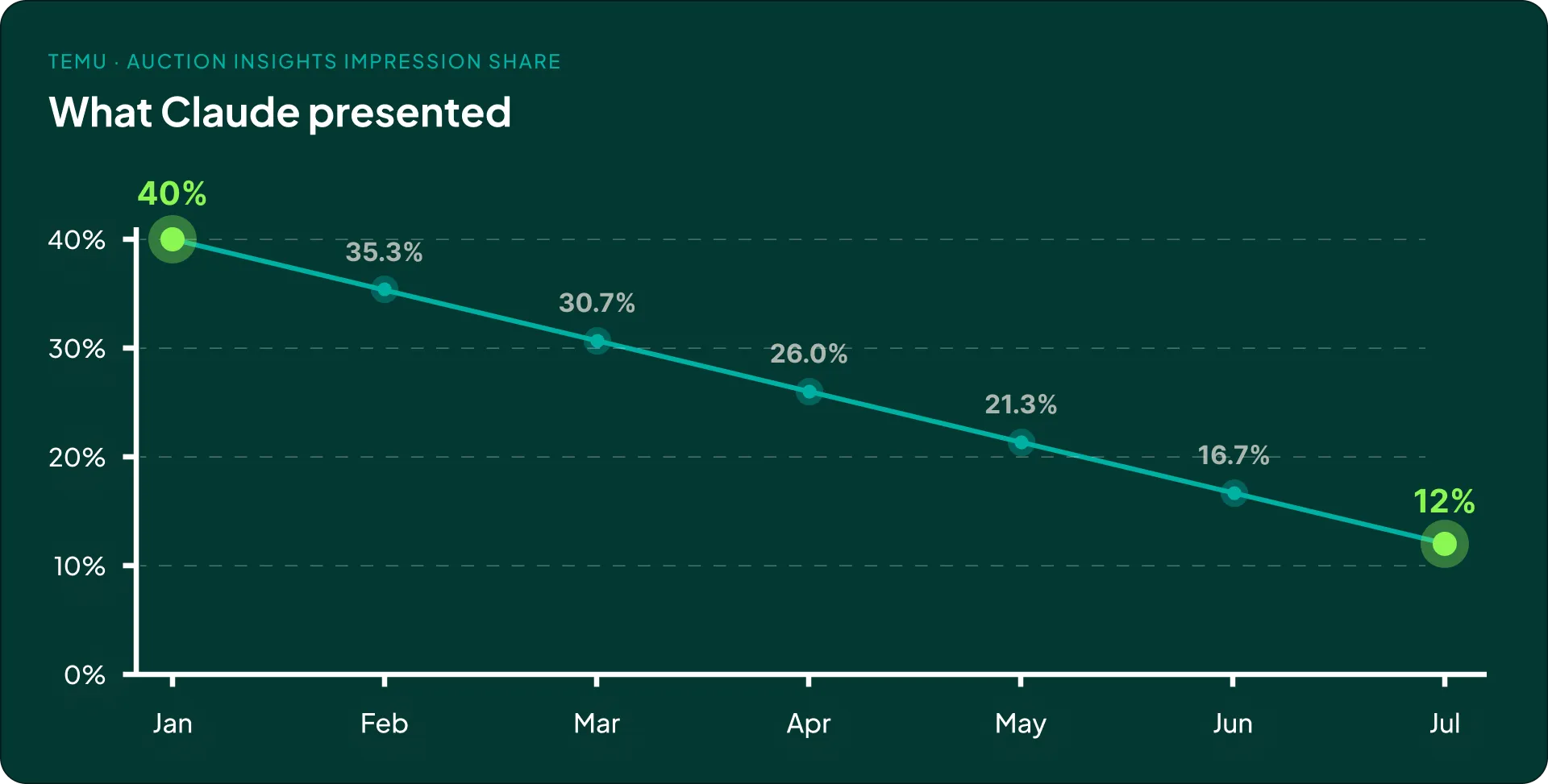
Claude had no data for the months in between. So it invented a smooth, steady monthly decline connecting the two points.
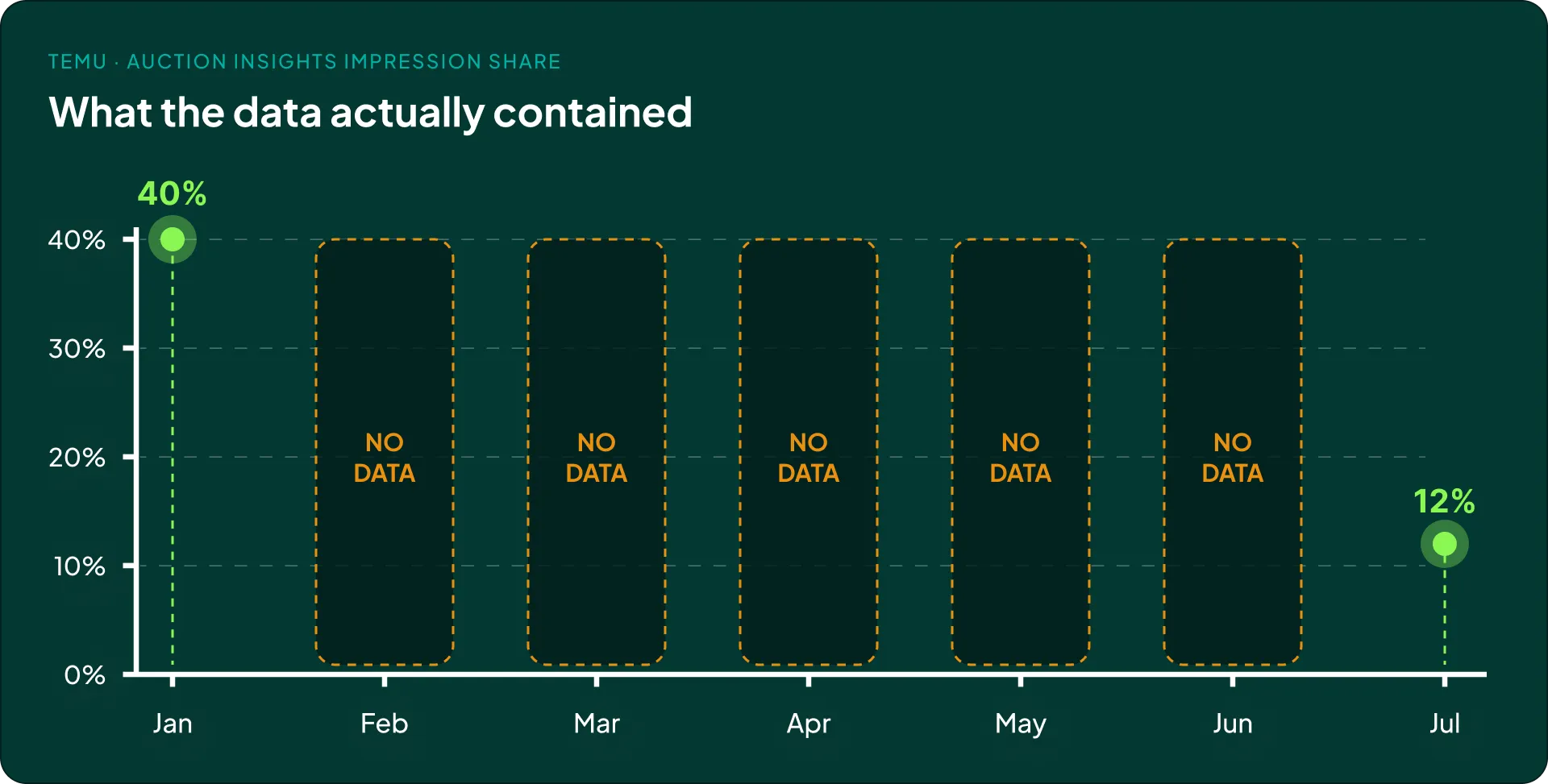
January was correct. July was correct. The entire story between them was fabricated. And it happened to be wrong, because the client already knew from Google’s own slides that TEMU had dropped out aggressively in June, not gradually across six months.
The failure mode here is how you reviewed it. When you check Claude’s output, you scan. Does the chart look clean? Do the numbers seem plausible? Does the conclusion match what I already believe? You’re confirming, not verifying.
Play devil’s advocate on everything you present. Trace the numbers back to the source. Find the mistakes, fix them, then send it.
Performance review: Serious offense. If your boss or client can’t trust that you even looked at the data before sending it, what are you contributing to the chain? You’ve just added a step where they have to verify your work.
Mistake 4: You Implement A Strategy You Can’t Explain
Watch this part (10:12) (opens in a new tab)This is the number one reason I’m confident we’ll see agencies and in-house marketers fired over AI: people are letting Claude make decisions with far too little oversight.
I’m already seeing it in audits. Marketers who are slightly too green in Google Ads becoming very confident about strategies they didn’t come up with and don’t actually understand.
One client’s team had been using Keyword Planner forecasts to decide how much to spend each month. In theory it made sense. They ran it for about a year and the strategy appeared to work.
Then Keyword Planner forecasted a market downturn and everyone panicked. Nobody could argue the data was wrong, because they’d been relying on it for twelve months and it had technically delivered. Nobody could tell the CEO to relax. Meanwhile the actual traffic in the following months didn’t decrease at all.
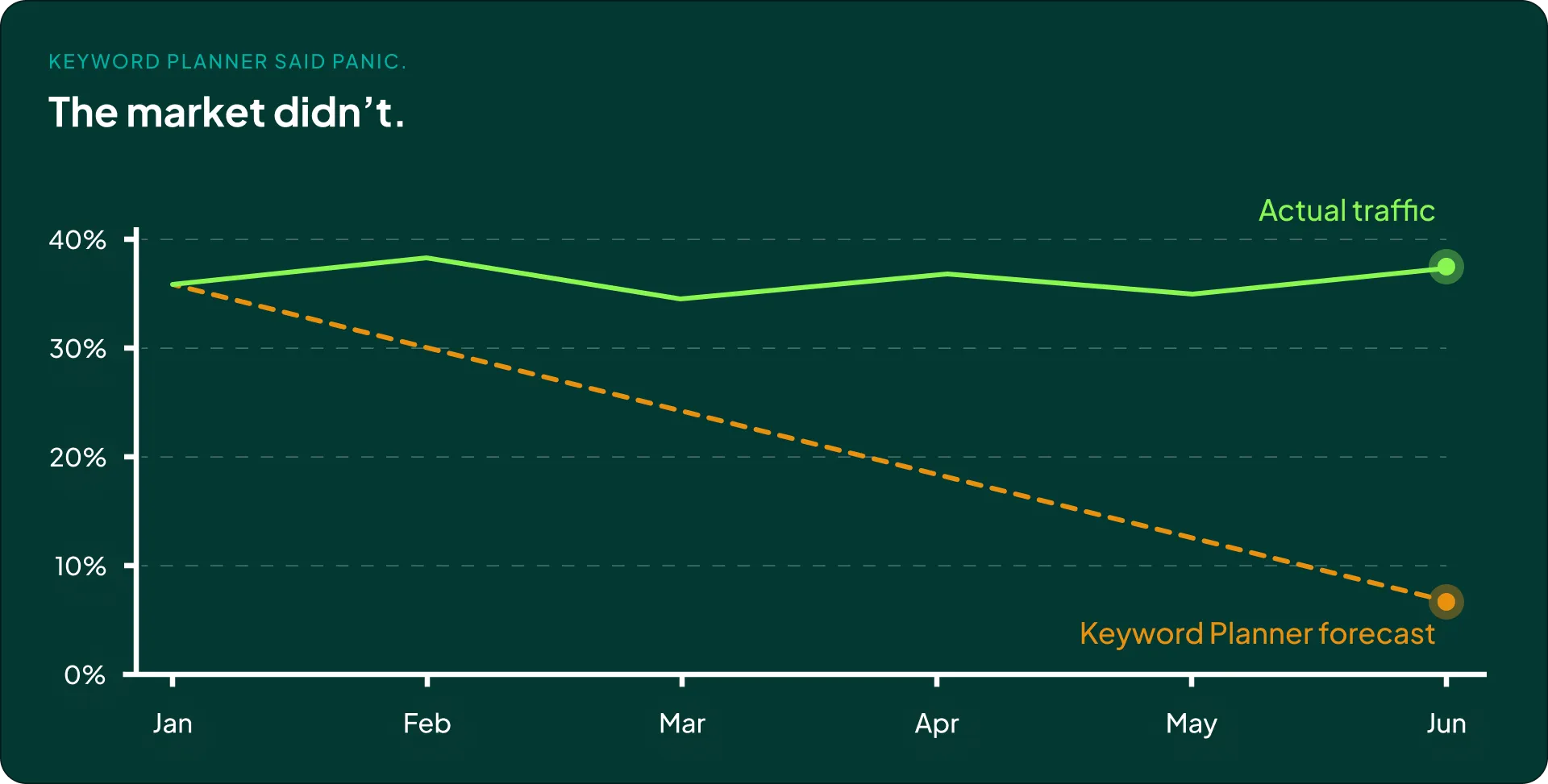
By the time I was pulled in, an in-house team and another agency had spent weeks building narratives about AI Mode taking market share to explain the forecast.
The actual answer was much simpler: Keyword Planner can’t be used for forecasting.
Their strategy worked because the forecasts gave them a reason to stop spending the same flat amount every month and start reallocating budget towards seasonal highs and lows. The forecast correlated with their success for a year, so they treated it as the cause. They would have gotten the same result (without the false red alert) by forecasting off their own historical performance.
That’s the exact failure pattern Claude accelerates.
I know, because I watch our own people flirt with it. When someone gets busy, the temptation is to have Claude propose a strategy for a problem. We’re lucky: we have skilled people who call BS when they see it, and a culture where that’s welcome. If you’re sitting alone, there’s no one to call BS. The strategy sounds coherent enough that you implement it without ever building your own argument for why it should work.
Then performance drops and your boss asks why you chose that approach. “Claude suggested it” is not an answer. If you can’t walk through why it should work, trust is gone.
Performance review: Fireable. You own the strategy you implement, even when Claude wrote it.
Mistake 5: You Lose Control Of The Account
Watch this part (13:43) (opens in a new tab)I’m untangling this one in audits already, and it’s going to get much worse.
Not all automation is bad. The problem starts when there are so many moving parts that you no longer know how one thing affects another.
I expect it to happen in three places: scripts, bid automations and campaign buildouts.
Most Google Ads managers never went deep on scripts and automation because the barrier to entry was high. You had to code. That barrier is gone. You can build a script in a few minutes with Claude Code. You can execute actions through a Google Ads MCP in Claude Cowork. You can hand Claude a plan (yours or its own) and it will run it.
Those of us who’ve been around a while learned automation layering the hard way. Yup, I’m that old. We built our own bidding rules back when you had campaign bids, ad group bids and keyword bids, then mobile, desktop and tablet adjustments on top, then audience adjustments on top of those, then location adjustments on top of those. Nobody knew what the heck was actually happening to a bid.
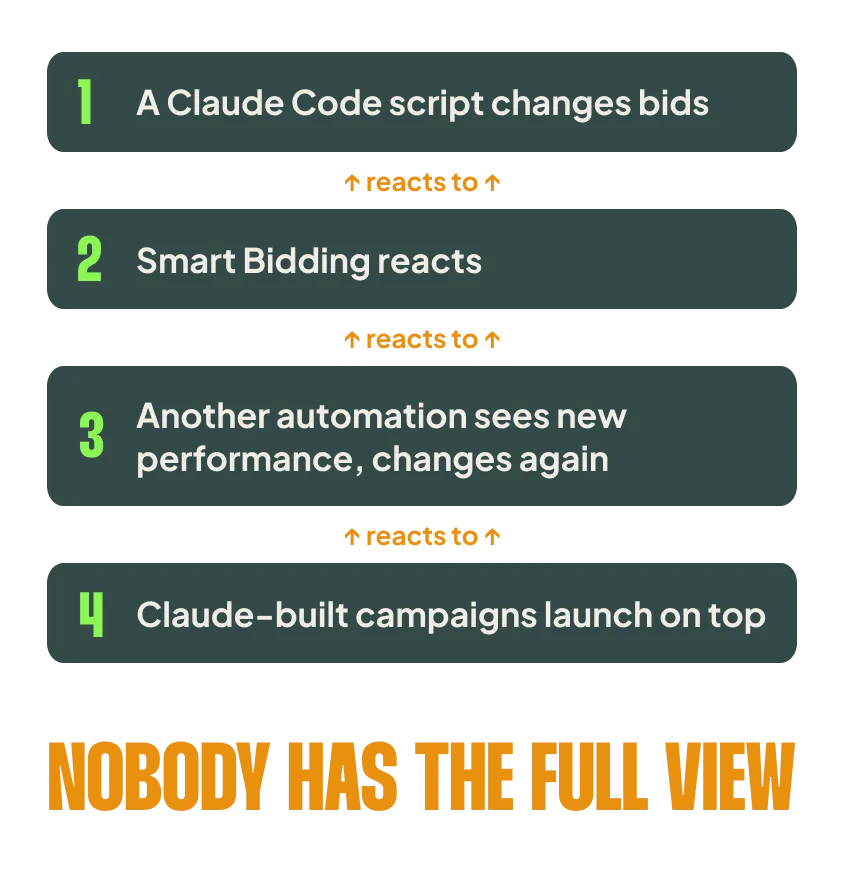
The same thing is coming. A Claude Code script changes something. The bid automation reacts to the change. A second automation sees the new performance and changes something else. Layer Claude-driven campaign buildouts on top, and nobody has a full picture of what is controlling the account.
Most Google Ads managers don’t have a programming background or a natural inclination for the systems thinking required to keep complex automation stacks coherent, which is where performance quietly falls apart.
None of this means you shouldn’t automate. It means you should apply 80/20 ruthlessly and build the few automations that deliver most of the gain, then know exactly what each one does and how to reverse it.
Performance review: You’re fired. Performance will drift downward over months and you won’t have an explanation, because you’ll never suspect your own brilliant automation. Eventually a third party gets hired to analyse it, and they’ll spot within hours that the decline started the week your automation stack went live.
How To Use Claude Without Getting Fired
Watch this part (16:19) (opens in a new tab)The rules are not complicated.
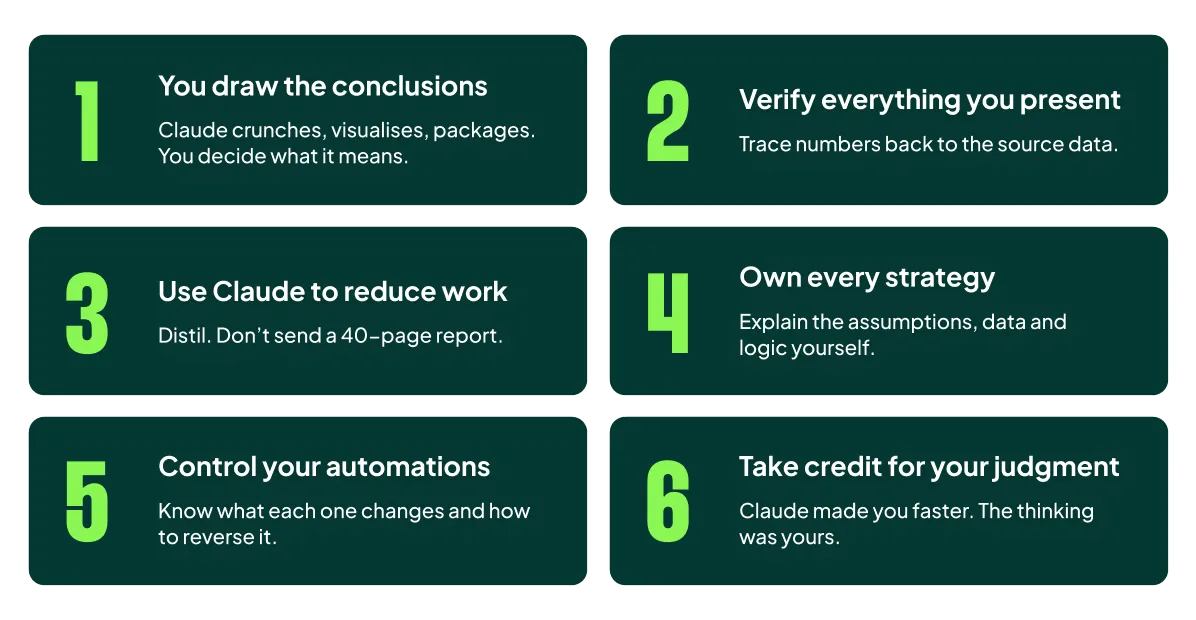
- You draw the conclusions. Use Claude to crunch the data, visualise it and package the presentation. You decide what the data means and what changes in the account.
- Verify everything you present. Trace numbers back to the source data. Review the actual work instead of scanning whether it looks right.
- Use Claude to reduce work, not create it. Don’t send a 40-page report just because Cowork could generate one. Distil it down to the few insights that should change someone’s behaviour.
- Own every strategy you implement. You need to explain the assumptions, the data and the logic without ever saying “Claude suggested it.”
- Control your automations. Know what each one changes, how it interacts with the rest of the account, and how to reverse it.
- Take credit for your judgment. Tell people how Claude helped you move faster. Make it obvious which part required your experience.
The biggest mistake you can make with AI is not using it at all. In a year or two, you’ll be fired for that instead. Someone else will use Claude, Claude Cowork and Claude Code to strip 75% of the grunt work out of their week while you’re still doing it by hand. They’ll have more time for strategy, they’ll understand the client better, and they’ll move faster than you.
Use Claude aggressively. Keep the judgment, the accountability and the control with you.
[TL;DR]
- What gets marketers fired is handing over judgment, verification and accountability to Claude.
- Never let Claude draw the conclusions. Use it to crunch, visualise and package data, then do the thinking yourself, because once a conclusion is on the page your brain will default to accepting it.
- Verify before you present. I caught Claude inventing six months of Auction Insights data between two correct data points. Scanning is not reviewing.
- More output is not better output. Cut 80% of the insights in a Claude-generated report and keep only what changes a decision.
- Own your strategy and your automations. “Claude suggested it” is not an explanation, and layered automation nobody understands will quietly erode performance for months.
- The bigger risk is not using AI at all. Use it aggressively, but keep the judgment and the accountability with you.