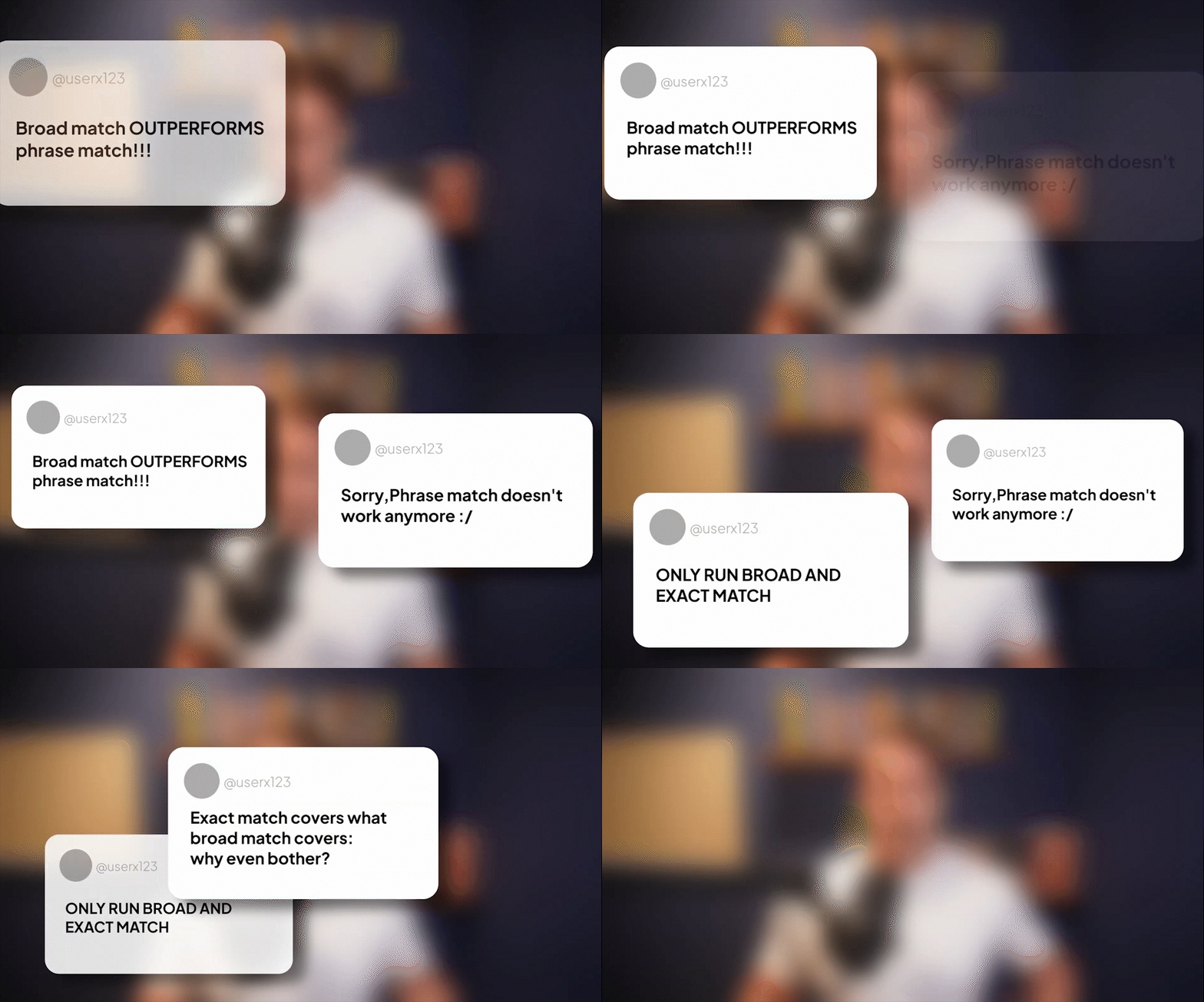
Lately, I’ve been hearing a lot of comments that go against everything we’ve tested this year at SavvyRevenue: “Broad match outperforms phrase match,” “Phrase match doesn’t work anymore,” “You should only run broad and exact.”
It’s an interesting narrative. But whenever we run a direct broad match versus phrase match test, two things consistently happen. First, broad match drives a higher volume at a lower ROAS. Second, broad match creeps into our phrase and exact match search terms, completely invalidating the idea that it’s generating truly new volume.
Now, that first point—more volume at a lower ROAS—isn’t a flaw. I consider that a feature. It’s a lever you can pull. The second point, however, highlights a much bigger problem with how we all evaluate performance, and it’s why this entire debate is so hard to settle.
Go Beyond the Article
Why the Video is Better:
- See real examples from actual client accounts
- Get deeper insights that can’t fit in written format
- Learn advanced strategies for complex situations
The Big Problem: Your Broad Match Data is Lying to You
The whole issue boils down to one thing: figuring out how broad match is *actually* performing. The obvious approach, which I’ve done myself, is to pull all your broad match keywords and compare the numbers to your phrase and exact match keywords. You might see a report where broad match performance looks decent, maybe even edging out phrase match on ROAS.

This is where most of the “broad match is better” conversations begin. But the data is misleading.
Keyword Match Type vs. Search Term Match Type
The problem is that the report I just described is a keyword match type report, not a search term match type report. A broad match keyword can, and frequently does, match with an exact match search term. This sounds crazy, but it happens all the time.
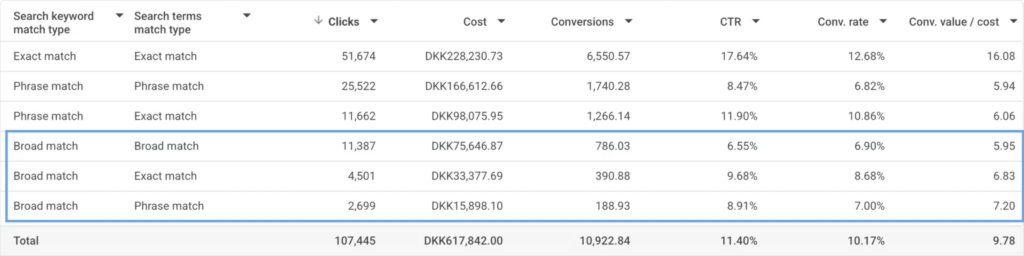
There is a natural overlap. A lot of the performance you think you’re getting from broad match is literally just your exact or phrase match search terms being triggered by a broad match keyword.
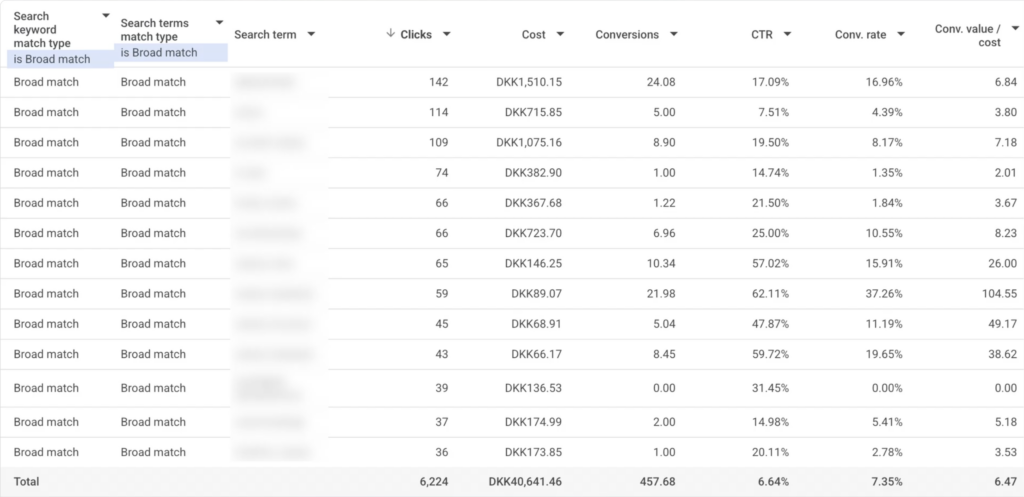
So, I always dig deeper. I’ll filter a report down to only show broad match keywords that had broad match search terms associated with them. The performance might still look pretty good. But then I go one level deeper and look at the actual search terms driving that performance.
In a recent analysis, I found that all of the top 10 “broad match” search terms were exact matches of keywords we *already had in the account*. The catch was that those exact match keywords were in different ad groups.
 Here’s an example:
- You have “winter jacket for men” as an exact match keyword in its own ad group.
- In another ad group, you have “winter jacket for skiing” as a broad match keyword.
That broad match keyword can match the search term “winter jacket for men.” Google will label it as a broad match, even though you already have an exact match keyword for that term. So, it’s not finding new volume; it’s finding volume you already should have access to. This makes a clean evaluation incredibly difficult because the reporting is, at best, flawed.
A Quick Refresher on Modern Match Types
It’s important to remember that we’re completely done with the old idea of a keyword literally matching a search term. (Yup, I’m that old; I worked online BEFORE Facebook Ads were effective).
Here’s how Google defines them now:
- Exact Match: Ads may show on searches that are the same meaning as your keyword.
- Phrase Match: Ads may show on searches that include the meaning of your keyword.
- Broad Match: Ads may show on searches that relate to your keyword.
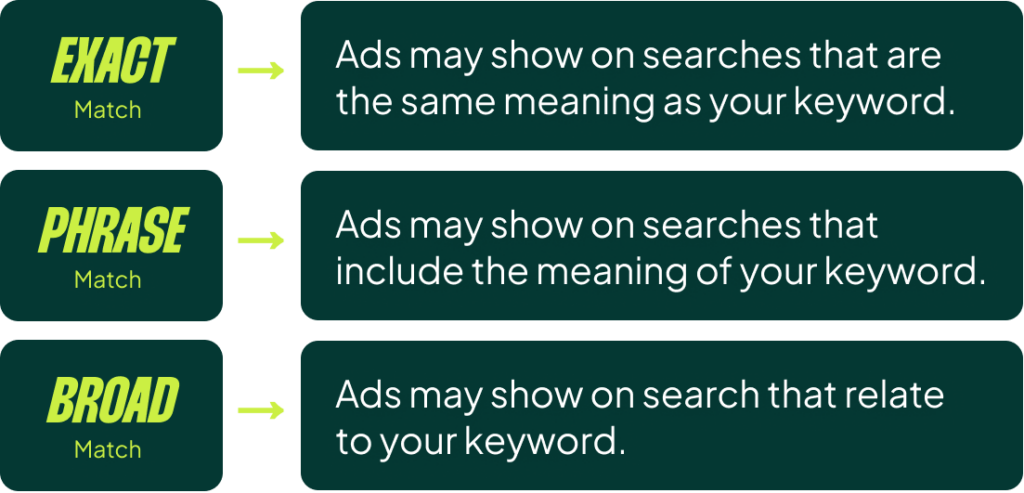
When you look at it this way, it’s clear that what used to be covered by exact match now bleeds into phrase match, and phrase match bleeds into broad. There’s technically very little space left for phrase match if you use all three. I believe this, combined with the flawed reporting, is where the arguments against phrase match come from. But for most e-commerce accounts, those arguments just don’t hold up.
The Case for Phrase Match: Our Default Starting Point
In my experience, the searches that phrase match triggers are far more aligned with e-commerce purchase intent than broad match. It’s why I never, ever start new accounts with broad match—there are just too many things that can go wrong.
We look at match types as levers:
- Broad Match tries to find new search terms at the expense of ROAS.
- Exact Match is often too narrow to scale without jacking up bids and killing your ROAS.
- Phrase Match is the sweet spot, offering controlled expansion without going completely off the rails.
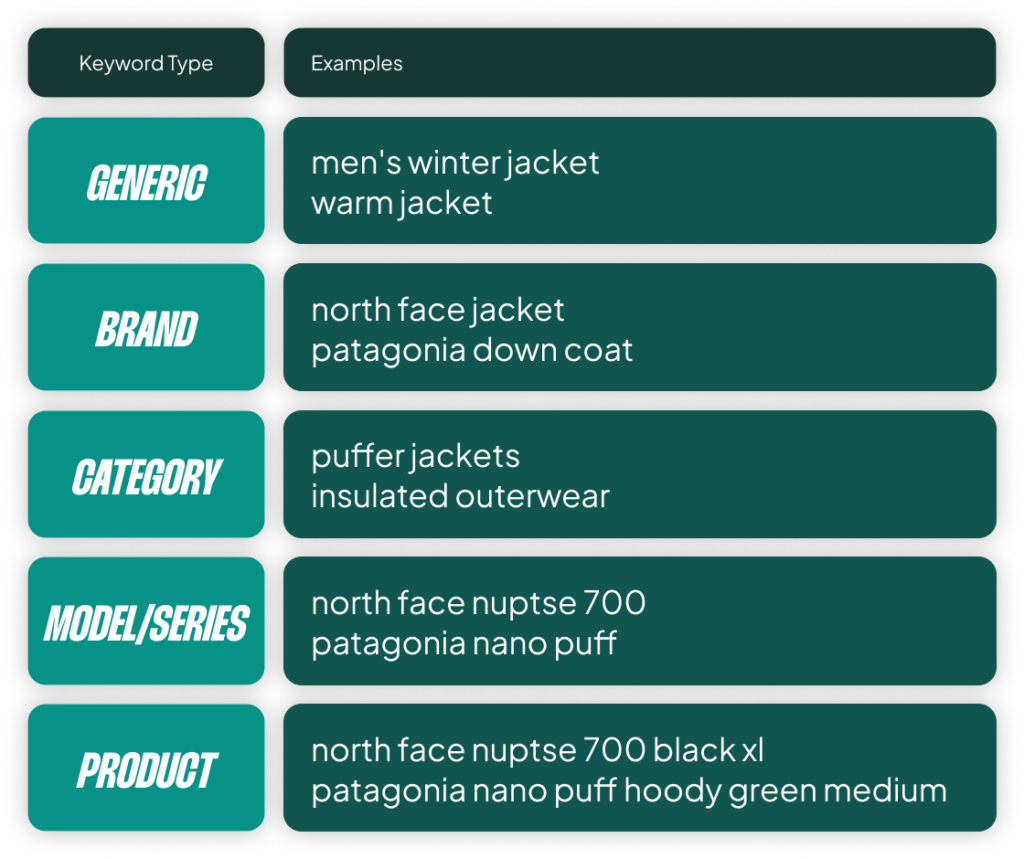
For most e-commerce accounts, keywords are straightforward: generic terms, brand names, categories, models, and products. Phrase match handles this world perfectly, which is why it remains our starting point.
So, When Does Broad Match Actually Make Sense?
If phrase match is the starting point, where does broad match fit in? Broad match starts to shine when you move into more diverse keyword territories where search intent is less clear.
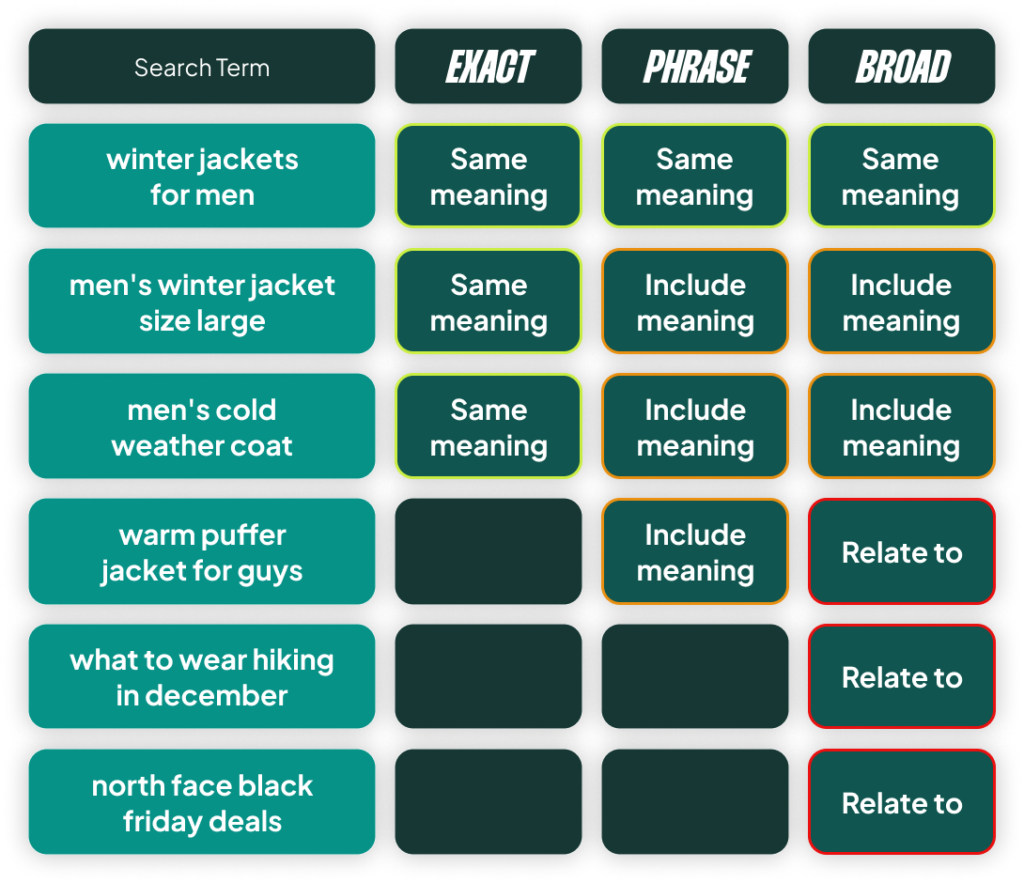
Continuing the example, “jacket for skiing” is simple. But what about “what to wear bike commuting in winter”? That could mean a jacket, gloves, a hat, or pants. The intent is much fuzzier. This is where broad match can start to work for you by discovering search patterns you hadn’t considered.
I’ve seen accounts where the top-performing keywords were ones I never would have found through traditional research. Broad match discovered them. But what makes it so powerful is also its main problem.
The Fundamental Trade-Off You Can’t Ignore
The more diverse the search terms get, the weaker the connection between your keyword, your ad, and your landing page becomes. This is the fundamental trade-off with broad match.
If someone searches for “jackets like Arcteryx but cheaper,” broad match might pick it up via your generic “men’s winter jacket” keyword. But the ad they see is a generic winter jacket ad. The landing page they hit shows *all* winter jackets, not just the premium-but-cheaper alternatives to Arcteryx. Nothing in that user journey speaks to what they actually searched for.
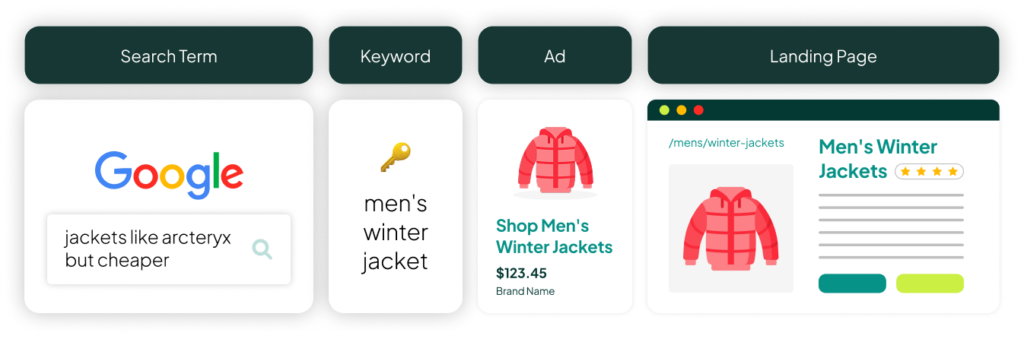
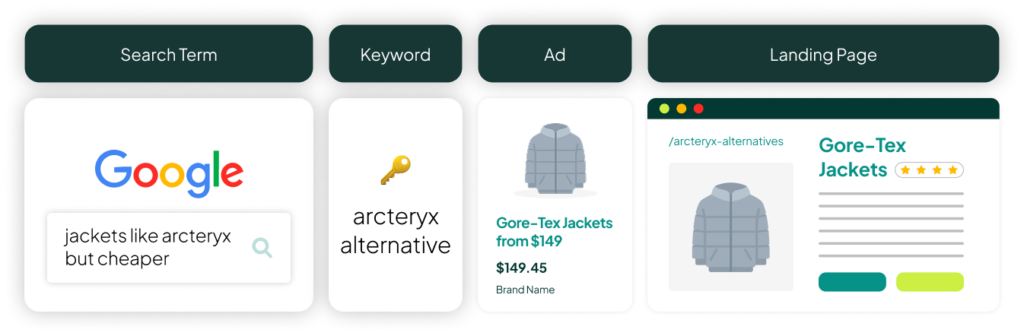
Broad match will find demand you never thought of, but it can’t write ads or pick landing pages to match that demand.
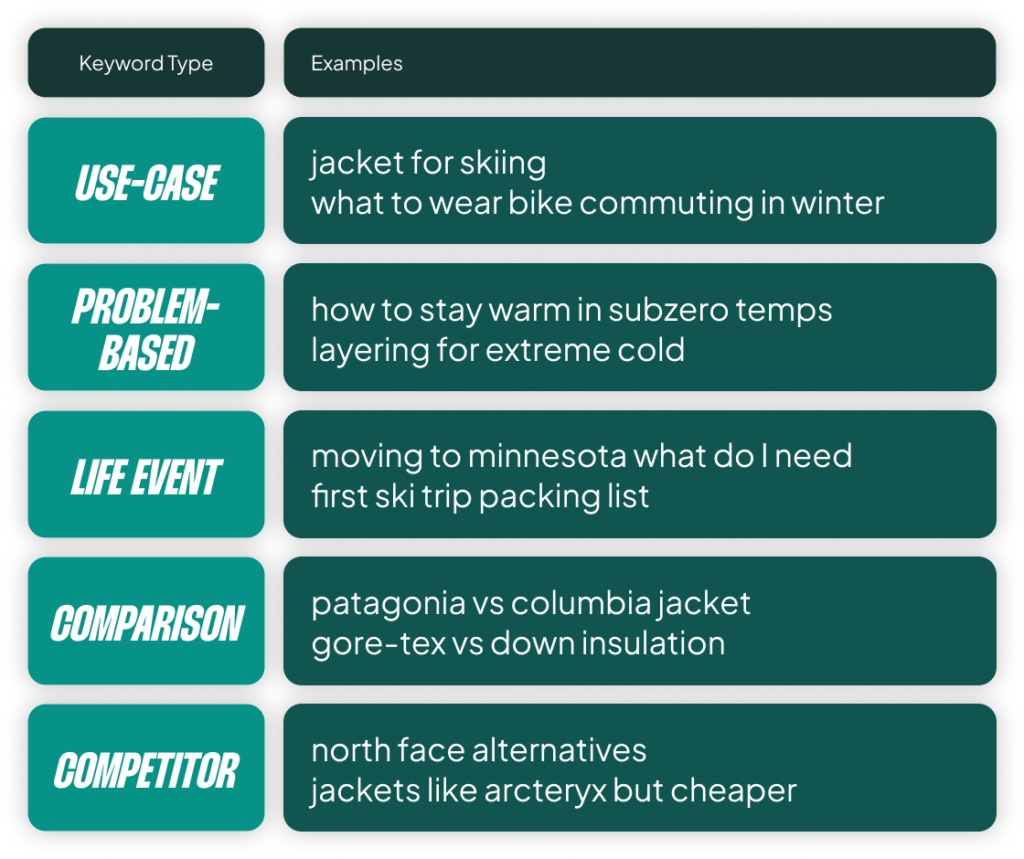
If you want to use broad match effectively, you have to mine your search term reports. When you find a high-volume term, create a dedicated ad group for it. Write a specific ad. Point it to the most relevant landing page. Performance will go up. Don’t just depend on the algorithm to make it work.
My Final Take: Use Match Types as Levers, Not Dogma
Broad match is a lever you can pull when you want more volume or suspect there are keywords you haven’t found yet. But do not rely on broad match only. The moment the match between the search term, ad, and landing page is off, your click-through rate and conversion rate will suffer.

You’ll get far better results by ensuring a tight match between what a user wants and what you show them.
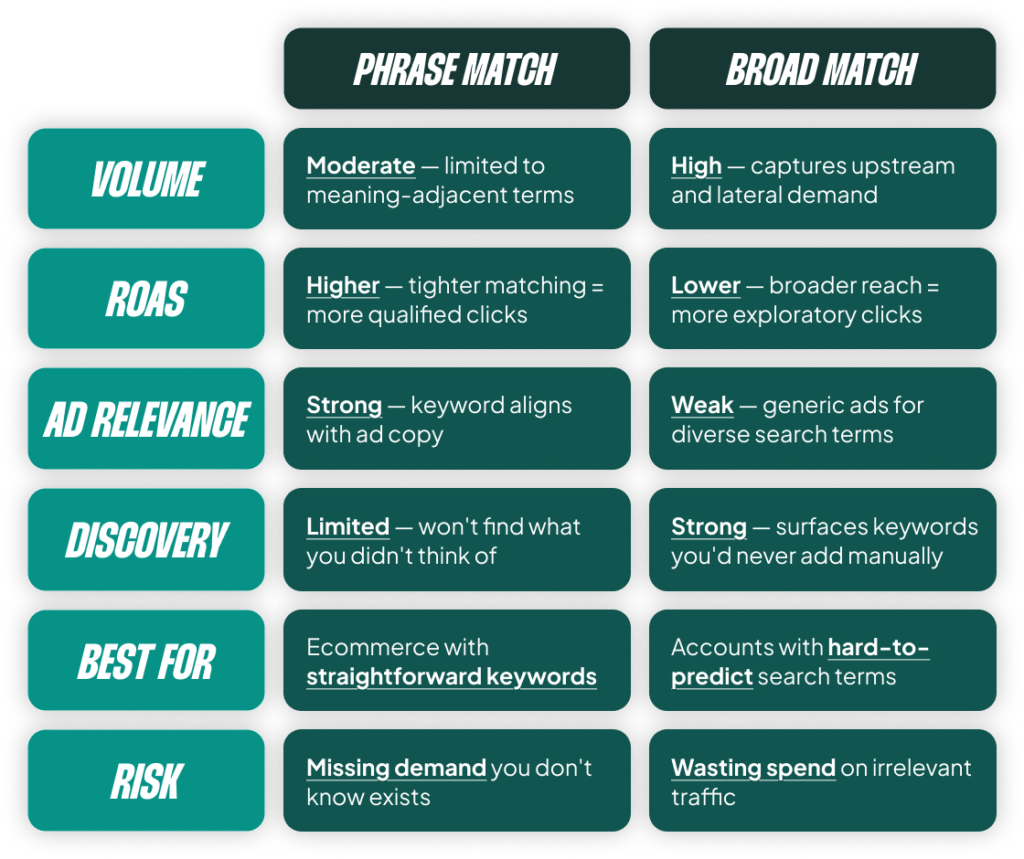
Would I be sad to see phrase match go away? Not really. But until it stops earning that performance edge for our clients, I’ll keep it as my starting match type in most accounts.
[TL;DR]
- Your data is misleading. Standard Google Ads reports show keyword-level performance, not search term performance. Broad match keywords often get credit for exact/phrase match searches, inflating their value.
- Phrase match is the best starting point for e-commerce. It provides a balance of controlled reach and high purchase intent, which is ideal for accounts with straightforward product keywords.
- Broad match is a discovery tool. Its real strength is uncovering new, unexpected pockets of demand that you can’t find through normal research.
- Broad match has a relevance problem. It often creates a disconnect between the user’s search, the ad, and the landing page, which hurts conversion rates.
- Mine your search term reports. When broad match finds a winning search term, create a dedicated ad group with a specific ad and landing page to maximize its performance. Don’t just let it run.