Dansk
Dansk

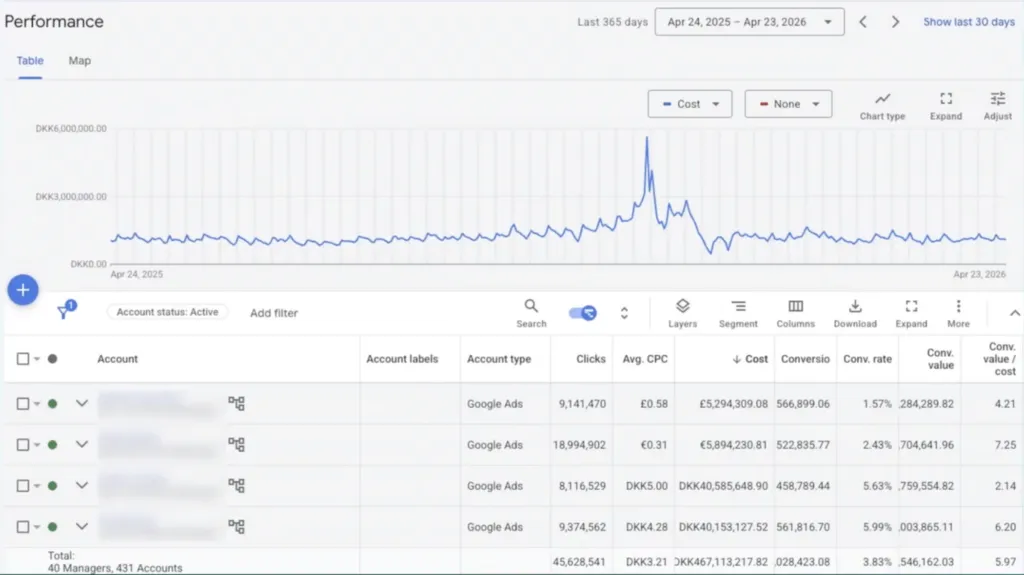
As an agency, we’ve managed both Performance Max and Standard Shopping campaigns across Europe, handling over $73 million in ad spend in the last year alone. I have a clear opinion on which one I prefer, but this article isn’t about my preference. It’s about giving you an honest, in-the-trenches comparison so you can make the right decision for your business.
We’re going to compare PMax and Standard Shopping across every important dimension: channels, algorithms, insights, levers, structure, and features. I’ll show you real data from real accounts and break down my thinking. By the end, you’ll understand why I choose one over the other in specific situations, and more importantly, how you can do the same.

The Multi-Channel Promise vs. Reality
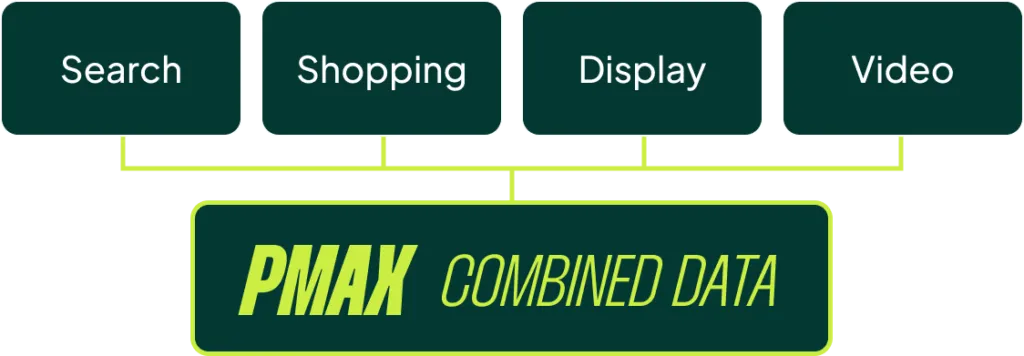
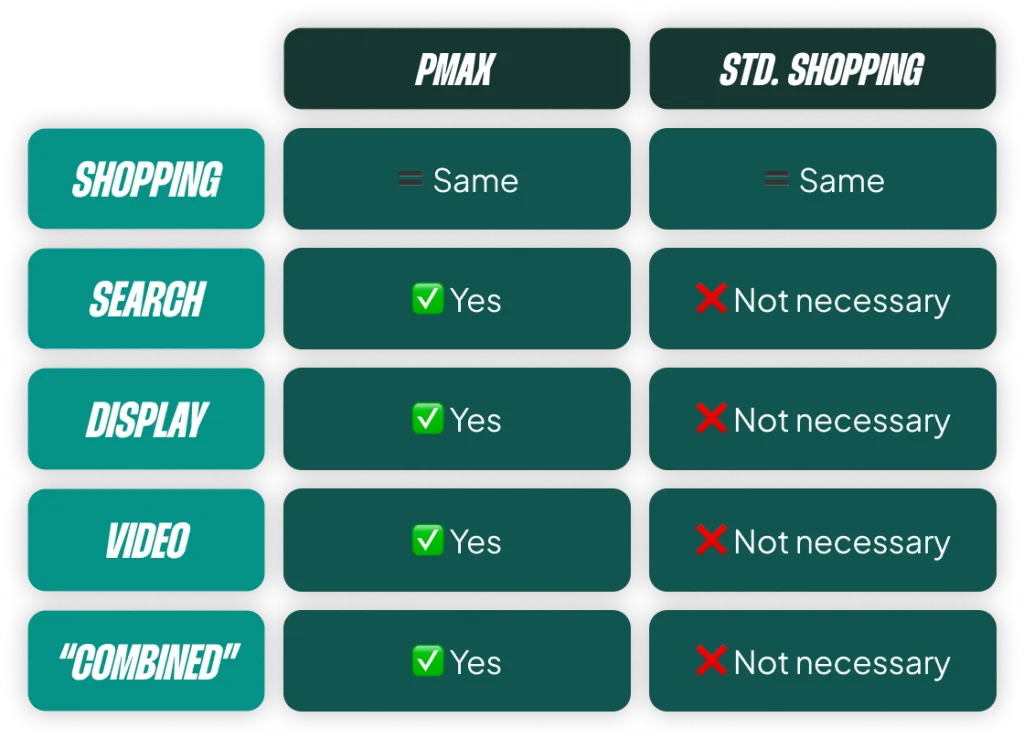
One of the biggest selling points for PMax is that combining data across multiple channels (Shopping, Search, YouTube, Display, Discover) gives it an advantage. In theory, I agree. The problem is that the theory rarely matches reality.
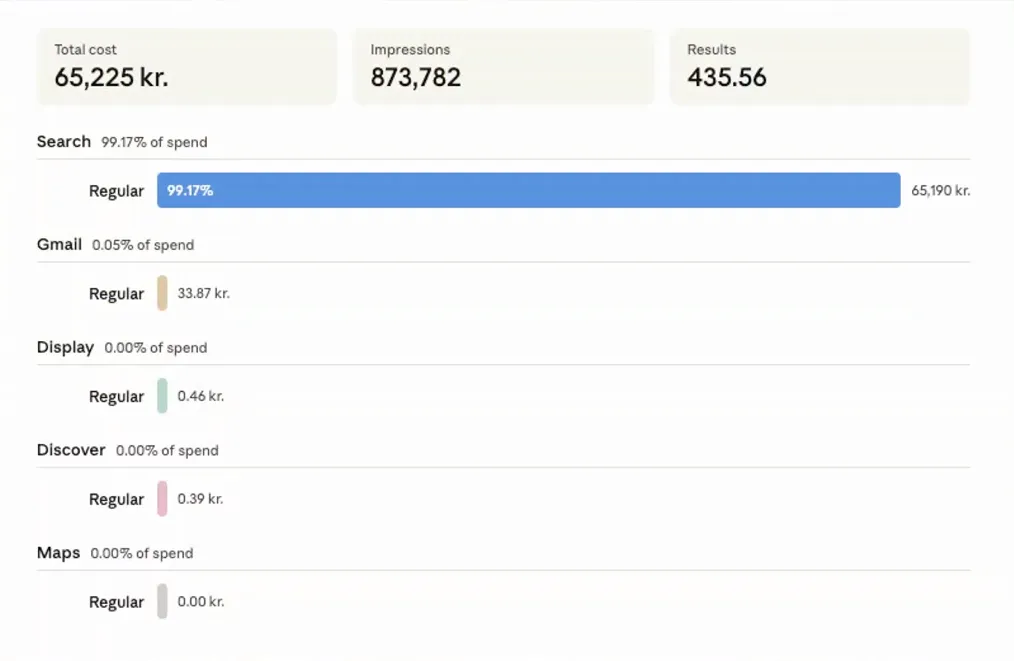
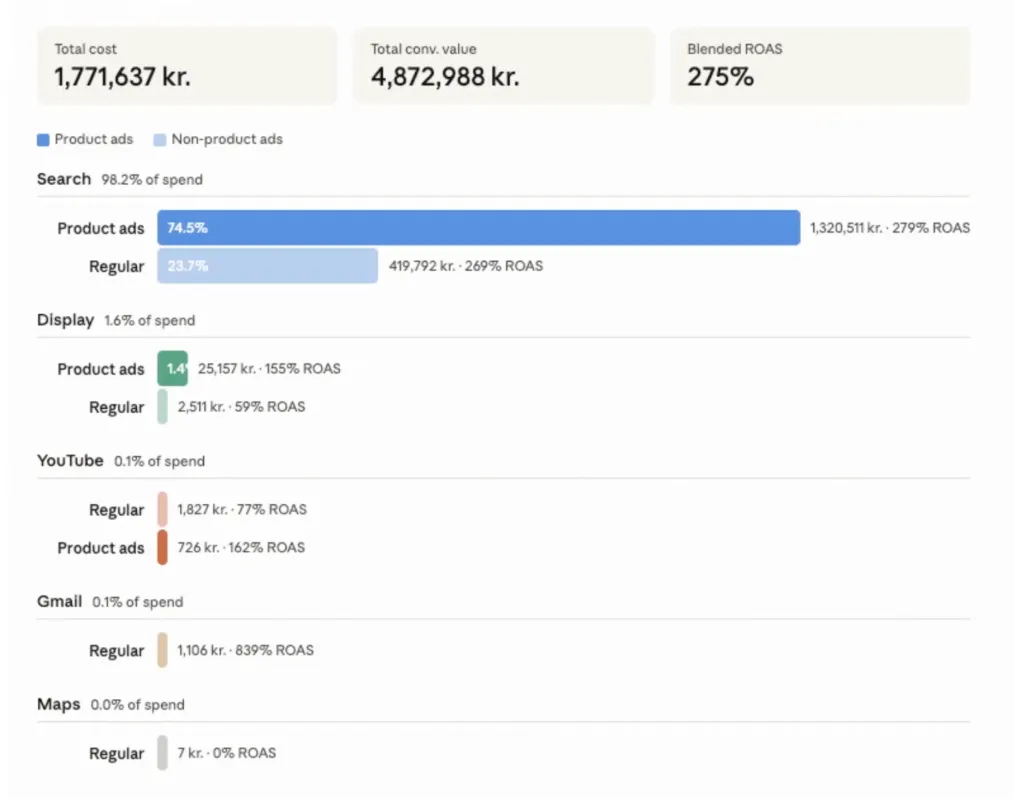
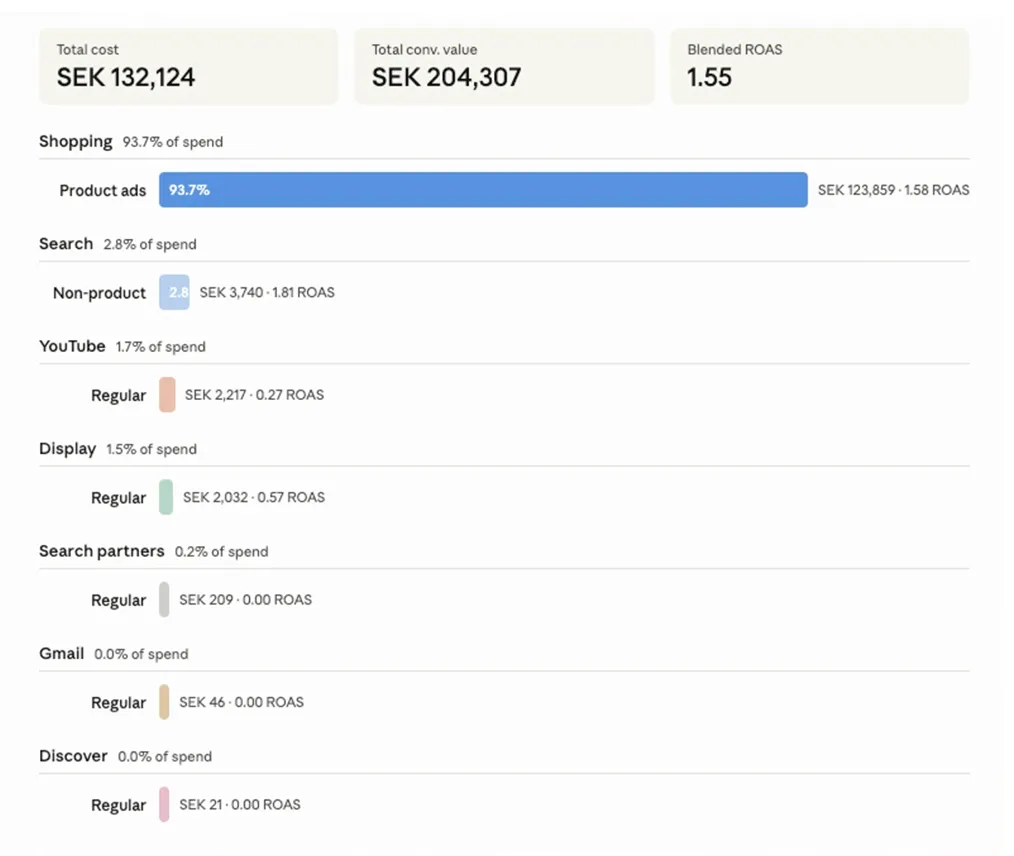
I have yet to see a Performance Max campaign truly take over an account and spend significantly across all channels. We consistently see Dynamic Search Ads spend plenty of money, so I’m always surprised at how little non-shopping spend PMax generates. Here are four examples from different accounts. Two were run in-house by the client (following all best practices), and two were our own experiments, meticulously set up with optimized assets refreshed monthly.
- Example 1: 99% of the spend went to Search and Shopping.
- Example 2: 98% of the spend went to Search and Shopping.
- Example 3 (Our ideal PMax setup): After 6 weeks of running a “perfect” campaign with Google’s feedback, 93% of spend was still on Shopping ads. The ROAS from YouTube and Display was almost non-existent.
- Example 4 (Another country): Similar results. YouTube hit 7.5% of spend, but whenever I see a YouTube ROAS that matches Search, my first thought is simple: it’s just retargeting.
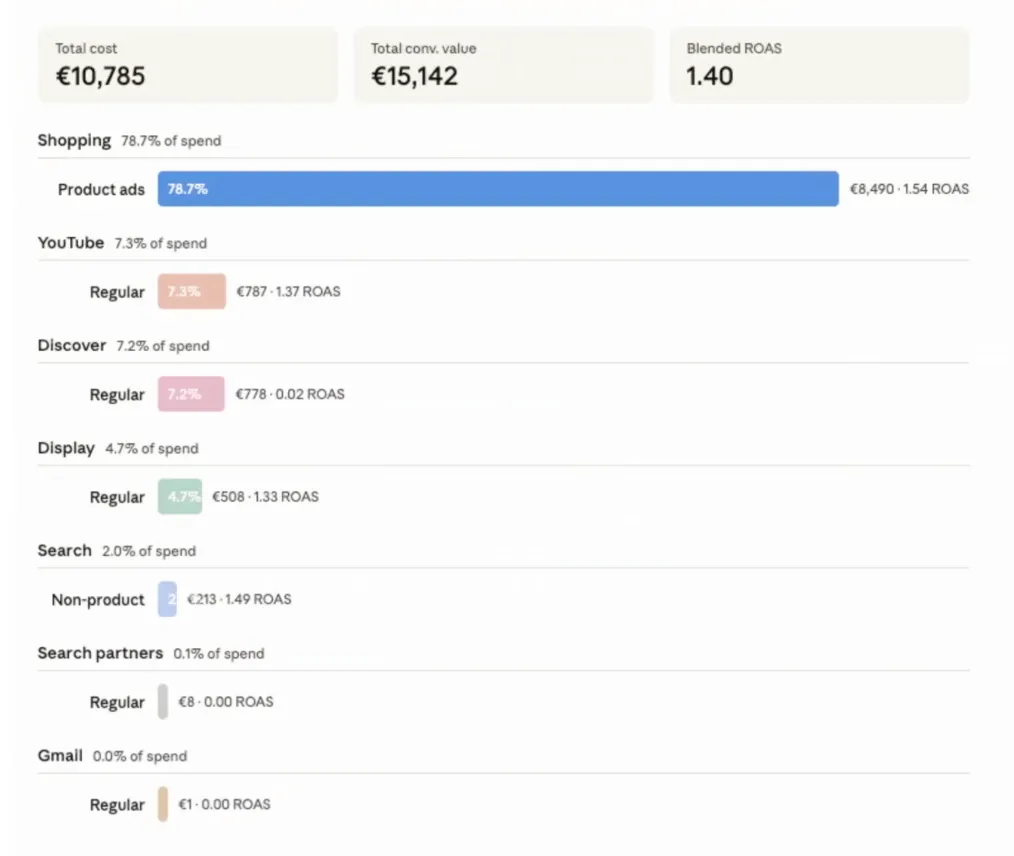
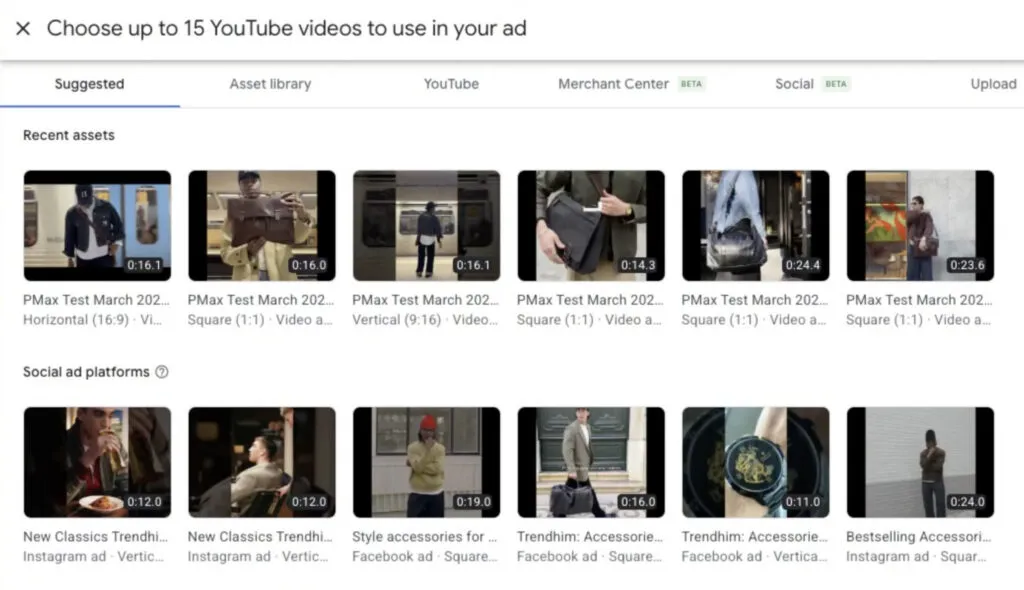
The issue is that you have no insight into whether that YouTube revenue comes from retargeting or cold traffic. You’re also severely limited in creative testing; PMax only allows 15 videos per asset group, which is essentially just five videos once you account for the three required aspect ratios. This makes rapid testing impossible.
My main problem is this: the theory behind PMax is amazing. It just doesn’t do what most people think it will do. As Google will tell you themselves, PMax isn’t intended to be the only campaign in your account. The non-shopping spend is meant to be supplementary, not a replacement for dedicated Search, YouTube, or Display campaigns. And the data supports this. Most of the time, 95% of your spend will go to Shopping anyway.

The Algorithm: Is It Really “Better”?
An early argument for switching to PMax was that its algorithm was newer and stronger than Standard Shopping’s. And that’s true. But it’s like saying a pizza is more flavorful than a piece of sourdough. It’s a true statement, but it’s the wrong comparison and leads to the wrong conclusion.
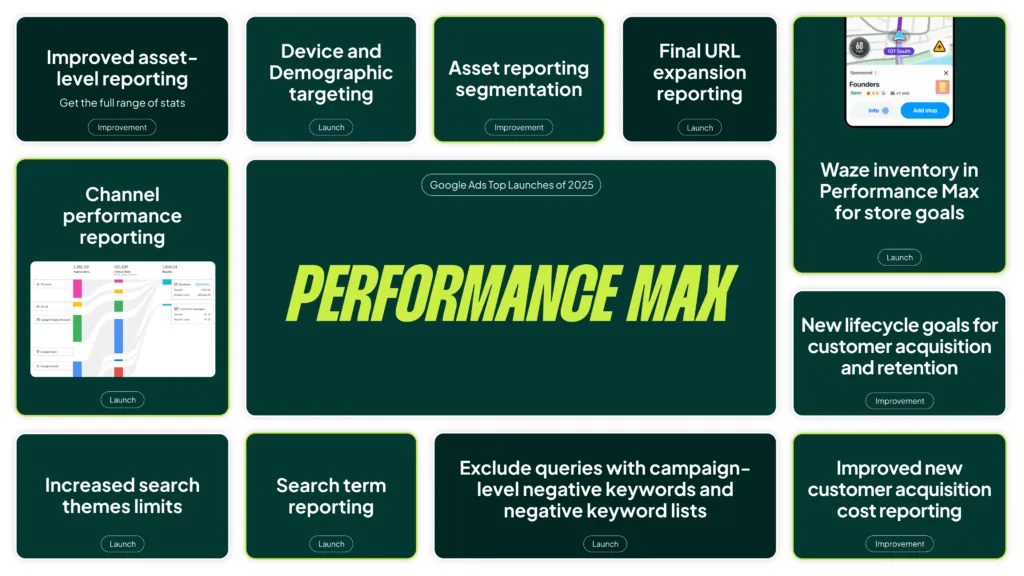
Yes, the PMax algorithm is newer because it has to manage multiple channels at once. But the core shopping algorithm is the same (or very, very similar) to the one in Standard Shopping. As a product manager at Google once told me at an event, the idea of a “feed-only” PMax campaign is flawed because it defeats the purpose of PMax. There’s no direct value in running a PMax feed-only campaign versus a Standard Shopping campaign. It’s the same shopping algorithm running both.
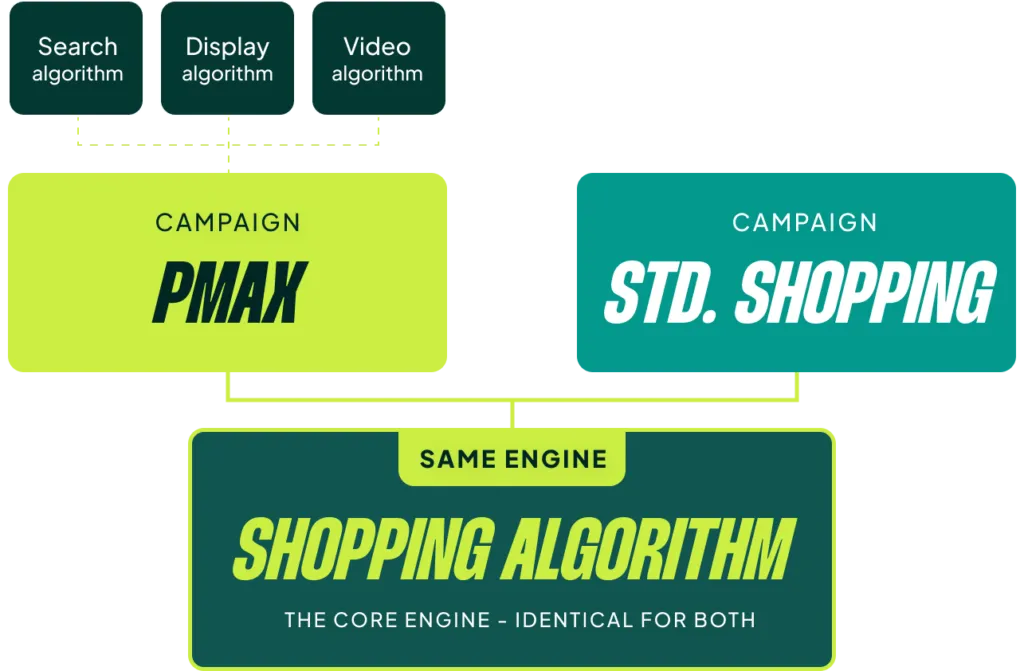
To say PMax has an advantage because of its “newer” algorithm is to miss the point. For the Shopping component, there is no real advantage.
Where You Lose Control: Insights and Levers
This is where the differences become critical for any hands-on advertiser. On paper, the insights look similar, but when you dig in, PMax is missing some crucial data points.
Key Insights You Forfeit with PMax
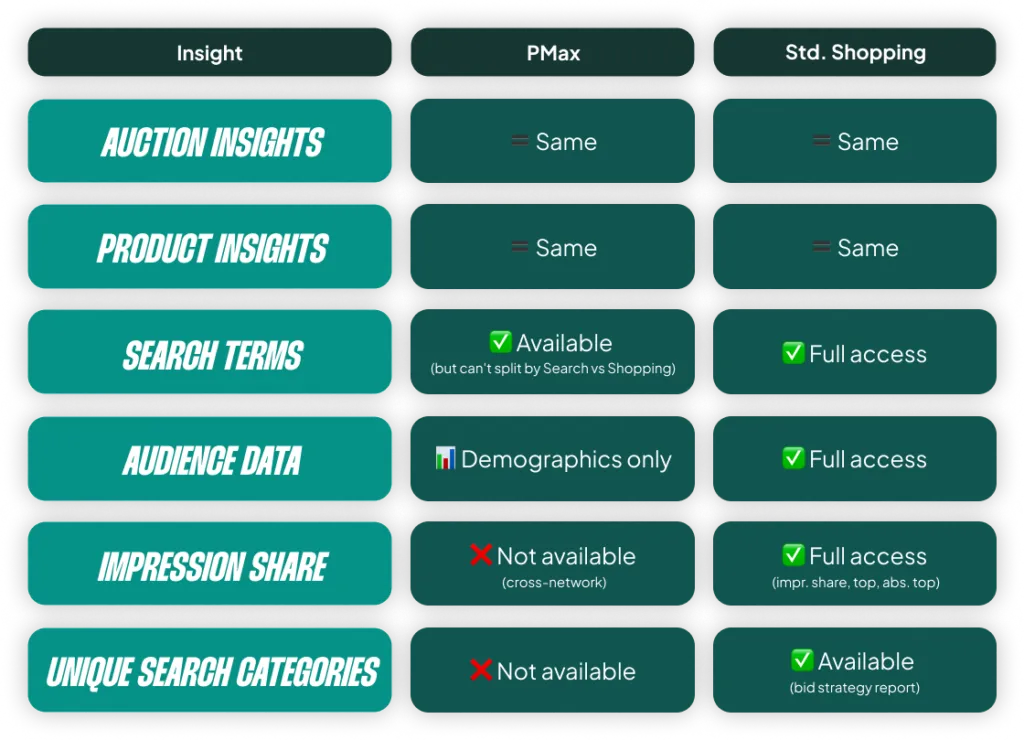
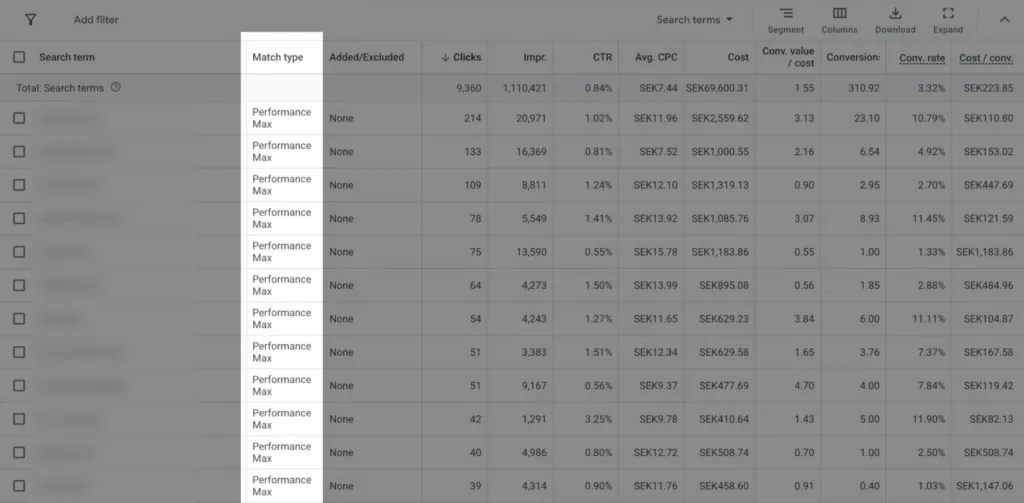
Auction insights and product insights are identical. Search terms are technically the same. But here’s what you lose:
- Impression Share: This is the big one. Because PMax is a cross-network campaign, you lose access to impression share, top impression share, and absolute top impression share data for Shopping. This is one of the most important metrics we use to determine if we’re leaving money on the table.
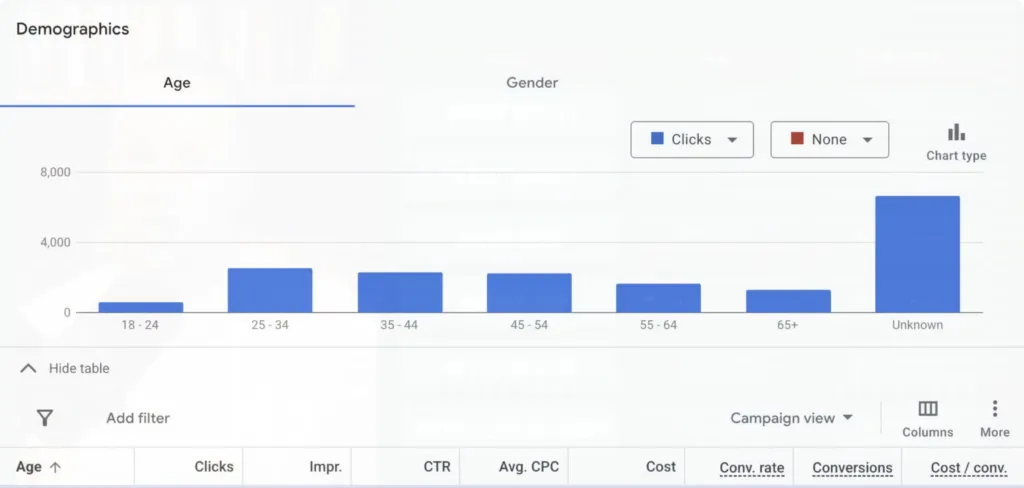
- Audience Spend Distribution: In PMax, you can’t see how your budget is being distributed across different audiences. You have no idea how much is going to your targeted audiences versus others.
- Bid Strategy Reports: The new unique search categories report, which is one of the best new tools for understanding what Smart Bidding is doing, is not yet available in PMax.
The Problem with Unpredictable Levers
In both campaign types, a core lever is adjusting your ROAS target. But the outcome is wildly different.
If you lower your ROAS target in Standard Shopping, the campaign spends more money on Shopping. Simple, predictable, and precise.
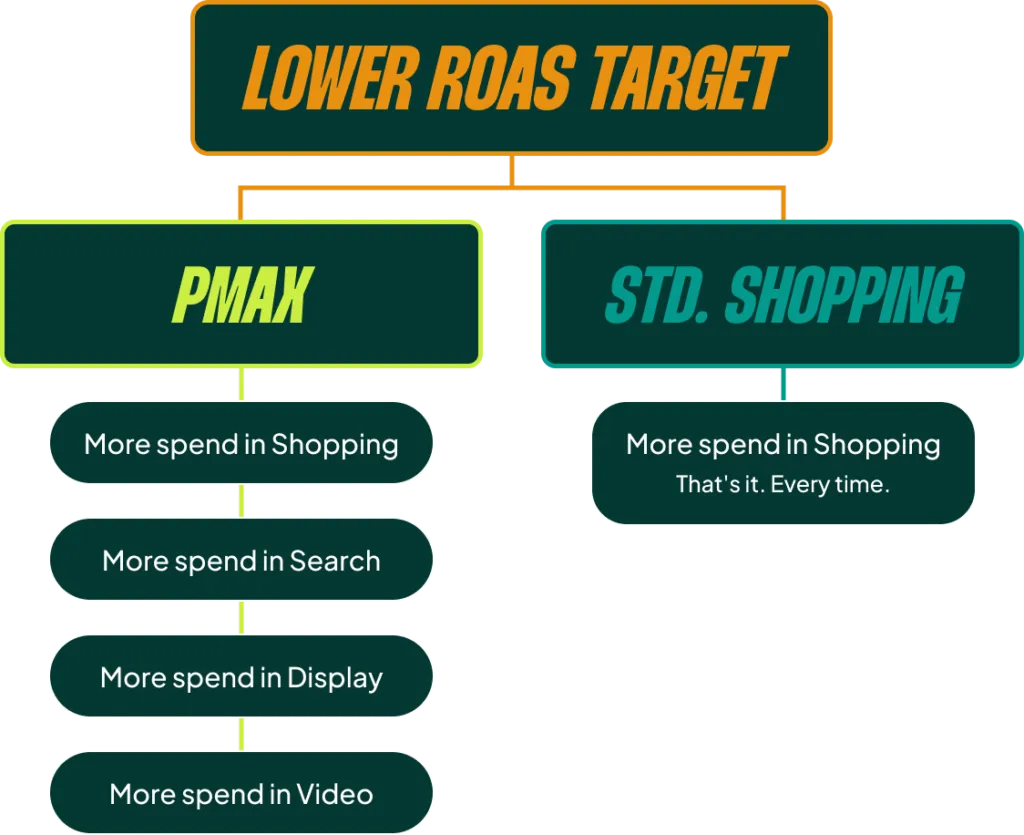
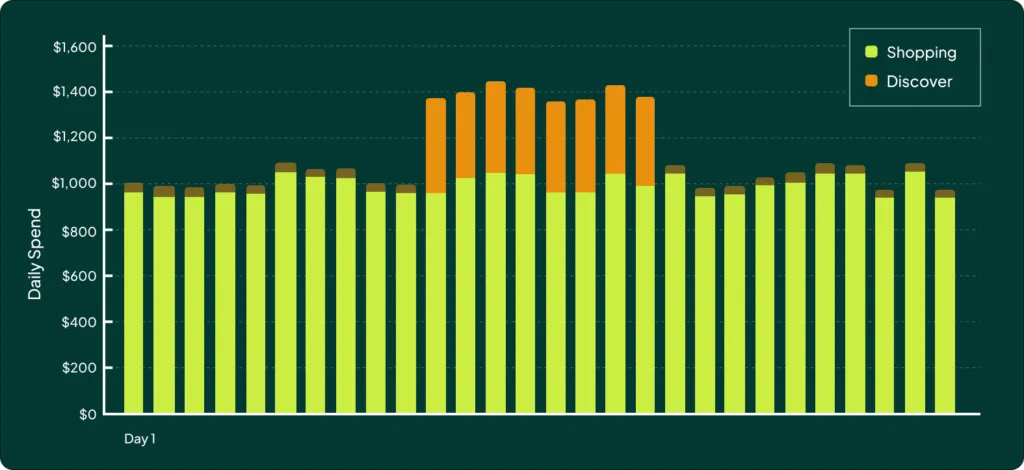
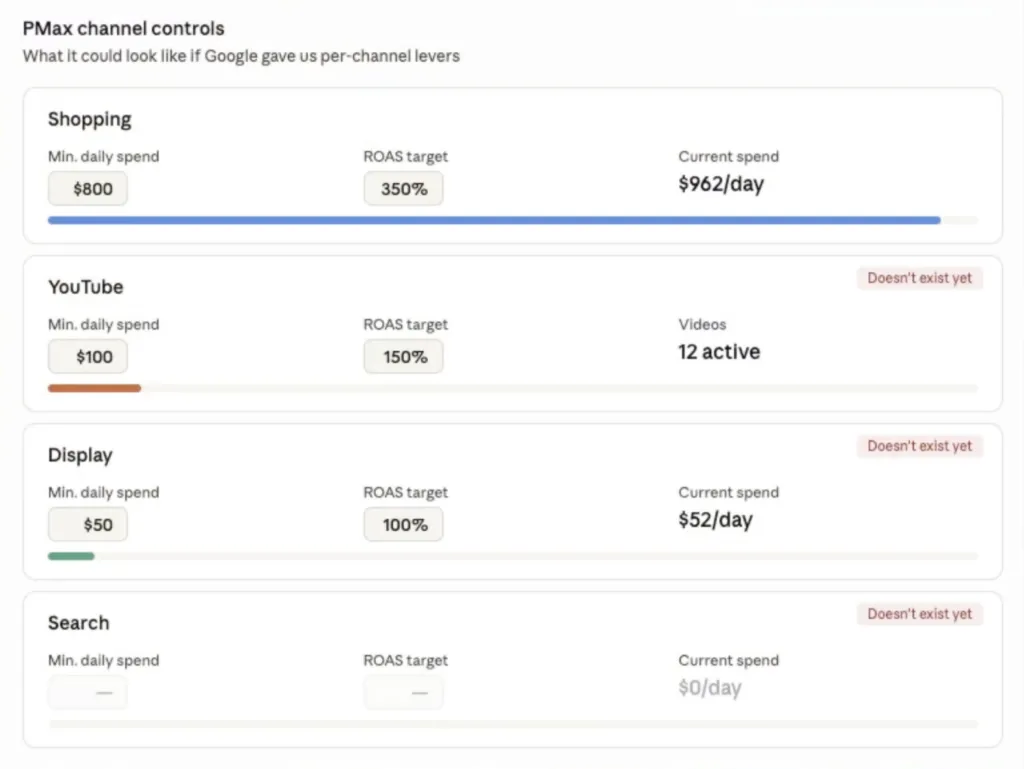
If you lower your ROAS target in PMax, one of four things can happen: it might spend more on Shopping, Search, Display, or Video. You have zero control over this. The algorithm might decide to “test” spending more on Display or Discover for a few weeks with no ROAS. While this is technically how it’s designed to work, imagine this happening during your peak season. You increase your budgets hoping for more sales from Shopping, and PMax decides it’s a great time to experiment with Discover. That’s a lot of wasted money at the worst possible time.
Debunking the “PMax is Simpler” Myth
For the longest time, PMax was pitched as the simpler campaign type. Back when it replaced Smart Shopping, that was arguably true. But today, I believe a properly managed PMax campaign is actually more time-consuming than Standard Shopping.
Why? Because a good PMax campaign requires a constant feed of high-quality, updated assets across text, images, and video. Standard Shopping just requires an optimized feed. The idea that you can “set and forget” PMax is a recipe for mediocre results.
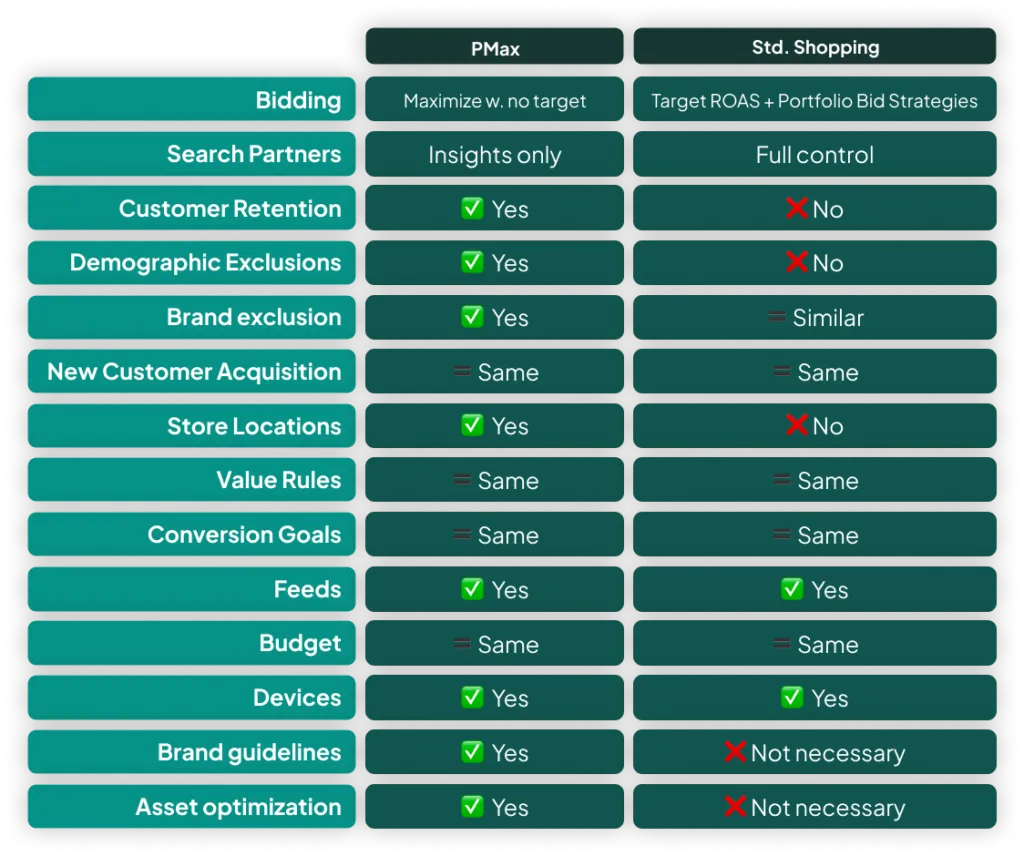
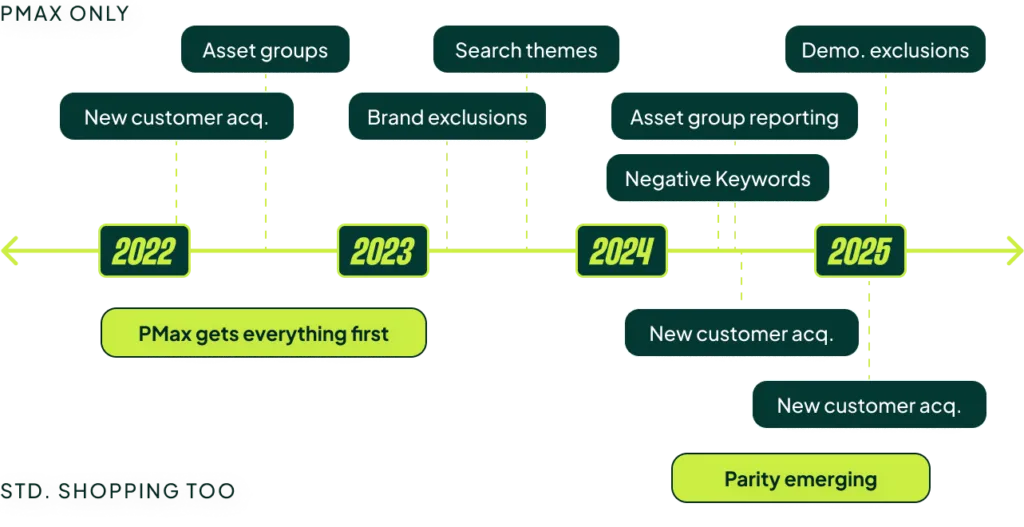
While Google is clearly focusing more development on PMax, we’re starting to see more feature parity. As of now, there are very few features, if any, that give PMax a standout advantage over a well-run Standard Shopping setup.
How to Choose: The Right Tool for the Job
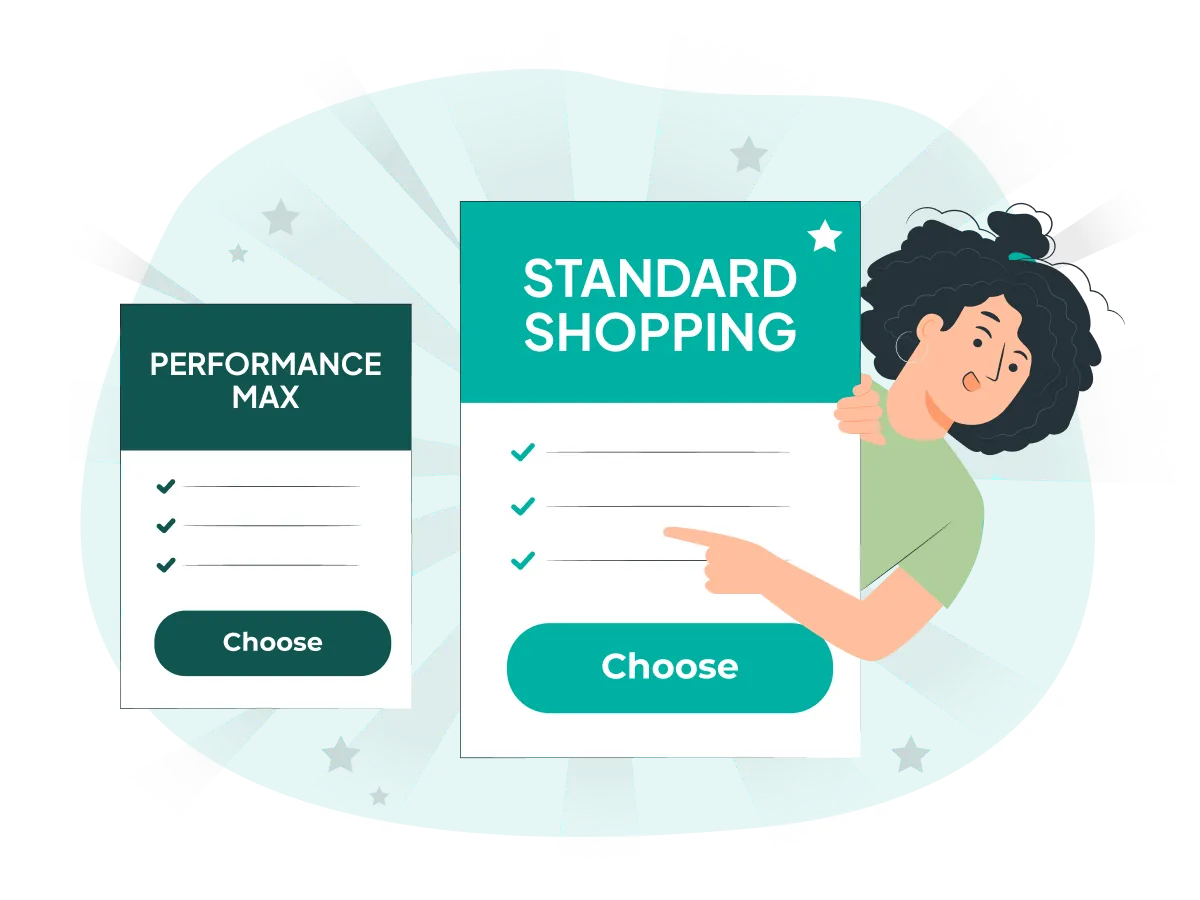
The conversation shouldn’t be “Performance Max versus Standard Shopping.” It should be about choosing the right tool for the job at hand.
Choose Standard Shopping If…
- You want to build a complex campaign structure (e.g., using priority settings).
- You rely on impression share data to make bidding and budget decisions.
- You want to use more advanced levers like portfolio bid strategies or bid limits.
- Your primary goal is to maximize performance from the Shopping channel specifically.
Choose Performance Max If…
- You prefer a simpler, more consolidated campaign setup.
- You primarily manage performance by adjusting budgets and ROAS targets.
- You already have high-quality creative assets for Display and Video ready to go.
- You are okay with having less control over where your budget is allocated.
The Bottom Line: PMax is Not a Replacement
Let me be perfectly clear on this point: Performance Max does not replace dedicated search campaigns or dedicated YouTube campaigns if you want real results.
The one thing PMax *does* replace is a separate Standard Shopping campaign. If you are running PMax with a product feed, do not create a separate Standard Shopping campaign. That is a wasteful approach that will only segregate your data and budget.
Ultimately, both are powerful tools. But one gives you precision and control, while the other offers broad (if unpredictable) reach. Choose wisely.
[TL;DR]
- PMax is not truly multi-channel: Despite its promise, 95%+ of PMax spend almost always goes to Shopping and Search. Other channels often show poor ROAS or are limited to retargeting.
- The “better algorithm” is a myth: The core shopping algorithm in PMax is the same as in Standard Shopping. There is no inherent algorithmic advantage for your product listings.
- You sacrifice critical insights and control: PMax hides key data like impression share and gives you no control over how budget is allocated across channels when you adjust targets.
- Standard Shopping offers more precision: It allows you to make changes that exclusively impact your Shopping performance, providing more predictable outcomes.
- Pick the right tool: Use Standard Shopping for control, complex structures, and data-driven decisions. Use PMax for simpler setups where you’re comfortable with less control over budget allocation.